
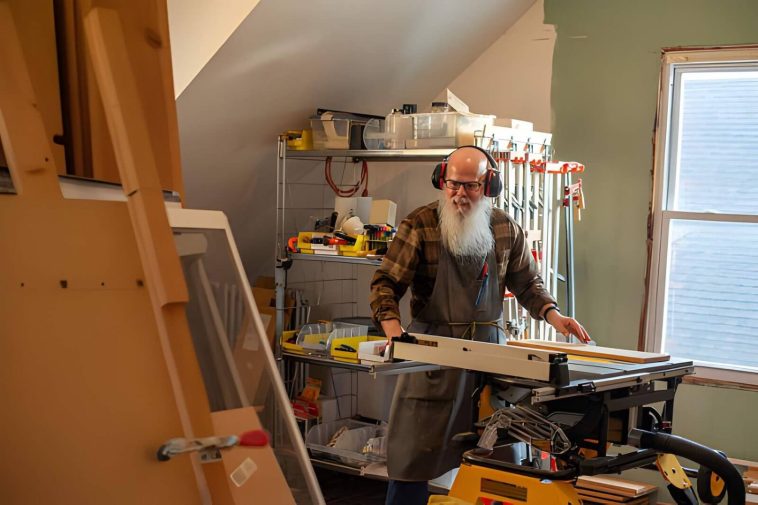
A table saw is one of the most useful tools in a workshop, but it can also eat up a lot of space. If your garage shop is small, a smart table saw workbench gives you a stronger cutting surface, better support, built-in storage, and a cleaner layout, instead of a bare saw stand you’re constantly tripping over.
I went digging through ten of the best table saw workbench plans actually out there right now, real builds with real dimensions, not made-up numbers, so you don’t end up guessing at sizes like I did on my first build. This guide covers small workshops, mobile setups, outfeed support, drawers, shelves, and storage. Every plan below links back to the original build so you can grab the free plan yourself.
What Makes a Good Table Saw Workbench?
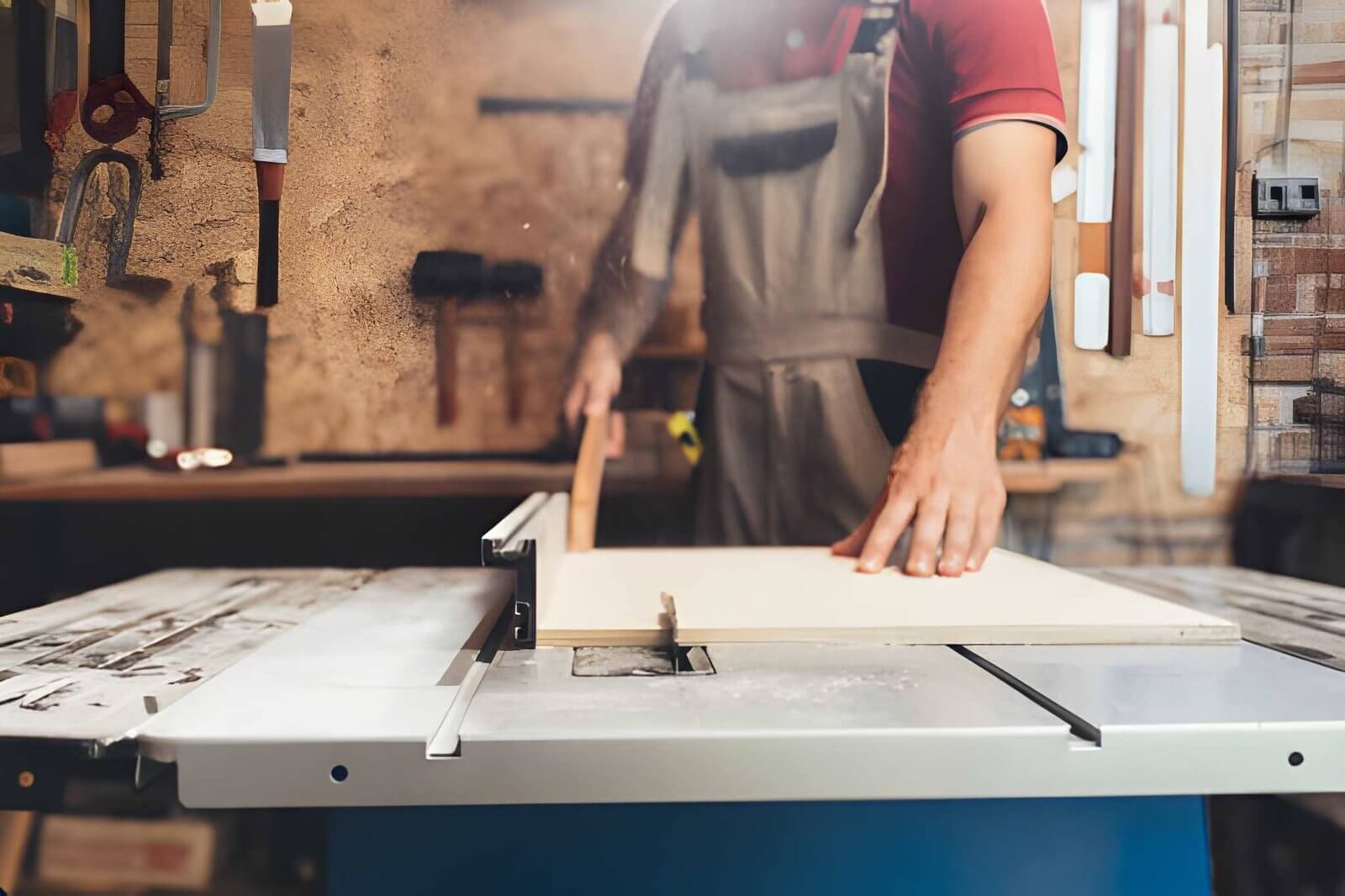
Before you buy a single 2×4, here’s what actually separates a great workbench from a wobbly disappointment:
- A stable base that doesn’t rock or flex when you’re pushing stock through the blade
- Correct height so the surrounding surface matches your table saw
- Outfeed support for long boards and full sheets of plywood
- Storage for blades and accessories
- Casters for mobility
- Dust collection space so you’re not breathing sawdust all afternoon
- Room for push sticks, fences, and jigs
- Strong plywood or 2×4 frame construction
Skip any of these and you’ll probably rebuild the thing in a year. Ask me how I know.
Tools and Materials You May Need
Tools:
Materials:
- 2×4 lumber
- ¾-inch plywood
- Screws
- Wood glue
- Locking casters
- Drawer slides
- Shelf brackets
- Dust collection port
- Wood finish or sealer
Got your list? Good. Let’s get into the plans.
| Table Saw Workbench Plan | Best For | Difficulty | Space-Saving Level | Best Feature |
|---|---|---|---|---|
| DeWalt-Ready Rolling Table Saw Cart | First-time builders with a compact benchtop saw | Easy | High | Small rolling cart with open shelves |
| One-Sheet Plywood Outfeed Table Saw | Ripping long boards and plywood | Medium | Medium | One-day outfeed table that doubles as an assembly surface |
| Fold-Away Table Saw Stand with Extension Wing | Small garages that need floor space back | Medium | High | Folding outfeed table and side extension wing |
| 8×3 Workbench with Built-In Shelving | Simple storage and general work surface | Easy | Medium | Big work surface with lower storage shelves |
| Large Mobile Table Saw Workbench with Double Drawers | Larger shops with room for a full workbench | Medium–Advanced | Low | Double-sided drawers and shop vac storage |
| Full-Sheet 4×8 Workbench with Clamp Traks | Assembly, outfeed support, and clamping | Medium | Low | Full-size 4×8 surface with built-in clamp tracks |
| All-In-One Table Saw and Router Workbench | Multi-use workshops | Advanced | Medium | Combines table saw, router table, vise, and T-track system |
| Three-Drawer Workbench with Back Shelf | Extra storage beside your table saw | Easy–Medium | Medium | Drawers, back shelf, lower shelf, and mobile work surface |
| Space-Saving Fold-Flat Workstation | Garages that share space with a car | Advanced | Very High | Folds down to save serious floor space |
| Height-Matched Outfeed Table Saw Setup | Using a separate workbench as outfeed support | Medium | Medium | Table saw shelf lines up with another workbench |
10 Table Saw Workbench Plans That Save Space and Add Storage
1. The DeWalt-Ready Rolling Table Saw Cart
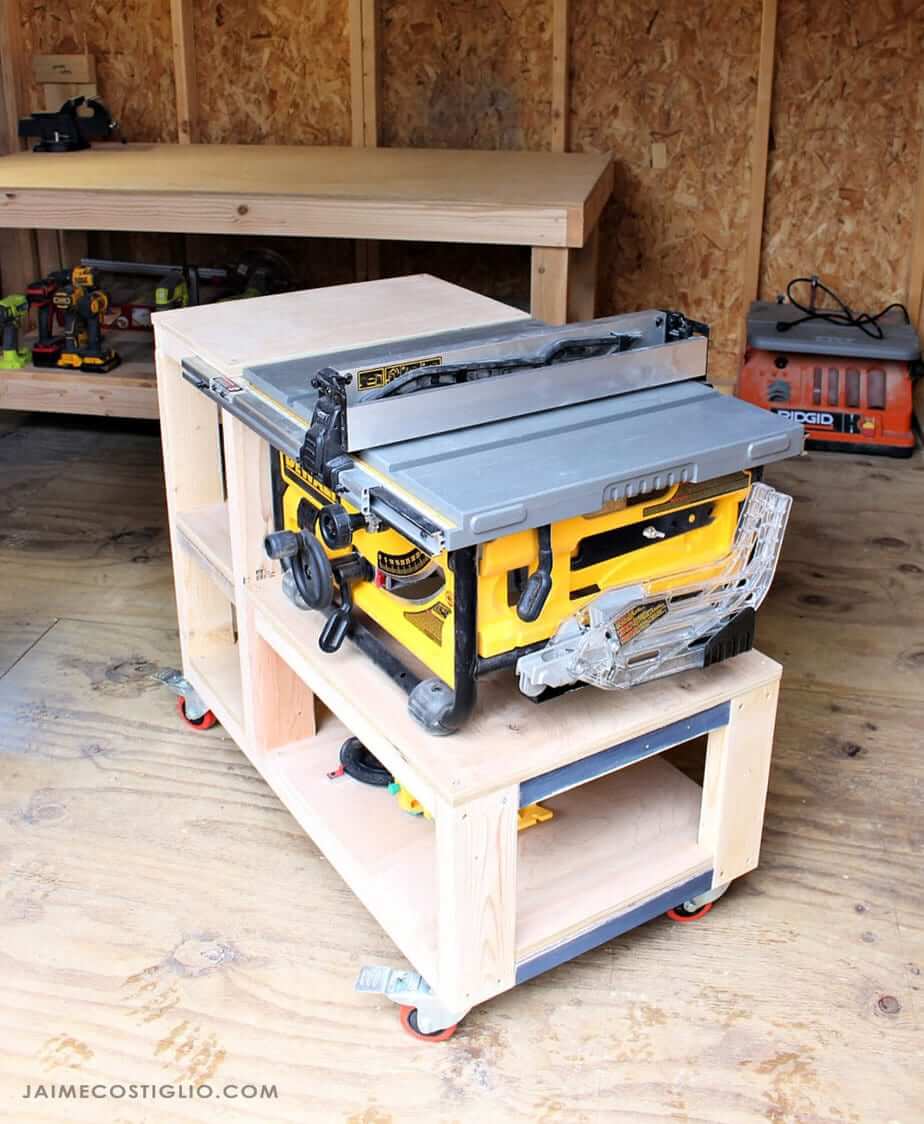
Souce : jaime costiglio
Best for: first-time builders with a compact benchtop saw Difficulty: Easy
Jaime Costiglio built this simple cart specifically for a DeWalt 10″ compact table saw, and it’s a great starting point if you want mobility without a big build. The cart measures 19-5/8″ wide (sized to the gap between her saw’s rails, so measure yours before cutting), stands 26″ tall to the top surface, and rolls on four 4″ locking wheels. It includes two open shelves for storage plus an extra work surface next to the saw, and several readers in the comments modified it to a full 48″ length for more room. Get the free plans here.
2. The One-Sheet Plywood Outfeed Table Saw
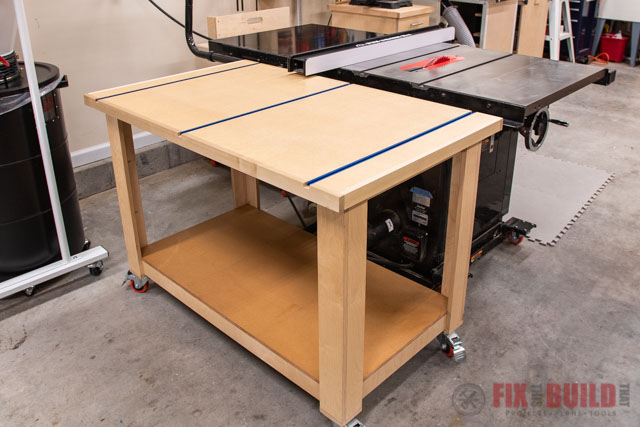
Source : Fix this build that
Best for: ripping long boards and plywood Difficulty: Medium
Brad Rodriguez at FixThisBuildThat built this outfeed table to solve the classic problem: a board leaving the blade with nothing behind it to catch it. The top measures 49-1/2″ x 30″ and can be built from a single sheet of ¾” plywood plus one 1×4, using pocket-hole joinery, 3″ locking casters, and an optional Kreg mini T-track for clamping. It’s an easy one-day build and doubles as an assembly table when you’re not sawing. Get the free plans here.
3. Table Saw for Small Shops
Source : Anika’s Diy Life
Best for: small garages that need the floor space back Difficulty: Medium
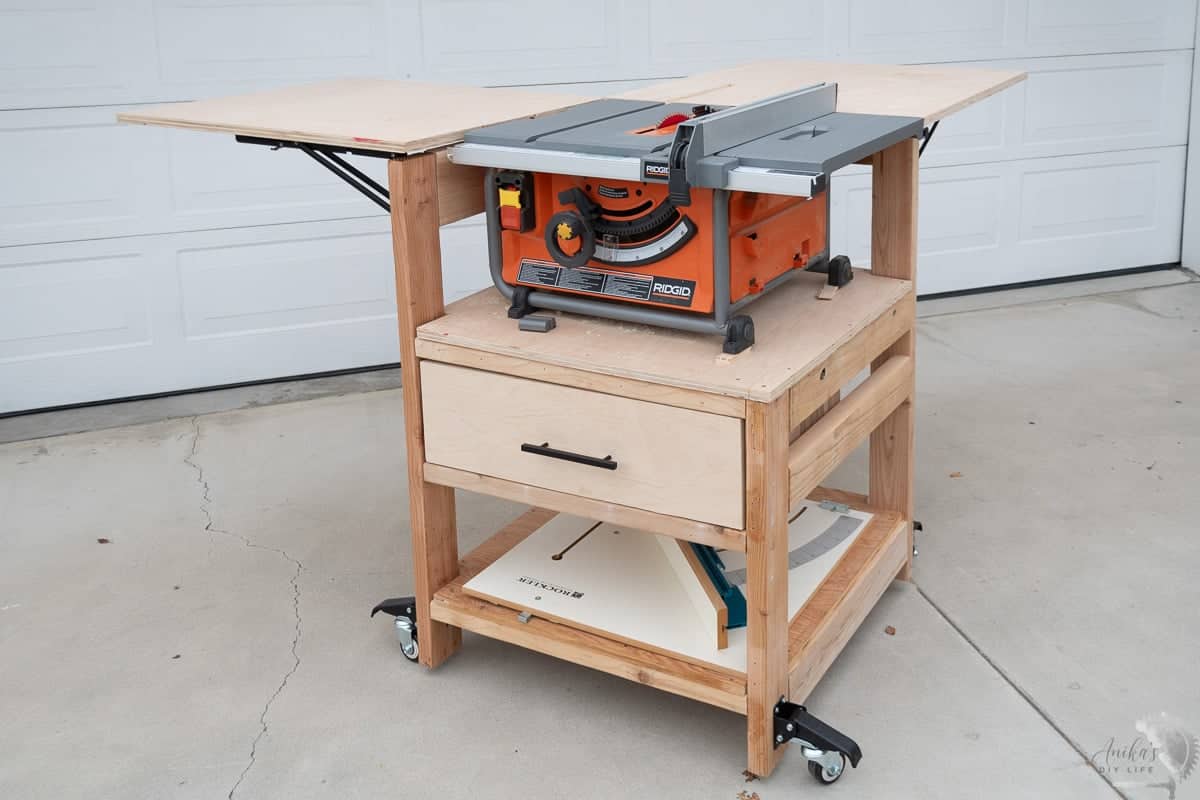
Anika Gandhi’s Table Saw Stand 2.0 is built around folding table brackets, so both the outfeed table and a side extension wing fold flat when you’re done cutting. It includes a storage drawer, drop-down casters that let the stand sit flush on the floor when disengaged, and routed grooves so the miter gauge can slide right through the outfeed section. The stand is sized for her own height (5’9″), so plan to adjust the leg length to match yours. Get the plans here.
4. The 8×3 Workbench with Built-In Shelving
Source : Craft camp
Best for: a simple, no-frills work surface with storage underneath Difficulty: Easy
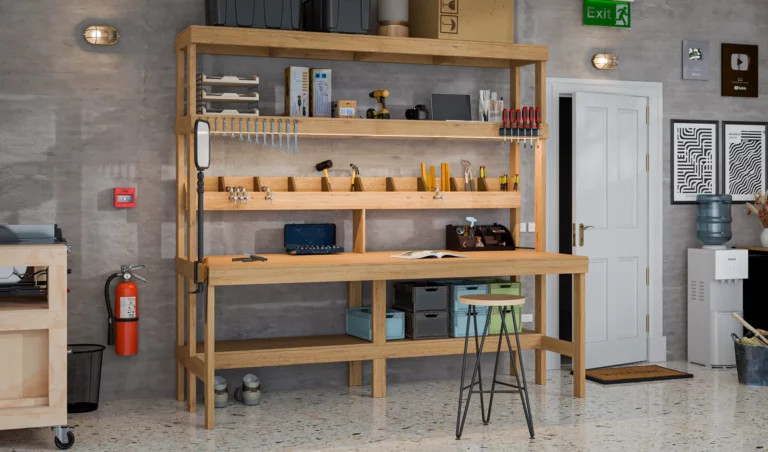
Craft Camp’s free plan builds a straightforward 2×4-framed workbench with a 8′-3″ x 3′-5″ top, plus storage shelves built into the lower section using ¾” plywood. It’s not designed around a specific saw, which makes it a flexible option if you want a big flat surface next to your table saw for outfeed or assembly, with room underneath for bins and tools. Get the free PDF plan here.
5. Large Mobile Table Saw Workbench with Double Drawers
Source : Wood shop diaries
Best for: shops with the floor space to spare Difficulty: Medium to advanced
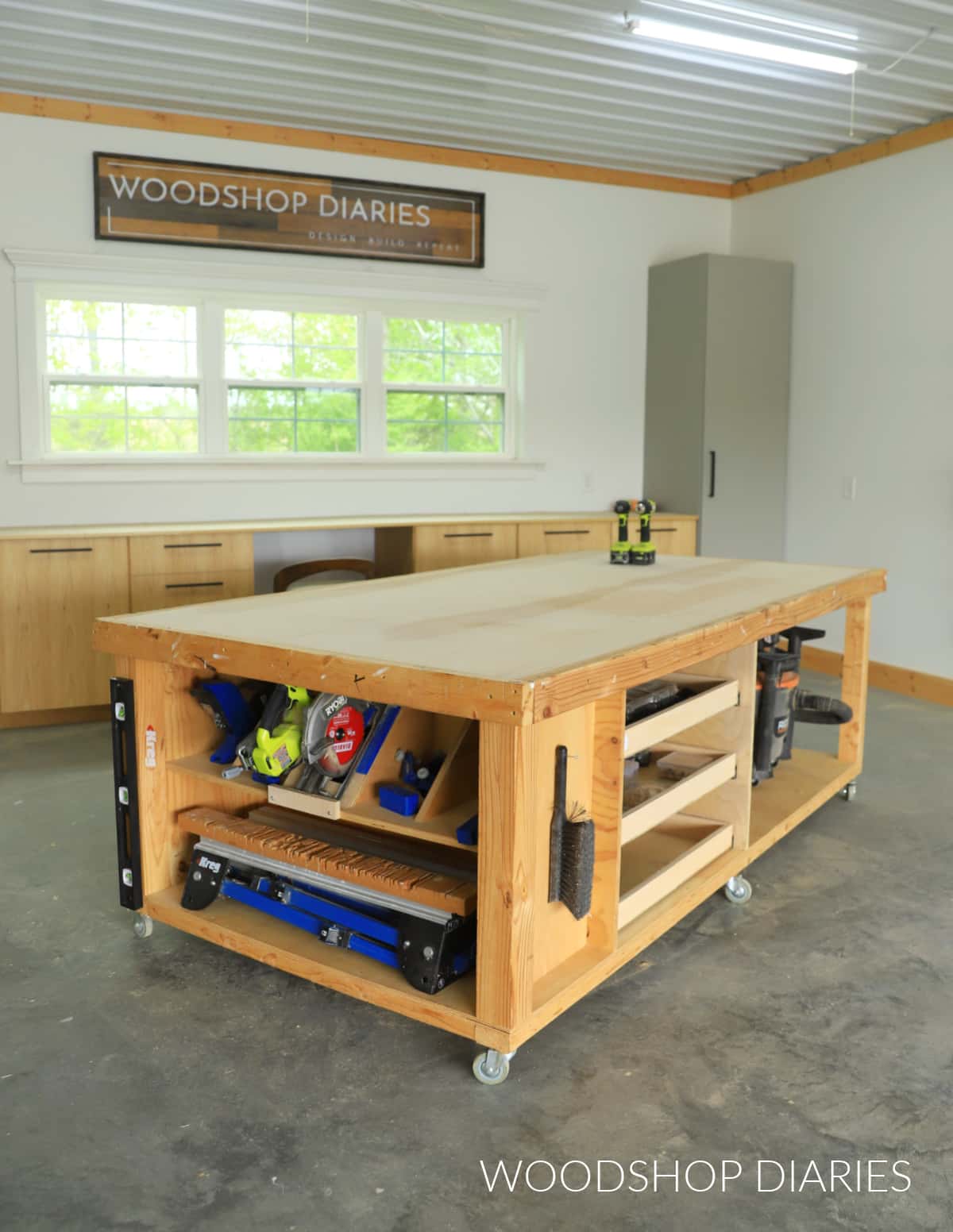
If you’ve got the room, Shara at Woodshop Diaries built this large mobile workbench at 51″ x 99″ x 34-1/2″, sized specifically to match her table saw’s height so it doubles as an outfeed table. It has drawers built into both sides plus cubbies for jigs and a large open area underneath for a shop vac. Without the caster wheels, the frame sits at 30-3/4″ tall, so double-check your own caster height before assembling. Get the free plan and video here.
6. The Full-Sheet 4×8 Workbench with Clamp Traks
Source : Kreg tool
Best for: a 3-in-1 assembly, outfeed, and storage station Difficulty: Medium
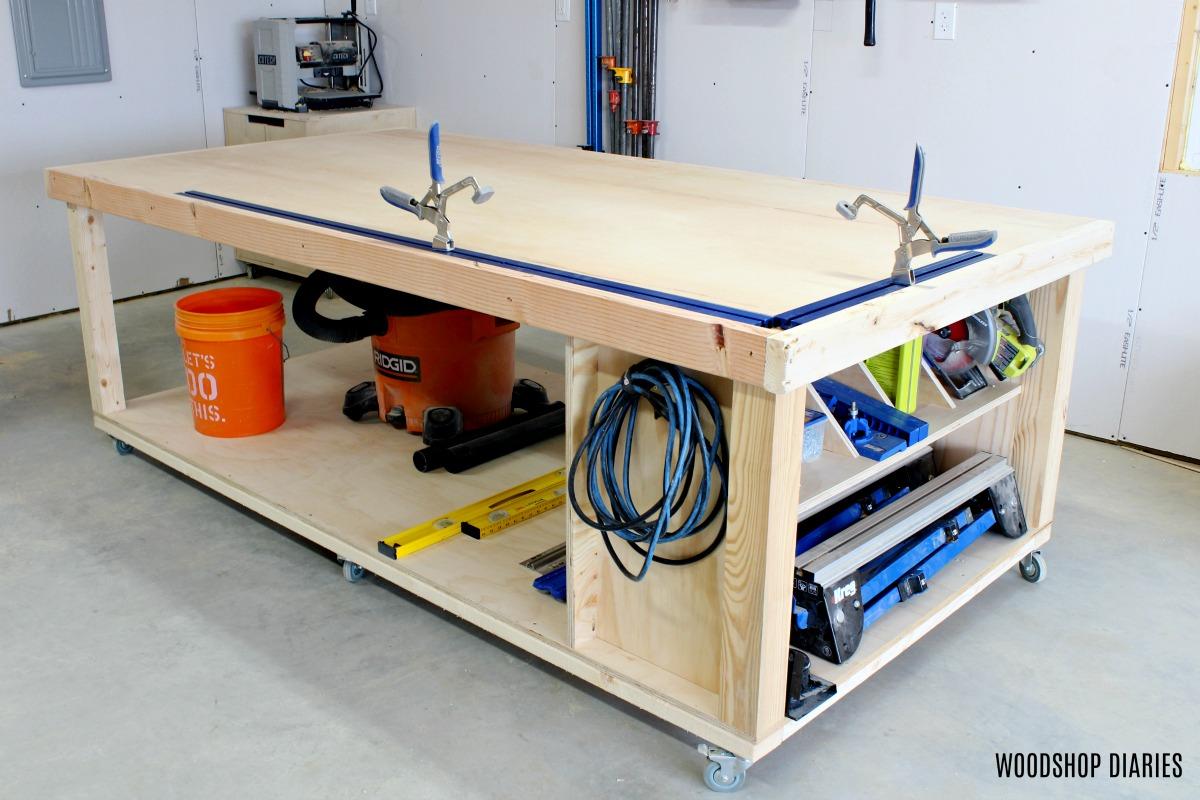
This Kreg Tool plan (also by Woodshop Diaries) uses a full 4′ x 8′ sheet for both the top and bottom shelf, with 4×4 legs cut to bring the bench to 34-1/2″ tall to match a table saw. It’s built with Kreg Clamp Traks inlaid into the top for clamping, six 3″ casters (two extra in the middle to prevent sagging), and a storage cubby with a shelf on one end. Easy to size down if 4×8 is too big for your shop. Get the free plan here.
7. The All-In-One Table Saw & Router Workbench
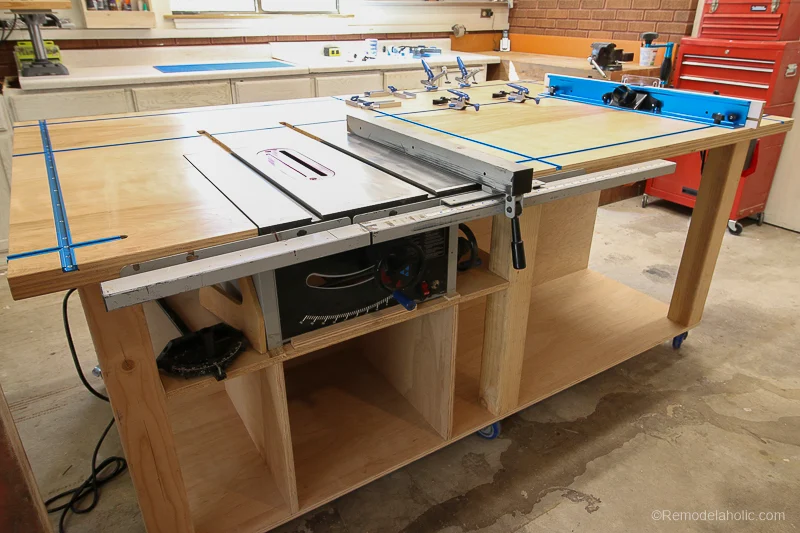
Source : remodel aholic
Best for: multi-use workshops that want everything in one bench Difficulty: Advanced
This is the biggest build on the list. Remodelaholic’s table saw workbench has a 78″ x 42″ plywood top on 4×4 legs, standing 36″ tall once the locking casters are on, and it packs in a built-in table saw, a router lift and fence, a T-track clamping system, and a bench vise. The core dimensions and build steps are shared free on the blog; the full printable cut list is a paid add-on if you want extra detail. See the build here.
8. The Three-Drawer Workbench with Back Shelf
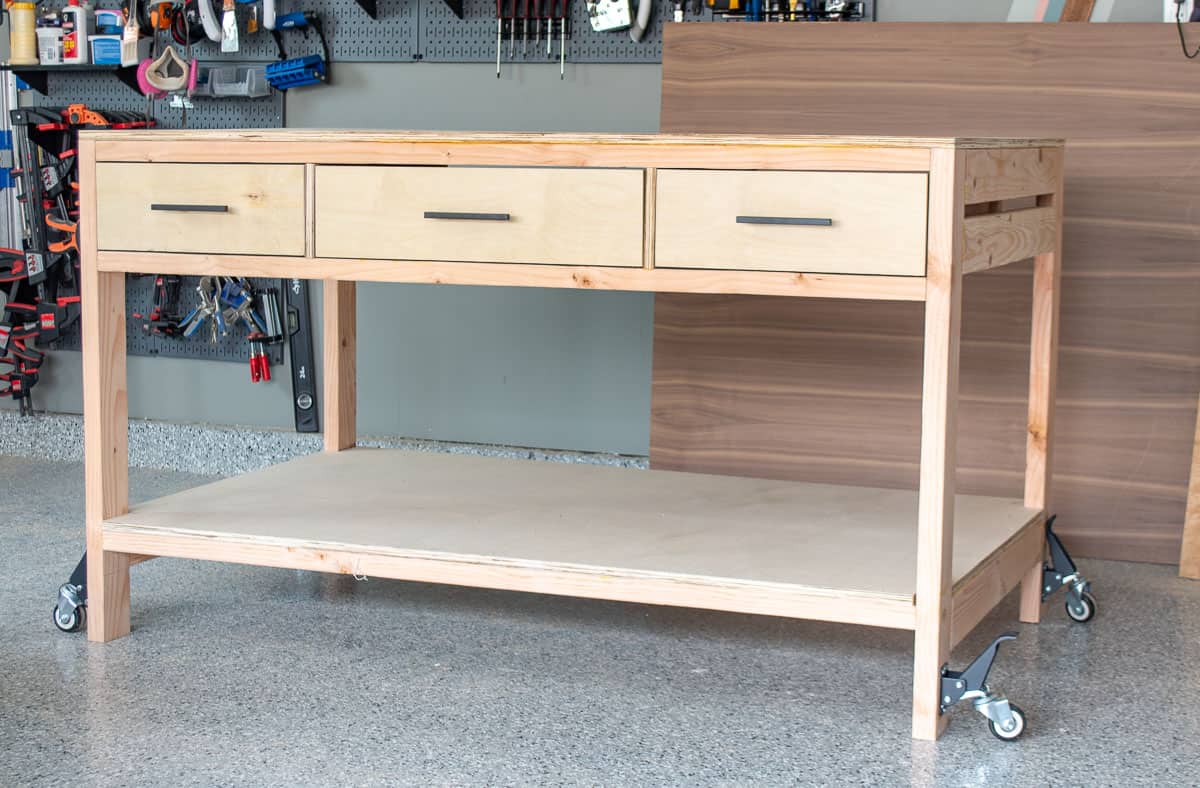
Source : Anika’s diy life
Best for: general-purpose storage next to your saw Difficulty: Easy to medium
This isn’t built around a table saw specifically, but it’s a genuinely useful companion bench: 64″ wide x 39″ deep x 37-3/4″ tall, with a 65″ x 39″ work surface, three drawers for small tools and screws, a narrow shelf at the back for hardware bins, and a large shelf underneath for scrap wood. It rolls on casters, so you can position it right next to your saw as extra outfeed or assembly space. Get the plans here.
9. The Space-Saving Fold-Flat Workstation
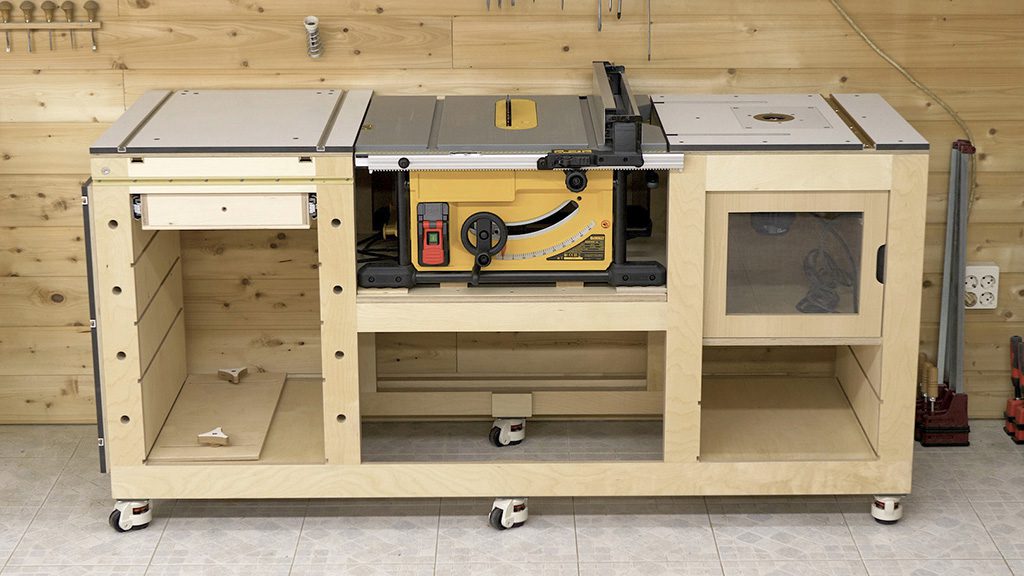
Source : Paoson
Best for: garages that share space with a car Difficulty: Advanced
Paoson’s folding outfeed table is the most compact option here by far. Open, the full workstation measures about 900mm high x 1450mm wide x 1370mm deep (roughly 35″ x 57″ x 54″). Folded flat against the wall, it shrinks down to 485mm high x 1450mm wide x 680mm deep (about 19″ x 57″ x 27″). It’s built around a DeWalt jobsite saw with a folding outfeed table, a side folding table, and leveling casters, so if floor space is your biggest constraint, this is worth studying even if you don’t copy it exactly. See the build here.
10. The Height-Matched Outfeed Table Saw
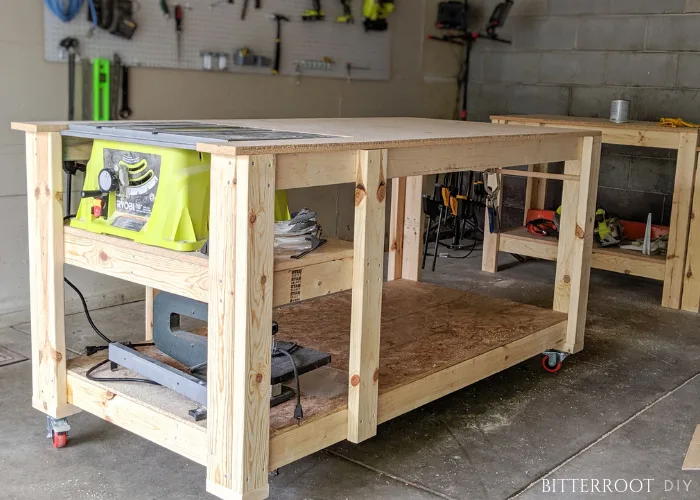
Source : tylynnm
Best for: pairing your table saw with a separate workbench as outfeed Difficulty: Medium
Tylynn M’s mobile workbench is built around a RIGID (or Ryobi) table saw, with the saw sitting on a shelf set at the exact height needed so the saw’s table lines up flush with a separate low workbench nearby, letting that second bench double as an outfeed table. The shelf height is customized to the saw (11″ in her build), and it rolls on locking casters with the option to add retractable wheels for extra stability. Free plans and full dimensions are shared right in the blog post. Get the plans here.
Common Mistakes to Avoid
Making the Workbench Too High or Too Low
The table saw surface and surrounding workbench top should match as closely as possible. Even a small mismatch can catch your workpiece and throw off a cut, so measure your own saw’s height before you cut a single leg.
Forgetting Outfeed Support
Without outfeed support, long boards become harder and less safe to control. It’s one of the first things people regret skipping.
Using Weak Casters
Cheap casters wobble or crack under weight. Use strong locking casters rated for the combined weight of your bench and saw.
Not Leaving Room for Accessories
Plan storage for blades, push sticks, the miter gauge, fence parts, and jigs before you build, not after everything’s already cluttering the floor.
Best Table Saw Workbench Plan for Beginners
If this is your first build, go with The DeWalt-Ready Rolling Table Saw Cart or The 8×3 Workbench with Built-In Shelving. Both are cheaper, faster to build, and still genuinely useful for a small workshop, with room to add drawers or outfeed support later.
Best Table Saw Workbench for Small Shops
For anyone working out of a small garage, The Fold-Away Stand with Extension Wing or The Space-Saving Fold-Flat Workstation are hard to beat. Both give you a full-size outfeed surface when you need it and a fraction of the footprint when you don’t.
Want More Workbench Ideas?
If this got you in a building mood, check out a few more guides that pair well with this one:
- 20+ Free DIY Workbench Plans for Every Skill Level
- 21 Easy French Cleat Tool Holders to Organize Your Workshop
- 15 Genius Tool Storage DIY Ideas to Organize Your Workshop
- 10 Essential Table Saw Jigs You Can Build This Weekend
Want a Smarter Small Workshop Setup?
A table saw workbench is a great start, but it works even better when the rest of your shop is planned around it. In a small garage workshop, every inch matters. Where you place your saw, how you store tools, how you manage dust, and how easily you can move around the bench can make a huge difference.
That is where a complete small shop setup guide can help. Instead of guessing where everything should go, you can follow a more organized plan for tool placement, storage, workflow, and space-saving layout ideas.
If you want help creating a workshop that feels clean, efficient, and easier to work in, Ultimate Small Shop is worth checking out. It is designed for woodworkers who want a practical shop setup without wasting space or overspending on tools.

Learn more about Ultimate Small Shop here.
FAQ About Table Saw Workbench Plans
What is the best table saw workbench plan for beginners?
The best beginner options are simple rolling carts, basic outfeed tables, and storage workbenches that do not require complicated joinery. The DeWalt-ready rolling cart and the 8×3 workbench with shelving are both good beginner-friendly starting points.
How tall should a table saw workbench be?
The workbench height should match your table saw surface as closely as possible. If the workbench is too high or too low, boards can catch while cutting, which makes the setup harder and less safe to use.
Should a table saw workbench have wheels?
Wheels are helpful in small shops because they let you move the bench when needed. Use strong locking casters rated for the full weight of the bench, saw, and anything stored inside.
Can a table saw workbench also work as an outfeed table?
Yes. Many table saw workbench plans are designed to double as outfeed tables. The key is making sure the workbench surface lines up flush with the table saw surface.
What is the best material for a table saw workbench?
A strong frame made from 2×4 lumber and a ¾-inch plywood top is a common beginner-friendly choice. It is affordable, sturdy, and easy to build with basic tools.
Do I need drawers in a table saw workbench?
Drawers are helpful, but not required. Open shelves are easier for beginners and still work well for storing blades, push sticks, jigs, clamps, and accessories.
Final Thoughts
A good table saw workbench does more than hold your saw. It gives you storage, support, mobility, and a safer place to work. Start with a simple design, match the height carefully, and add storage features as your workshop grows.