
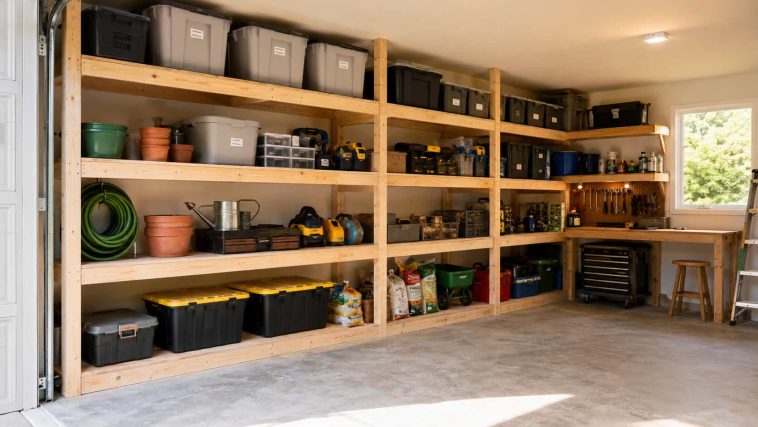
Garages have a strange talent for turning open floor space into a maze of storage totes, sports equipment, garden supplies, paint cans, and tools. You clear one corner, feel productive for ten minutes, and then discover three more boxes that apparently have nowhere to live.
The most effective fix is usually not a larger garage. It is better use of the walls, corners, and safe overhead space you already have.
These 15 DIY garage shelves cover almost every common storage problem. You will find narrow shelves that leave room for a car, deep units for large totes, an L-shaped system for a wasted corner, pull-out storage, shelves above the garage door, and a cabinet-and-shelf combination that hides visual clutter. Every idea links to a free plan or a detailed free tutorial from the original builder, so you can review the full materials list, measurements, diagrams, and assembly guidance before choosing a project.
Some plans are downloadable PDFs, while others are complete on-page build guides. Material prices, garage construction, and local building requirements vary, so treat each plan as a starting point and adapt it only after checking your own space.
Quick Comparison: Which Garage Shelf Should You Build?
| Garage shelving plan | Best for | Typical difficulty | Approximate time |
|---|---|---|---|
| Heavy-duty floating shelves | Open space above a workbench | Easy–Medium | Half day |
| Attached-to-wall 2×4 shelves | Long walls and large totes | Medium | One day |
| Bracket-style wall shelves | Keeping the floor completely open | Medium | One day |
| All-in-one storage wall | Workbench, tools, and bins together | Medium | Full weekend |
| Between-the-studs shelves | Small cans and hardware | Easy | A few hours |
| Above-door storage shelf | Seasonal items | Medium–Advanced | One day |
| Ceiling-perimeter shelves | Using high wall space | Medium–Advanced | One weekend |
| Ceiling-mounted platform | Bulky, lightweight bins | Medium–Advanced | One day |
| Budget freestanding shelves | Renters and flexible layouts | Easy | Half day |
| Narrow sidewall shelves | Garages that still hold a car | Easy–Medium | One day |
| L-shaped corner shelves | Wasted corners | Medium | One weekend |
| Sliding storage shelves | Reaching items at the back | Advanced | One weekend |
| Tote storage rack | Matching plastic bins | Medium | One weekend |
| Paint storage shelf | Cans and finishing supplies | Easy–Medium | One day |
| Shelf with cabinet | Open and concealed storage | Medium | One weekend |
Plan the Storage Before You Buy Lumber
The smartest garage shelves begin with the things you need to store. Buying boards first and measuring later is how you end up with attractive shelves that miss every tote lid by half an inch.
Start by grouping your belongings into categories: large totes, power-tool cases, paint and finishing supplies, garden equipment, automotive items, seasonal decorations, and frequently used hand tools. Measure the largest container in each group, including the lid and handles. Add enough clearance that you can remove it without scraping the shelf above.
Next, measure the room rather than only the empty wall. Check garage-door tracks, the opener, windows, outlets, switches, utility panels, water heaters, ceiling lights, and the path of the door itself. Park the car and open every door before deciding how deep a sidewall shelf can be. A 24-inch-deep unit holds plenty, but a 16-inch shelf may be the better design if it prevents a daily argument between the shelving and the passenger door.
If the garage also serves as a workshop, plan around the workbench and the way materials move through the space. The guides to setting up a small woodworking shop and free DIY workbench plans can help you create a layout instead of filling every available wall independently.
Materials That Work Well for Garage Shelves
Most of the projects below use construction-grade 2x4s for the frame and plywood, OSB, or MDF for the shelf surfaces. The right choice depends on the environment and the load.
- 2×4 lumber: Affordable, widely available, and suitable for sturdy frames when the spans and connections follow a proven plan.
- Plywood: A strong, clean shelf surface. Three-quarter-inch plywood is a common choice for demanding storage, while some plans use thinner panels over closely spaced supports.
- OSB: A budget-friendly option for utility shelves. It is practical rather than decorative and should stay dry.
- MDF or particleboard: Flat and inexpensive, but heavy and less forgiving in a damp garage. Use it only where the original plan recommends it and moisture is controlled.
- Structural fasteners: Wall and ceiling systems require fasteners selected for the framing, load, and plan—not leftover drywall screws.
If you have plywood offcuts after the build, save the usable pieces for bins, dividers, or tool holders. These DIY plywood projects offer more ways to use the remainder.
Garage-Shelf Safety Comes First
Shelves are only useful when they remain where you installed them. Wall-mounted units must connect to structural framing, and ceiling storage requires confirmed joist locations, suitable hardware, and safe clearance from the garage door and opener. Never guess about hidden wiring, plumbing, or the load capacity of an anchor.
Follow the original plan, the fastener manufacturer’s limits, and local requirements. Keep heavy objects low, distribute weight evenly, secure tall freestanding units against tipping, and load-test shelves gradually. Overhead work and power-tool use should be handled or supervised by an experienced adult; if the framing is unclear, use a qualified professional. Wear appropriate eye, hearing, and respiratory protection, keep guards in place, and follow every tool manufacturer’s instructions.
15 DIY Garage Shelves with Free Plans
1. Heavy-Duty Floating Garage Shelves
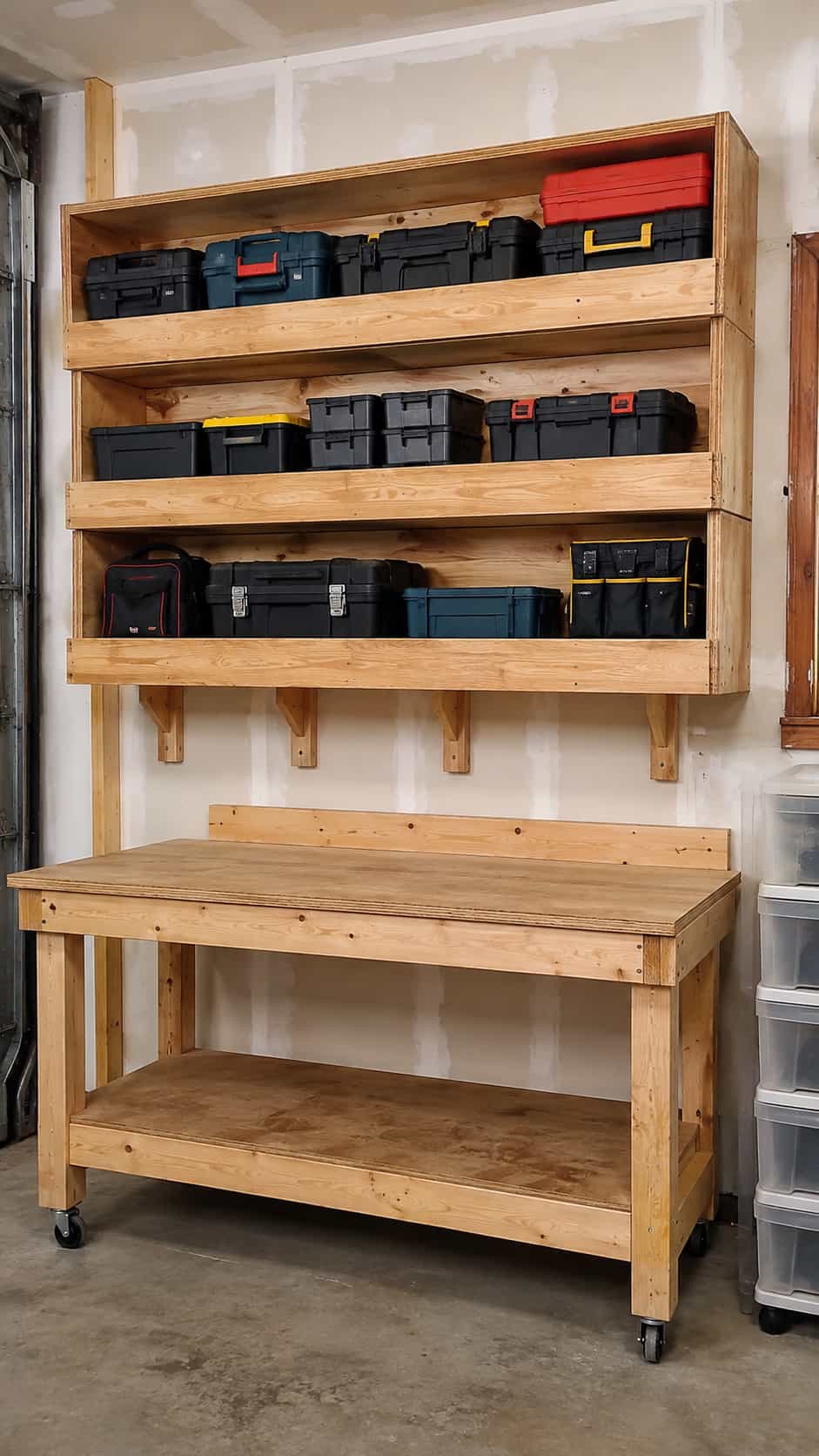
Floating shelves are a strong choice when you want storage above a workbench without adding legs that interrupt the floor. This version from Anika’s DIY Life uses an internal wooden frame attached to the wall, with a plywood box that slides over it for a clean finished appearance.
The design is especially useful for tool cases, small bins, and supplies you reach regularly. Its dimensions can be adjusted, but the shelf length should be planned around the available studs rather than an arbitrary number. Anika’s example is approximately 38 inches long because it reaches multiple studs.
Best for: Space above a workbench
Difficulty: Easy to medium
Important check: Stud locations and shelf depth
Free plan: Heavy-duty floating shelf plan and tutorial from Anika’s DIY Life
2. Attached-to-the-Wall 2×4 Garage Shelves
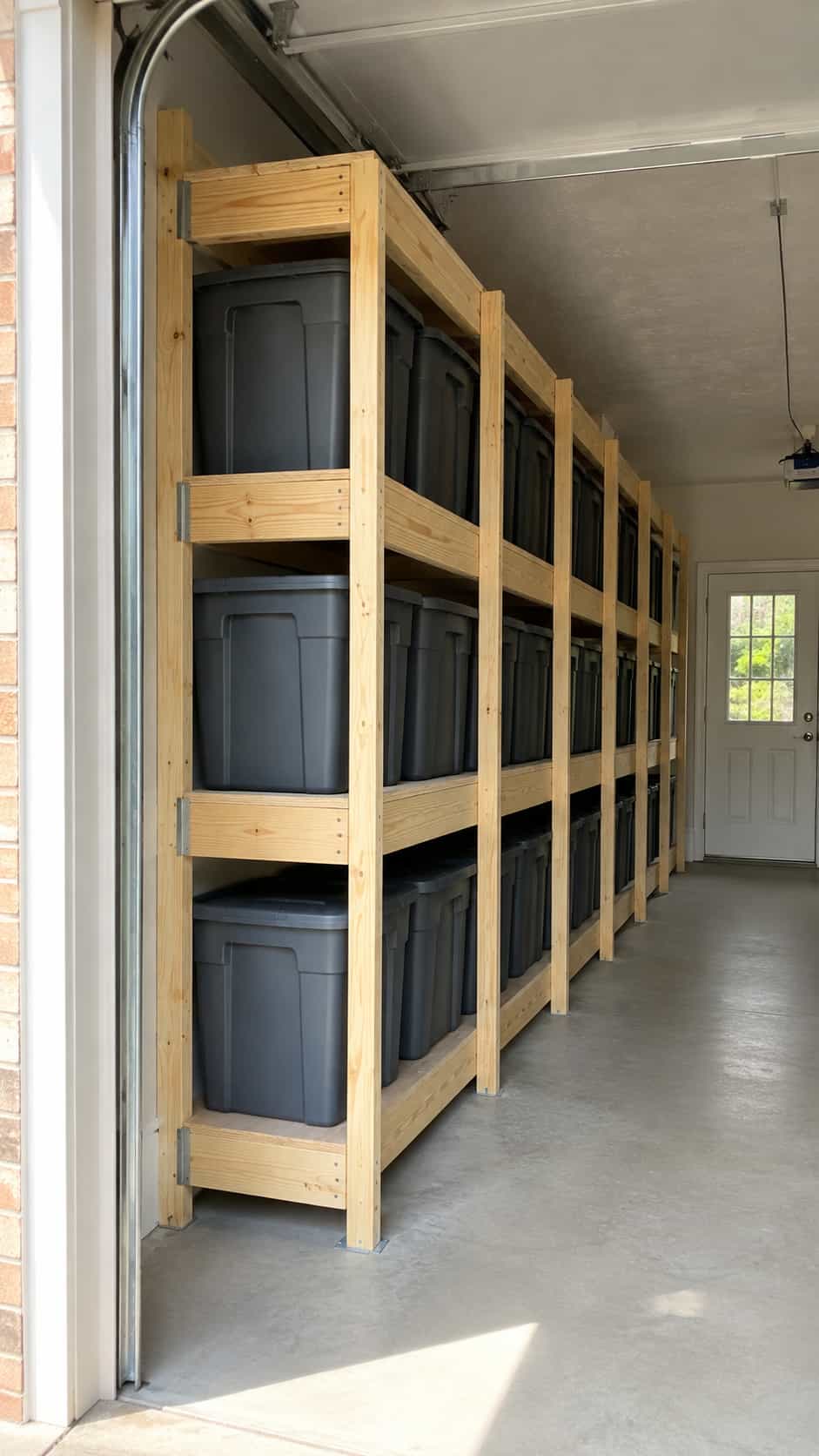
Ana White’s attached-wall system is made for serious storage along a long garage or basement wall. Horizontal 2×4 members connect to the wall framing, while front legs and cross supports carry the outer edge of the shelves. Plywood or OSB creates broad surfaces for large totes, camping equipment, and seasonal boxes.
The published plan shows a large 12-foot-long, 6-foot-tall, 2-foot-deep configuration, but the same structure can be adapted to an 8-foot wall. Planning depths around common sheet-goods widths can reduce waste. The open bottom also gives you flexibility for rolling equipment or unusually tall containers.
Best for: Long walls and bulky storage
Difficulty: Medium
Important check: Wall studs, floor slope, and vehicle clearance
Free plan: Attached-wall garage shelving plan from Ana White
3. Bracket-Style Wall-Mounted Shelves
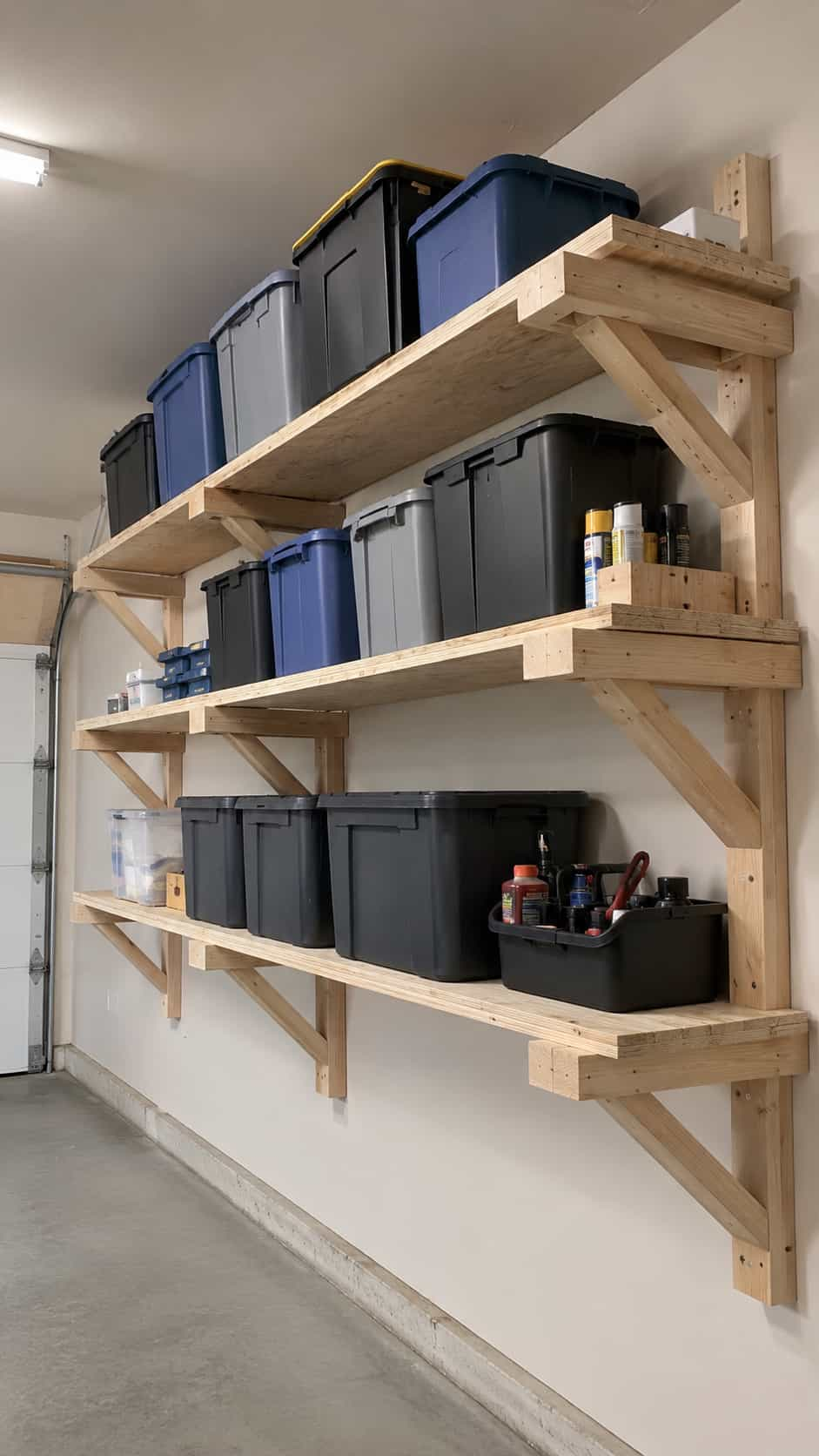
This Woodshop Diaries design takes the floor-saving idea a step further. Each plywood shelf rests on strong triangular wooden brackets attached to the wall. With no front legs, the area below remains open for a workbench, mower, compressor, or rolling storage cart.
Bracket shelves also make cleaning easier because there are fewer legs around which dust and leaves can collect. The trade-off is that the wall connection does all the important work. Bracket spacing, fastener selection, shelf depth, and the condition of the framing must match the original plan and the intended load.
Best for: Maximum open floor space
Difficulty: Medium
Important check: Bracket spacing and reliable attachment to studs
Free plan: Garage wall-shelf tutorial from Woodshop Diaries
4. All-in-One Garage Storage Wall and Workbench
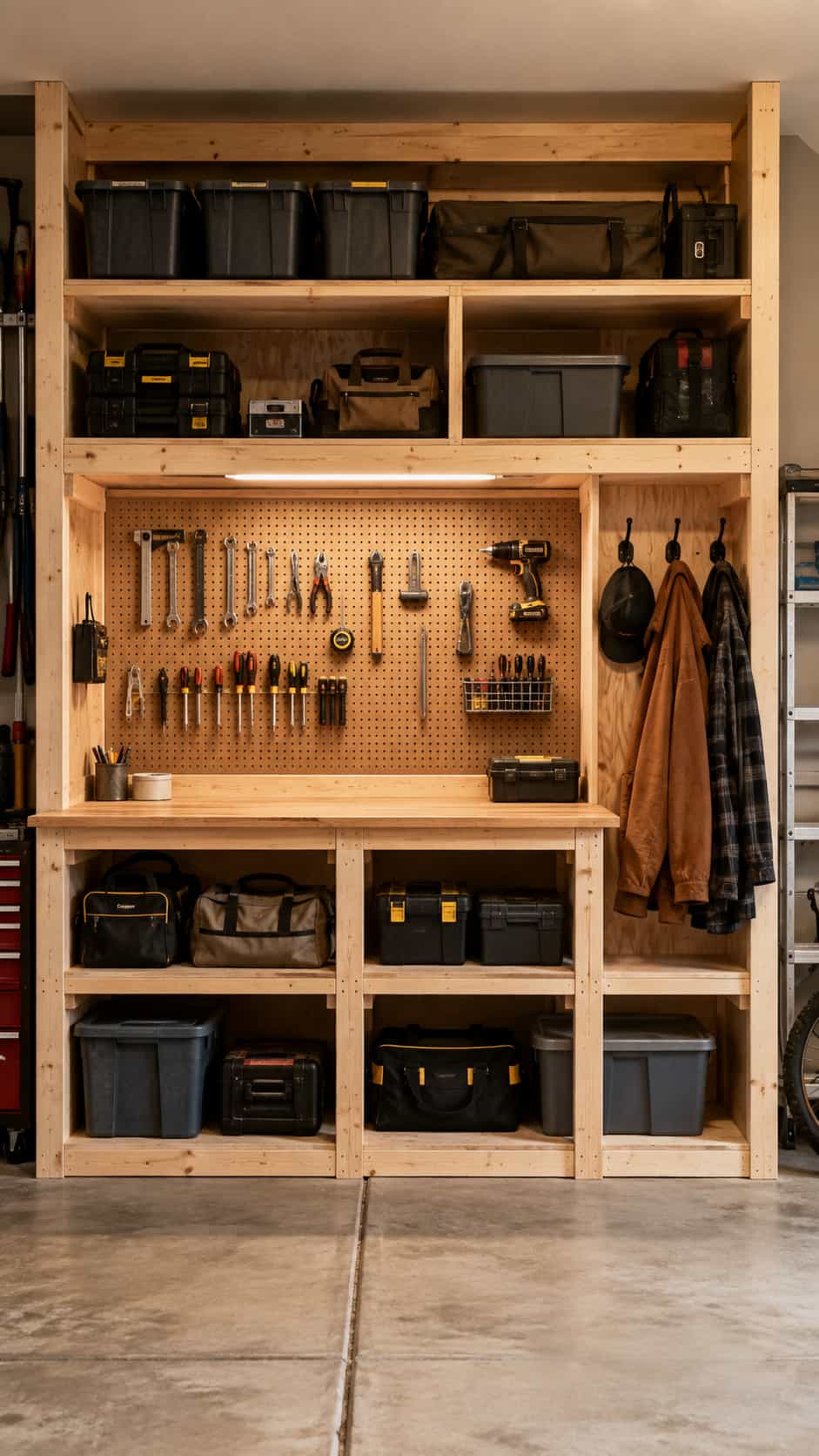
Sometimes several separate organizers create more visual noise than the clutter they were supposed to solve. Modern Builds combines open shelves, a work surface, pegboard-style tool storage, and hanging space in one continuous wall system built mainly from 2x4s and sheet material.
The design works particularly well in a one-car garage or dedicated workshop wall because it assigns every vertical zone a job. Less-used totes go high, frequently used hand tools remain at eye level, and larger cases fit below the bench. You can scale the width to the wall and rearrange the open sections around your own equipment.
Best for: A compact garage workshop
Difficulty: Medium
Important check: Comfortable workbench height and access to outlets
Free plan: Garage shelving and workbench build from Modern Builds
5. Between-the-Studs Garage Shelves
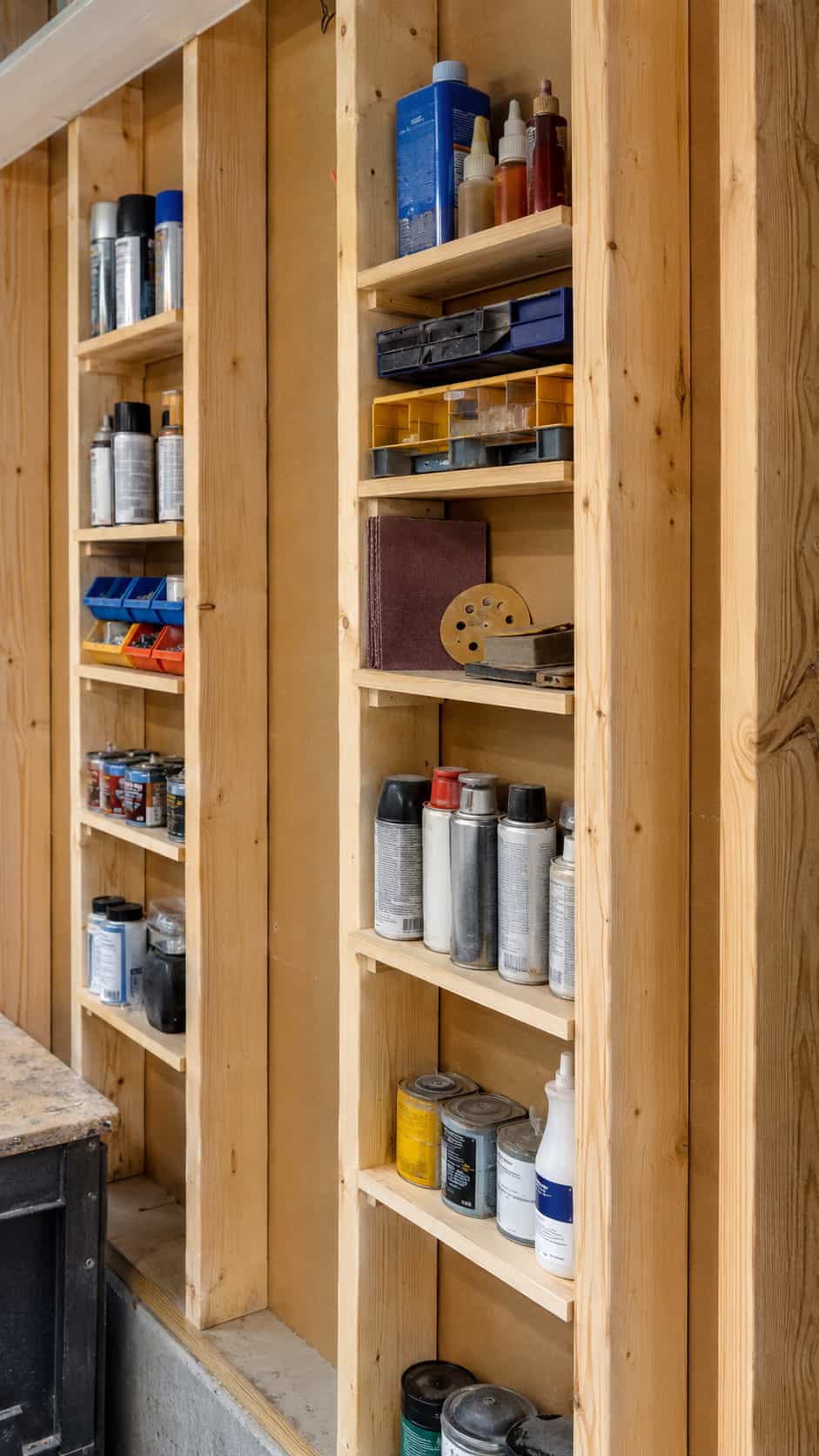
An unfinished garage wall already contains a row of narrow storage bays. The Handyman’s Daughter turns those gaps into shallow shelves using small cleats and boards or plywood. The result adds useful capacity without reducing the walking or parking area.
These shelves are ideal for hardware organizers, sanding supplies, small sealed cans, bottles, and frequently used accessories. They are not intended for heavy machines or oversized containers. Build the spacing around the actual items you want to store so the short shelves do not become a random collection of half-empty spaces.
Best for: Small supplies in unfinished garages
Difficulty: Easy
Important check: Hidden utilities inside the wall
Free plan: Between-the-studs shelving tutorial from The Handyman’s Daughter
6. Above-the-Garage-Door Storage Shelf
The space above a garage door is often large enough for seasonal decorations, camping equipment, and other lightweight items that only come down a few times a year. Her Tool Belt’s overhead shelf uses wall and ceiling framing with rigid connectors to create storage above the door’s travel path.
This design can recover genuinely wasted space, but it demands more planning than a freestanding shelf. Check the door at every point in its movement, the track hardware, opener rail, emergency release, lights, and the clearance needed to remove a bin. Store only lightweight, well-contained items overhead and include a retaining edge if the plan calls for one.
Best for: Lightweight seasonal storage
Difficulty: Medium to advanced
Important check: Joists, hardware, and full garage-door clearance
Free plan: Overhead garage storage plan from Her Tool Belt
7. Ceiling-Perimeter Garage Shelves
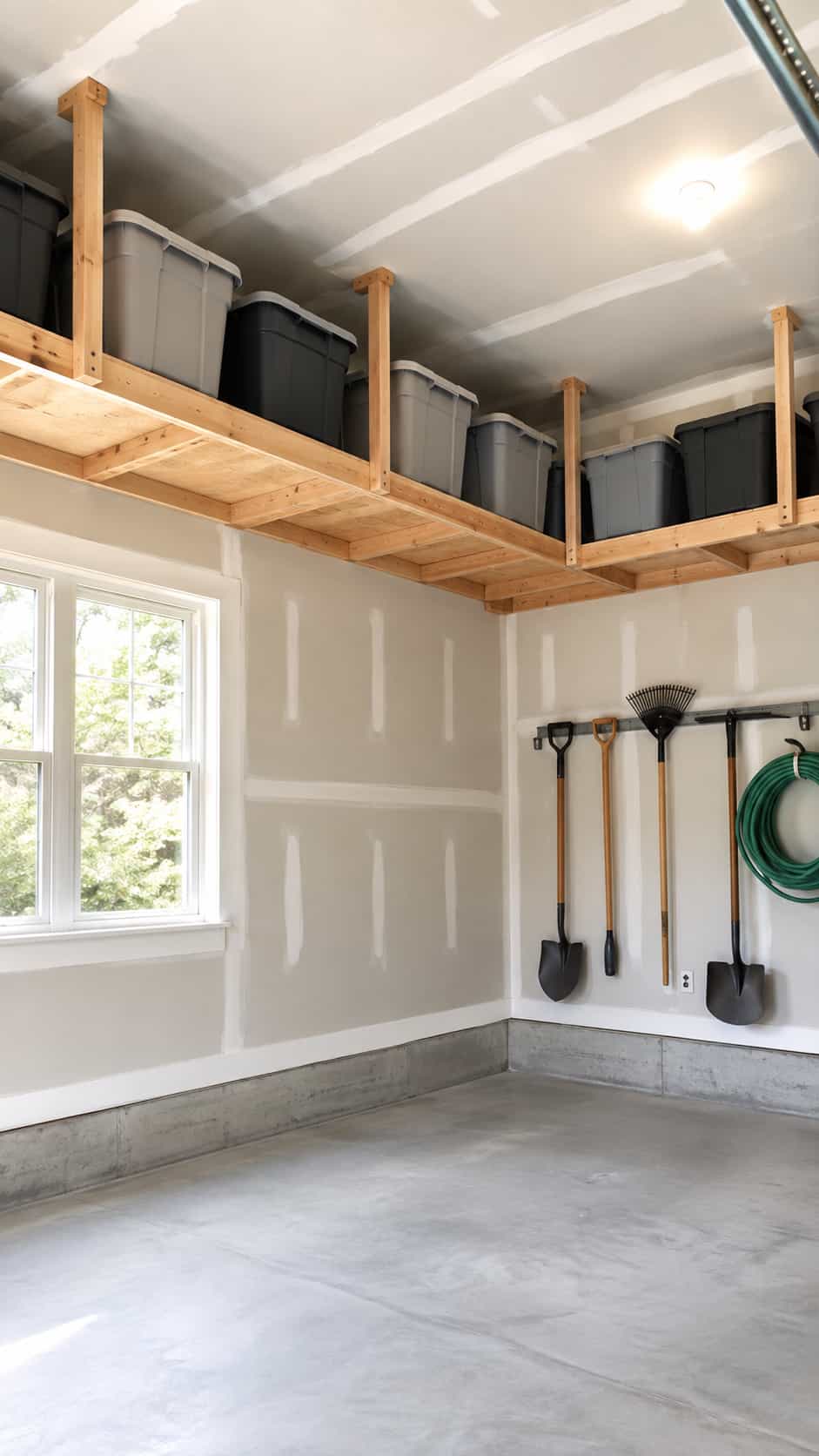
Crafted Workshop’s system places shelving high along the wall and ceiling, creating a continuous storage band without taking over the floor. It is a practical layout for matching totes filled with holiday décor, archived household items, or other lightweight belongings.
Running the shelf along more than one wall can provide impressive capacity, but it also multiplies the number of framing connections. Measure ceiling height, door tracks, windows, lights, outlets, and the safe access method before deciding how far the shelf should continue. Use identical bins where possible so you can set one consistent depth and clearance.
Best for: High-volume seasonal storage
Difficulty: Medium to advanced
Important check: Continuous framing and safe access
Free plan: Ceiling-mounted garage shelf plans from Crafted Workshop
8. Compact Ceiling-Mounted Storage Platform
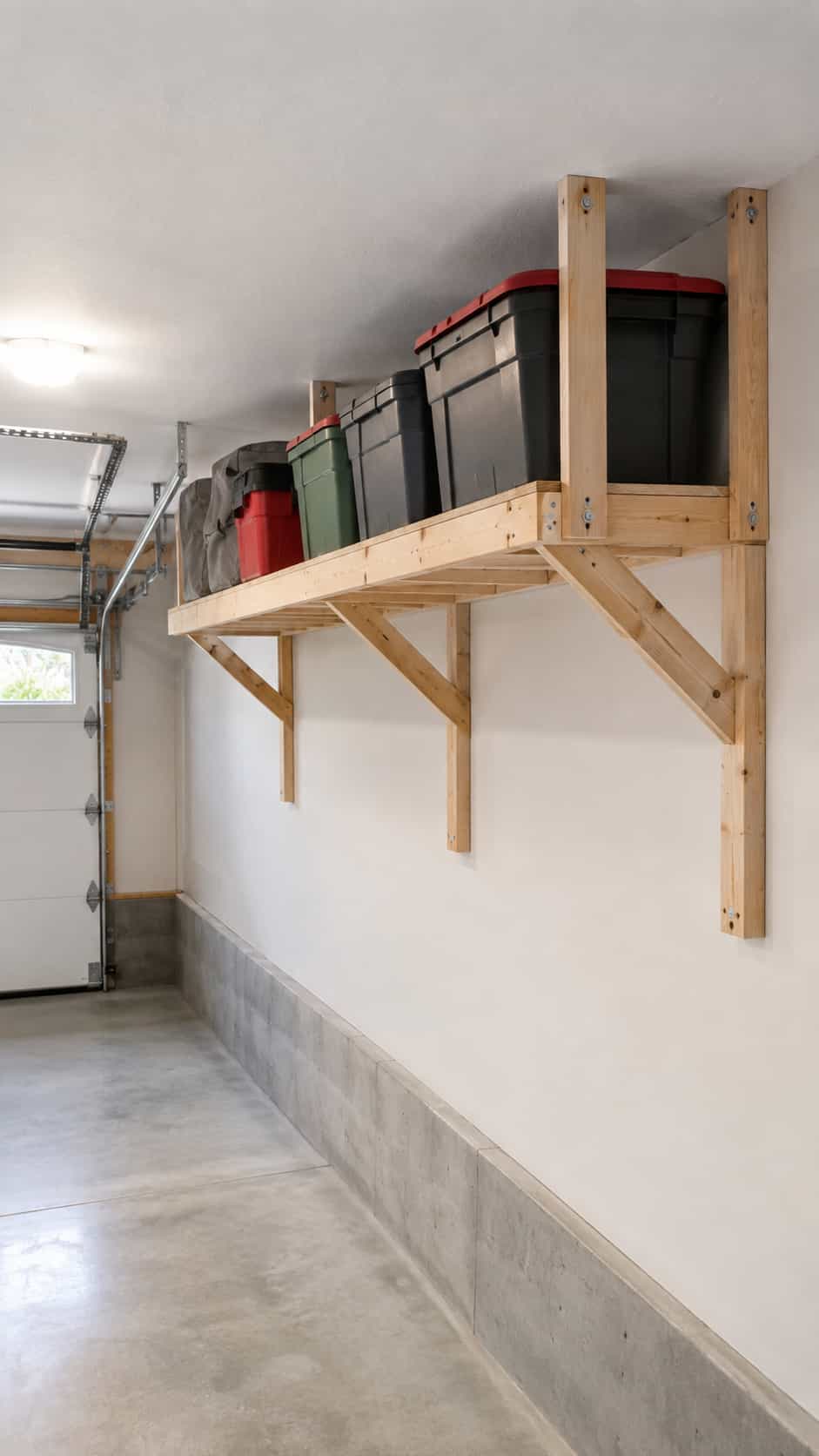
If a full perimeter system feels excessive, a single ceiling-mounted platform may solve the problem. The Kenarry tutorial uses 2x4s and plywood to create a focused overhead shelf for a small group of bins while leaving the floor and most of the wall untouched.
This approach works well over a side area that does not conflict with the garage door. It is easier to inventory than a shelf that wraps the entire room, and you can locate it near the category it serves—for example, outdoor cushions near the patio door or holiday boxes near the main storage wall.
Best for: A few bulky, lightweight totes
Difficulty: Medium to advanced
Important check: Joist direction, shelf span, and nearby fixtures
Free plan: Ceiling-mounted garage shelf tutorial from Kenarry
9. Cheap and Easy Freestanding Garage Shelves
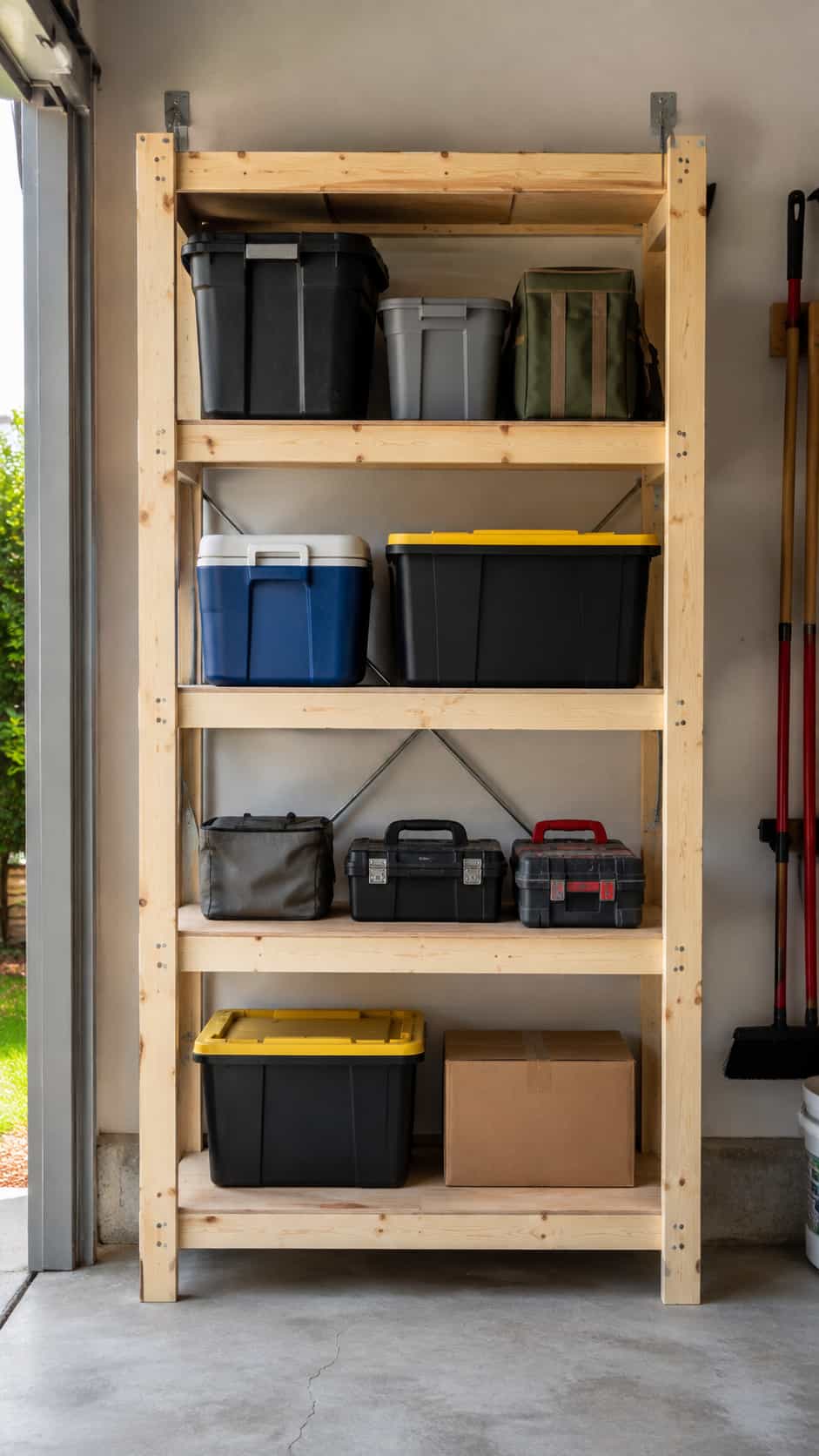
Pneumatic Addict’s freestanding unit is refreshingly straightforward: a four-tier frame made with nine 2x4s and one sheet of plywood, MDF, or particleboard. The published shelf is about 48 inches wide, 24 inches deep, and 75 inches tall, making it useful for a short wall, shed, basement, or temporary workspace.
Because it does not depend on a long wall-mounted frame, this design is easier to relocate than a built-in system. It is also a practical starting point for beginners who want a clear plan and a manageable amount of material.
Best for: Budget storage and flexible layouts
Difficulty: Easy
Important check: Level floor and anti-tip attachment
Free plan: Cheap freestanding garage-shelf plan from Pneumatic Addict
10. Narrow Sidewall Garage Shelves
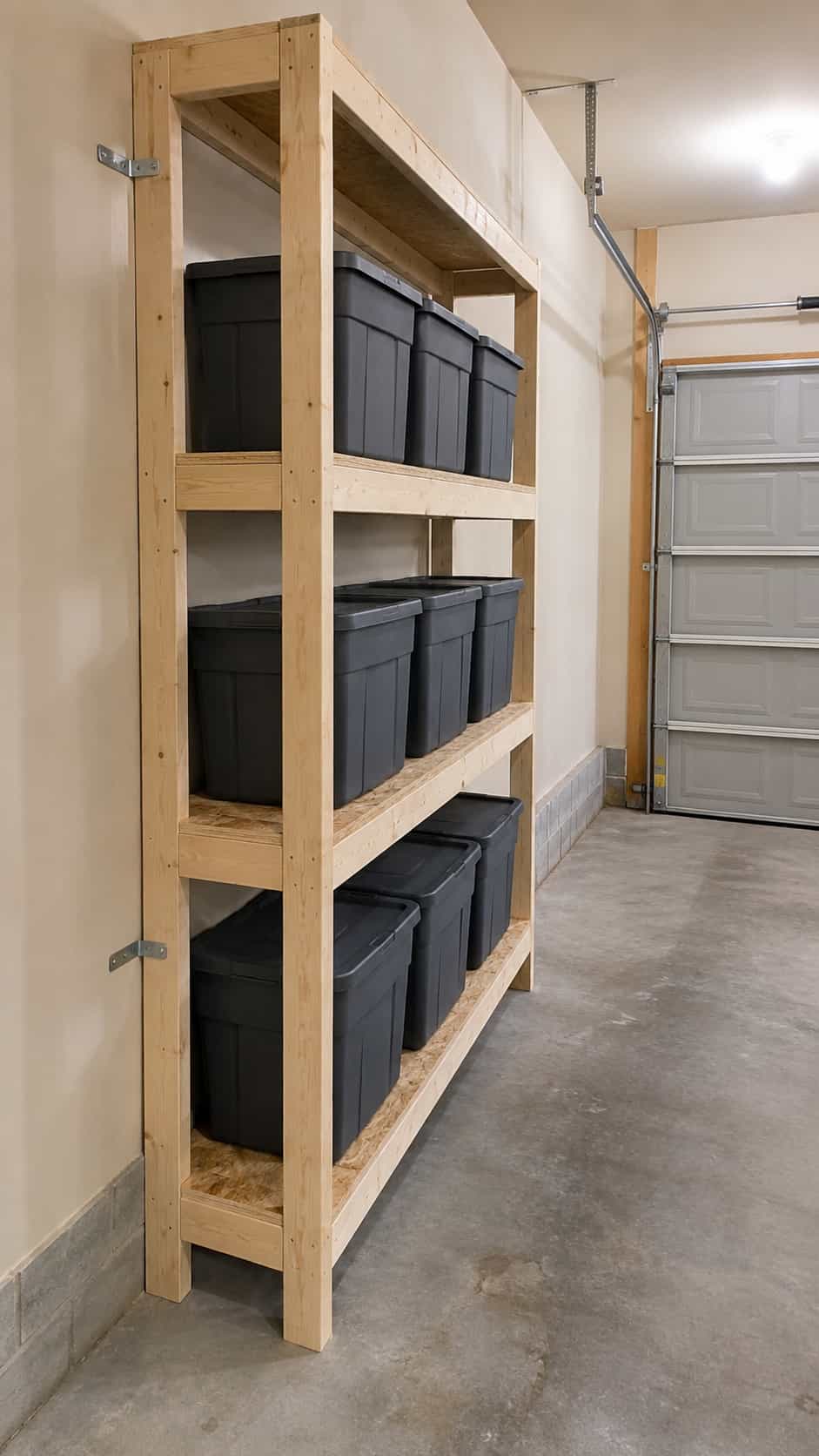
Fix This Build That designed this unit for the side of a garage where every inch of parking clearance matters. The finished shelves are approximately 6 feet long, 16 inches deep, and 75.5 inches tall. The plan uses twelve 2x4s and one sheet of OSB efficiently, with shelf spacing suited to medium totes.
Sixteen inches is deep enough for useful storage but much less intrusive than a standard 24-inch utility shelf. That makes this one of the strongest options for a garage that still needs to accommodate a vehicle, bicycles, or a wide walking path.
Best for: A one-car garage or narrow parking lane
Difficulty: Easy to medium
Important check: Floor slope and car-door clearance
Free plan: Efficient sidewall garage-shelf plan from Fix This Build That
11. L-Shaped Corner Garage Shelves
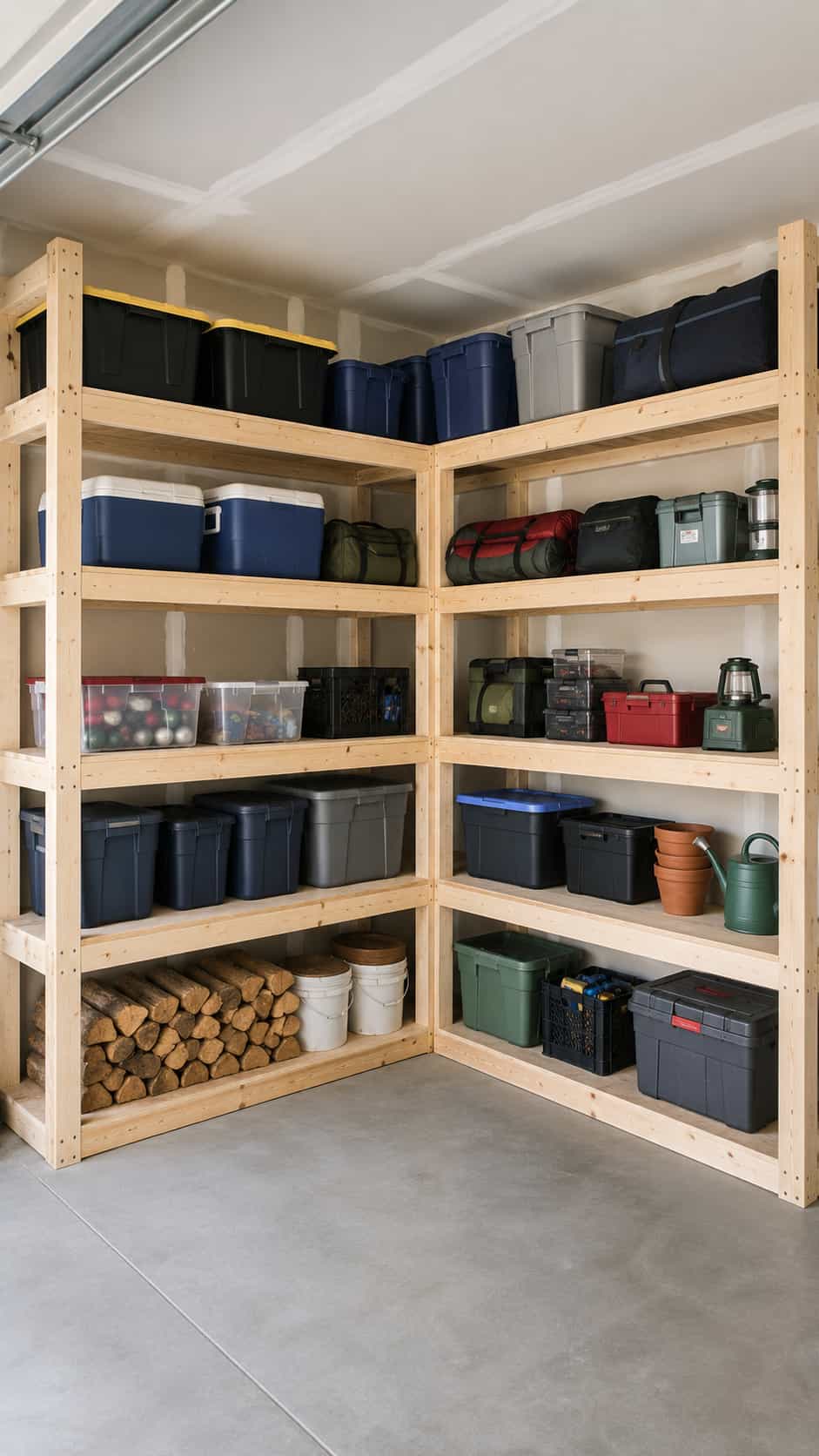
Corners often become clutter traps because two ordinary shelving units leave an awkward square that is difficult to reach. Kenarry’s L-shaped plan creates a continuous frame around the corner while keeping access open from the front.
This configuration offers far more usable surface than a tiny triangular corner shelf. It is well suited to camping equipment, garden supplies, tool cases, and household bins. The key is avoiding shelves so deep that items disappear into the back corner. Use the least-accessible area for large, rarely moved containers and keep frequently used supplies near the open ends.
Best for: Turning a dead corner into high-capacity storage
Difficulty: Medium
Important check: Reach into the corner and door clearance on both walls
Free plan: L-shaped corner garage-shelf tutorial from Kenarry
12. Sliding Garage Storage Shelves
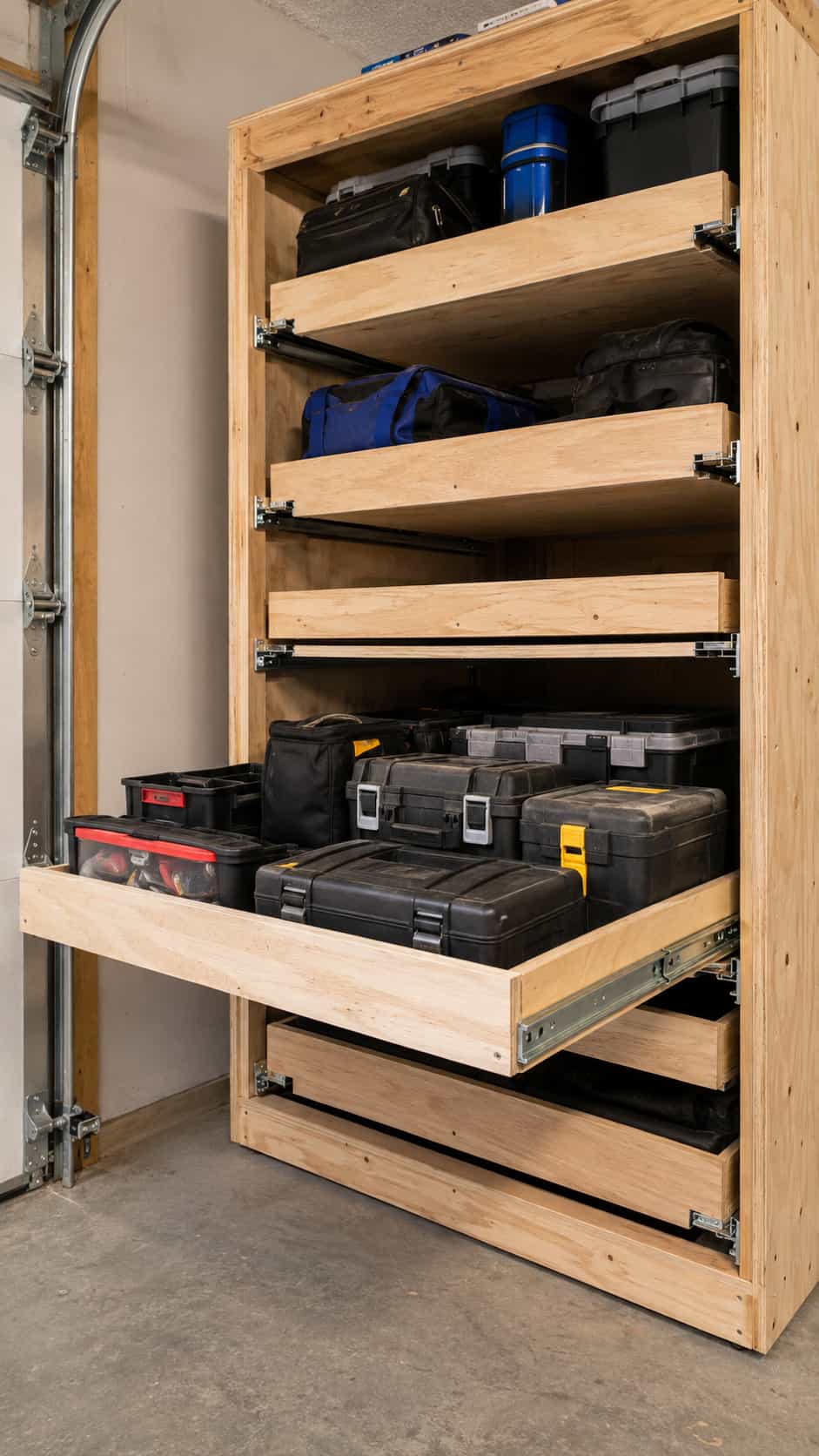
Deep shelves hold more, but the items at the back often become invisible. Just Measuring Up solves that problem with pull-out storage trays that bring the entire shelf forward. It is a clever option for tool cases, project supplies, and bins that need to remain accessible in a deep cabinet.
This is one of the more advanced builds on the list because smooth operation depends on a square cabinet, parallel slide placement, and hardware rated for the expected load. Before building, measure the fully extended tray and verify that it will not block a car, door, or main walkway.
Best for: Deep storage with full access
Difficulty: Advanced
Important check: Slide rating, cabinet squareness, and extension clearance
Free plan: Sliding garage-shelf tutorial from Just Measuring Up
13. DIY Tote Storage Rack
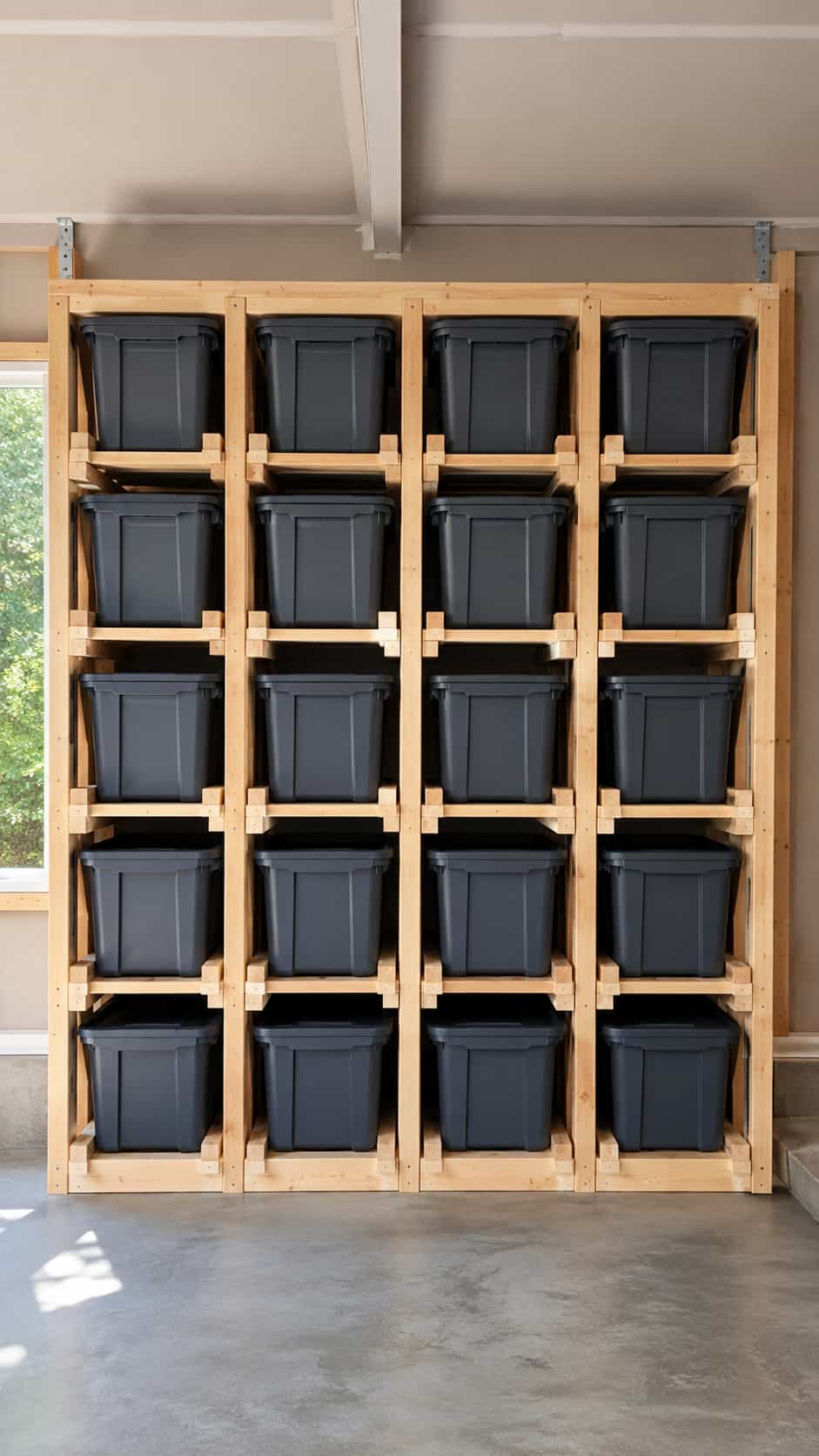
When most of your garage storage already lives in plastic totes, individual wooden rails can be more efficient than full shelf decks. Simply Aligned Home’s rack is designed around 16 large containers, giving each tote its own opening so you can remove one without unstacking everything above it.
The concept only works when the rack matches the exact tote. Measure the widest points, lid, rim, and any taper before finalizing the rail spacing. If you expect to replace bins later, use a common size that is likely to remain available rather than a one-off container.
Best for: Large collections of matching storage totes
Difficulty: Medium
Important check: Exact tote dimensions and rail spacing
Free plan: 16-tote storage rack tutorial from Simply Aligned Home
14. One-Sheet Paint Storage Shelf
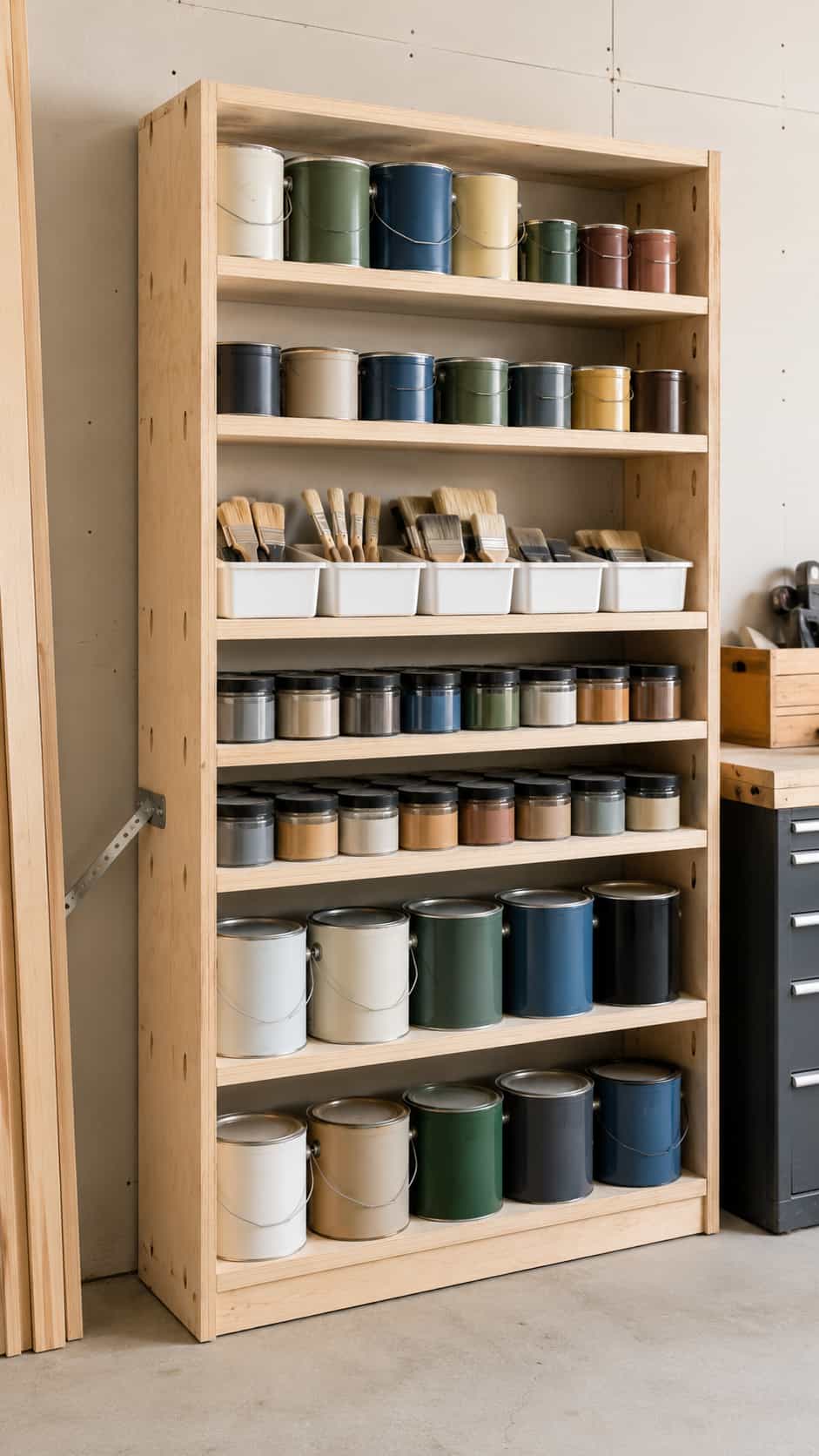
Paint cans are awkward residents of a general storage shelf: they are dense, come in several sizes, and tend to vanish behind larger boxes. Charleston Crafted’s freestanding organizer uses a single sheet of half-inch plywood to create closely spaced shelves dedicated to paint and finishing supplies.
Keeping similar materials together makes inventory easier and helps prevent buying a third nearly identical can because the first two were hiding in different corners. Adjust the vertical spacing only after measuring the tallest sealed container you intend to keep. Store products according to their labels, protect them from temperature extremes, and dispose of unwanted material through the appropriate local program.
Best for: Paint, stain, and finishing supplies
Difficulty: Easy to medium
Important check: Product storage requirements and total shelf load
Free plan: Plywood paint-storage shelf tutorial from Charleston Crafted
15. Garage Shelf with a Closed Cabinet
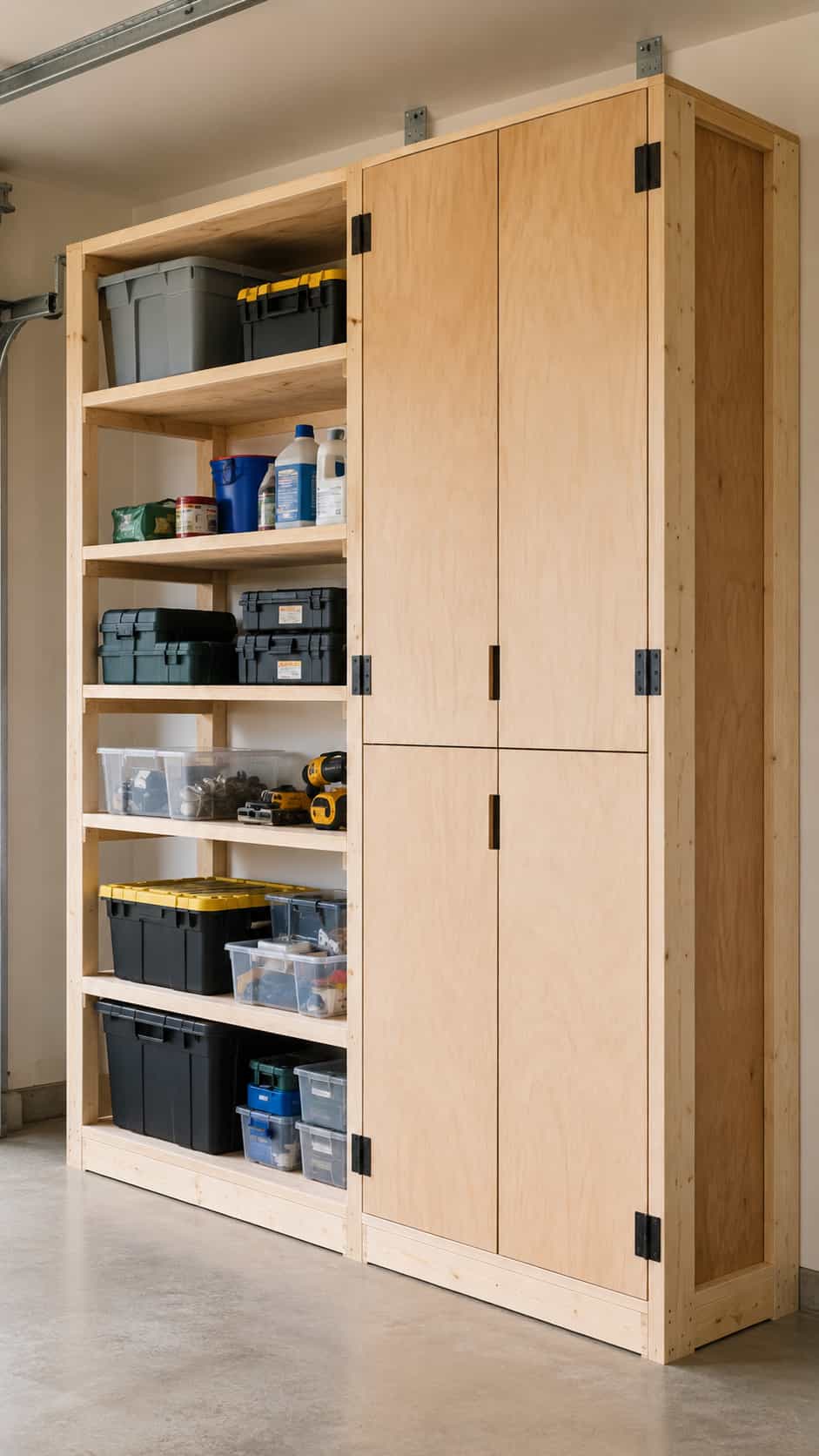
Open shelves are convenient, but not everything needs to be on display. Woodshop Diaries combines quick-access shelving with a tall cabinet, giving you space for frequently used bins on one side and less attractive or more dust-sensitive items behind doors on the other.
This balanced design can make a multipurpose garage look calmer without forcing every object into a closed cabinet. Use the open section for durable items you grab often and the enclosed section for smaller supplies that benefit from protection. Adjustable interior shelves can make the cabinet more flexible as your storage needs change.
Best for: A mix of visible and concealed storage
Difficulty: Medium
Important check: Door swing, wall attachment, and level setup
Free plan: Garage shelf with cabinet plan from Woodshop Diaries
Want a Garage Workshop That Works as One Complete System?
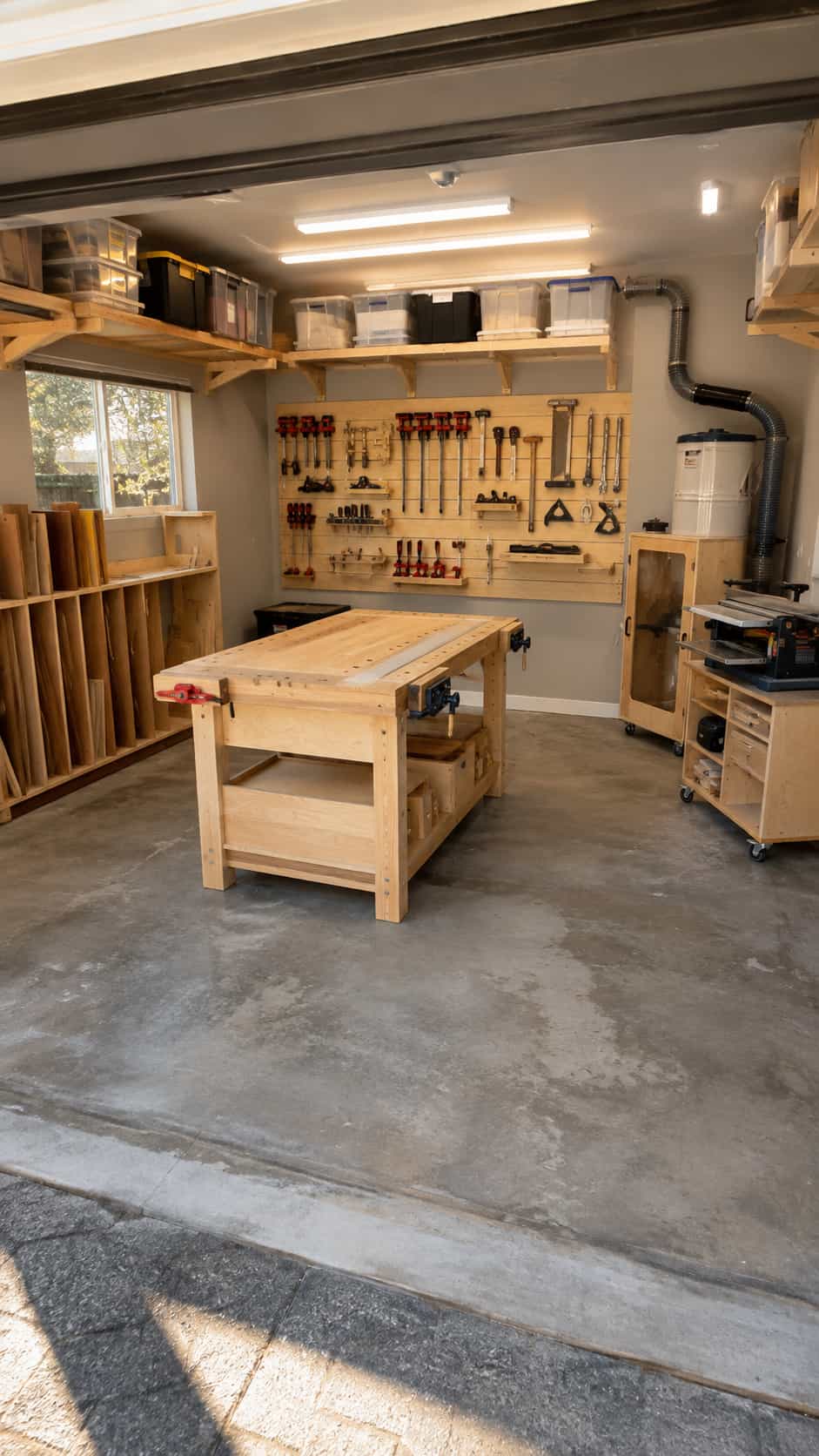
New shelves can clear the floor, but storage is only one part of a functional workshop. Tool placement, lighting, workbench position, lumber storage, dust control, and the route you use to move a project through the shop all affect how comfortable the space feels.
That is where Ultimate Small Shop may be useful. It is a workshop-planning resource created for woodworkers who want to arrange a practical shop in a garage, basement, shed, or other limited area without buying unnecessary equipment. It can help you think beyond a single shelving unit and plan the whole space around your actual workflow and budget.
Review the offer carefully and decide whether it fits your workshop goals. If your only problem is a stack of totes, one free shelf plan above may be all you need. If you are reorganizing an entire small shop, a broader layout system may save you from moving the same workbench and machines three times.
Learn more about Ultimate Small Shop
You can also combine these shelves with tool-wall storage ideas, French cleat holders, or scrap-wood storage solutions to keep the workbench clear after the larger boxes are off the floor.
Frequently Asked Questions
What is the cheapest material for DIY garage shelves?
Construction-grade 2x4s with OSB shelf panels are often among the least expensive practical combinations. Prices vary by location, and the cheapest panel is not always the best value in a damp garage. Compare plywood and OSB locally, then follow the thickness and support spacing in the chosen plan.
How deep should garage shelves be?
About 16 inches works well along a narrow sidewall, while 24 inches accommodates many large storage totes. Shallower shelves suit paint cans and small supplies. Measure the objects, the car-door swing, and the walking lane before choosing a depth.
Should garage shelves be freestanding or wall-mounted?
Freestanding shelves are easier to move and may suit a changing layout. Wall-mounted shelves preserve floor space and can fit above a bench, but their structural connections require careful planning. Tall freestanding units should still be secured against tipping.
Can I use half-inch plywood for garage shelves?
Some published plans use half-inch plywood or OSB over closely spaced framing, while others recommend thicker panels for deeper shelves or heavier loads. Use the thickness, bracing, and span specified by the plan. Do not assume one panel thickness suits every shelf.
What should never be stored on high garage shelves?
Avoid very heavy objects, unstable containers, frequently used items, and anything that cannot be lifted down safely. Keep dense tools, liquids, and large cans on lower shelves. Follow product labels for materials affected by garage temperature extremes.
How do I keep a garage shelving system organized?
Create zones, use matching bins where practical, label more than one side, and leave a small amount of empty capacity. Review the shelves seasonally and remove items that are damaged, expired, or no longer needed. A storage system works best when every category has a defined home.
Final Thoughts
The best DIY garage shelves are not necessarily the largest. They are the ones that fit the containers, protect the walking and parking space, connect safely to the building, and make frequently used items easy to reach.
Start with the problem that causes the most frustration. Build narrow sidewall shelves if the car barely fits. Choose a tote rack if stacks of plastic bins dominate the room. Use a corner system if two walls meet in wasted space. Add overhead storage only when the framing and access can be handled safely.
One well-chosen weekend project can clear more floor space than a month of rearranging boxes. Measure carefully, follow the original free plan, keep heavy storage low, and build a system that makes the garage easier to use long after the weekend is over.