

A lumber pile never stays small for long. One sheet of plywood leans against the wall, a few useful offcuts collect behind the workbench, and suddenly half the garage feels like a badly managed lumberyard.
The right storage rack fixes more than clutter. It keeps boards visible, protects sheet goods from damage, clears walking space, and makes it easier to use the wood you already own. The best design depends on what you store: long boards need support along their length, plywood needs a stable divider or cart, and short scraps need open bins where they will not disappear.
This guide brings together 15 practical DIY lumber storage rack plans and detailed tutorials from their original creators. You will find wall-mounted racks, vertical organizers, compact rolling carts, and large all-in-one systems for busy workshops. Before choosing one, measure your available floor and wall space, sort your lumber, and be honest about how often the rack must move.
If your wood pile includes mostly small leftovers, start with our guide to 20 scrap wood storage ideas for a small garage workshop. If larger boxes and tools are also taking over the room, these DIY garage shelf plans can help you organize the rest of the space.
Quick Comparison: Which Lumber Rack Should You Build?
| Design | Best for | Footprint | Difficulty |
|---|---|---|---|
| Ultimate lumber cart | Boards, plywood and scraps together | Large | Intermediate |
| Simple rolling 2×4 cart | Long dimensional lumber | Medium | Beginner |
| Moveable conduit rack | Full sheets and long boards | Large | Intermediate |
| One-sheet mobile cart | Plywood and mixed lumber | Compact | Intermediate |
| Small lumber cart | Short and medium offcuts | Small | Beginner |
| Wall-mounted 2×4 rack | Long boards with no floor-space loss | Wall only | Beginner |
| Adjustable vertical rack | Mixed board lengths | Small | Beginner |
Before You Build: Sort, Measure and Check the Structure
Sort your wood into long boards, sheet goods, medium offcuts, short scraps, thin strips and material that should be discarded. This tells you whether you need a lumber rack, a plywood cart, or simply a divided scrap bin. Building a huge cart for a small offcut collection wastes floor space; mounting long boards high on a wall you cannot safely reach creates a different problem.
For wall-mounted designs, identify the actual wall framing and follow the original plan’s fastener and spacing requirements. Drywall alone is not a structural support. For mobile carts, calculate the weight of the rack plus its likely load and choose locking casters rated comfortably above that total. Long or heavy boards should be kept low, and any freestanding unit must remain stable when material is removed from only one side.
Workshop safety: These projects may involve power tools, heavy sheet goods and structural wall mounting. Follow the original plan and every tool manufacturer’s instructions, use appropriate eye and hearing protection, and get qualified adult or professional help when you do not have the experience to complete a step safely. Never climb a rack or work beneath an unsecured load.
15 DIY Lumber Storage Rack Plans for Your Garage or Workshop
1. Ultimate Lumber and Plywood Storage Cart
Credit : Ana-white
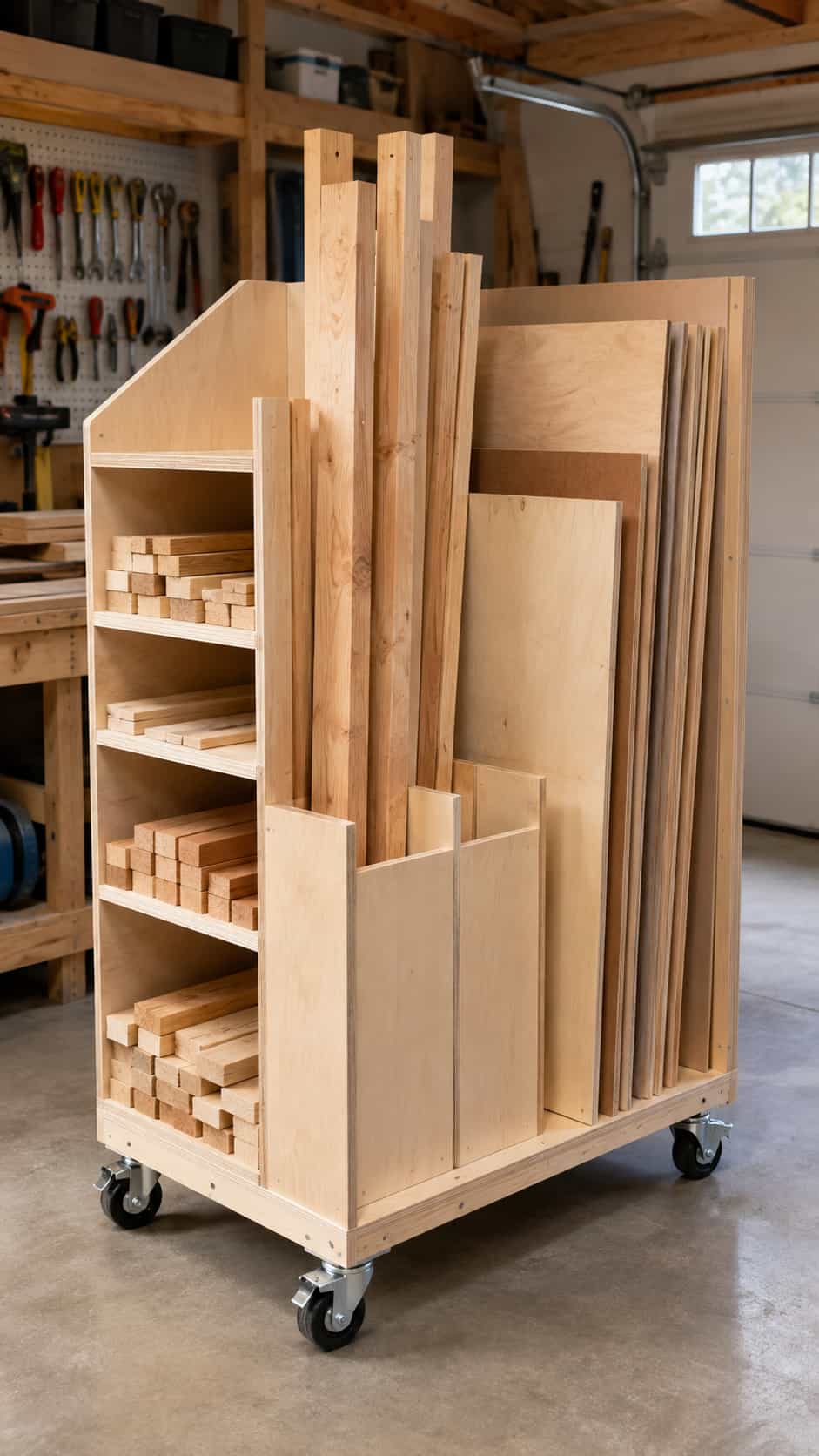
Ana White’s large rolling cart is designed for a serious material collection. It places plywood in the center, longer boards along one side, and divided scrap storage on the other. This is the closest option on the list to a complete mobile lumber station.
The design is useful when you buy full sheets and keep many board lengths, but it requires a generous aisle and heavy-duty casters. Ana notes that the finished cart becomes difficult to move when fully loaded, so treat “mobile” as occasional repositioning rather than effortless daily rolling. Measure the intended parking spot, doorway width and turning space before committing.
Best for: Large garages and mixed lumber collections
Difficulty: Intermediate
Important check: Loaded weight and clearance around the cart
View Ana White’s free lumber and plywood cart plan
2. Simple Rolling 2×4 Wood Cart
Credit : Ana-white
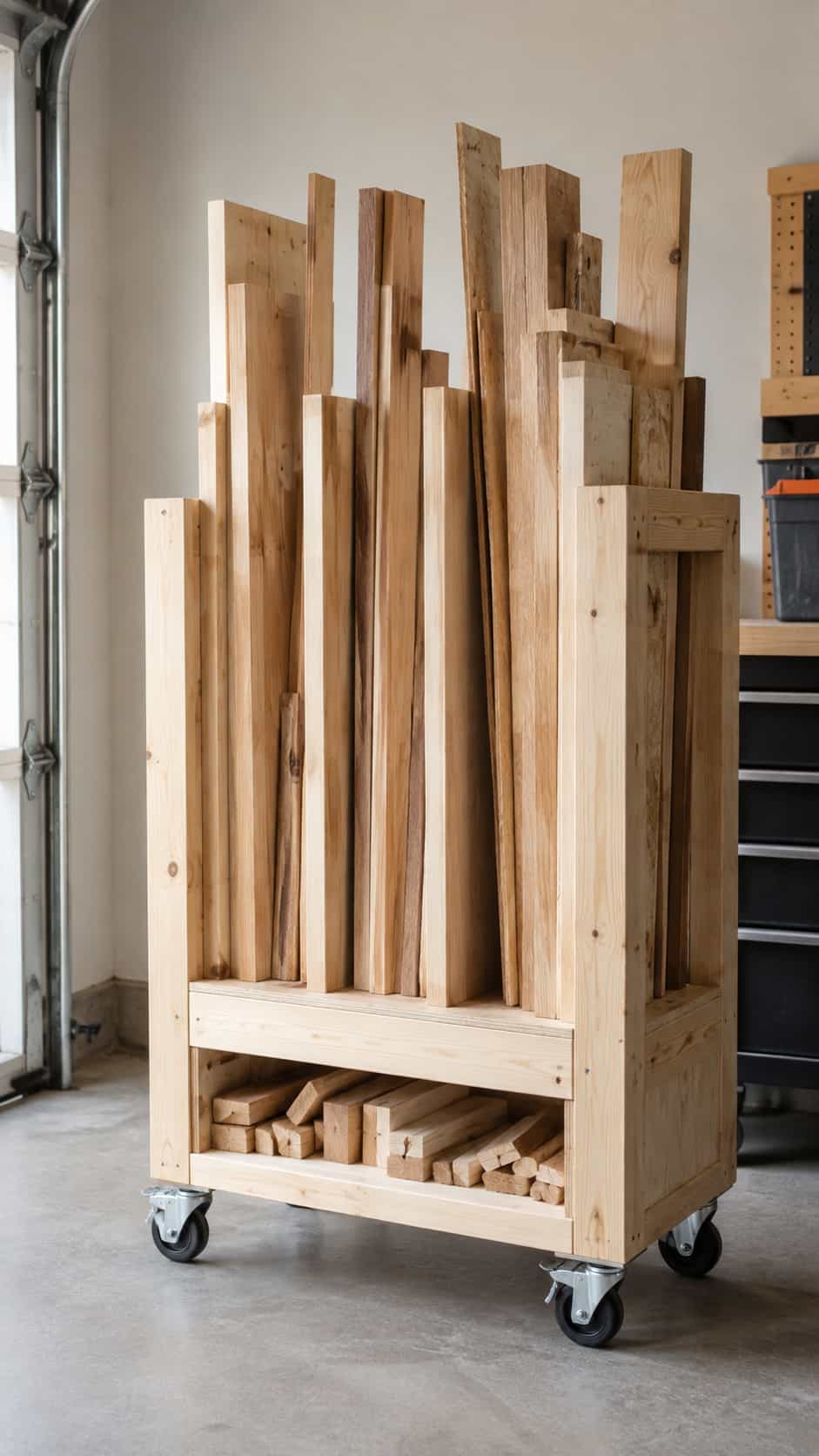
This beginner-friendly Ana White plan uses a straightforward 2×4 frame with several upright bays. Long boards rest horizontally in separated sections, so different lengths and species can be sorted without digging through one deep pile.
The open construction makes inventory easy to see, and the approximately five-foot frame offers substantial capacity without the plywood-heavy complexity of an enclosed cart. It still occupies meaningful floor space, so it works best against a long wall or in a dedicated workshop bay. Add labels to the uprights if you regularly separate hardwood, softwood and construction lumber.
Best for: Long dimensional lumber
Difficulty: Beginner
Important check: A level base and caster capacity
Get the free rolling wood cart plan
3. Moveable Lumber Rack with Conduit Supports
Credit : Jaime Costiglio
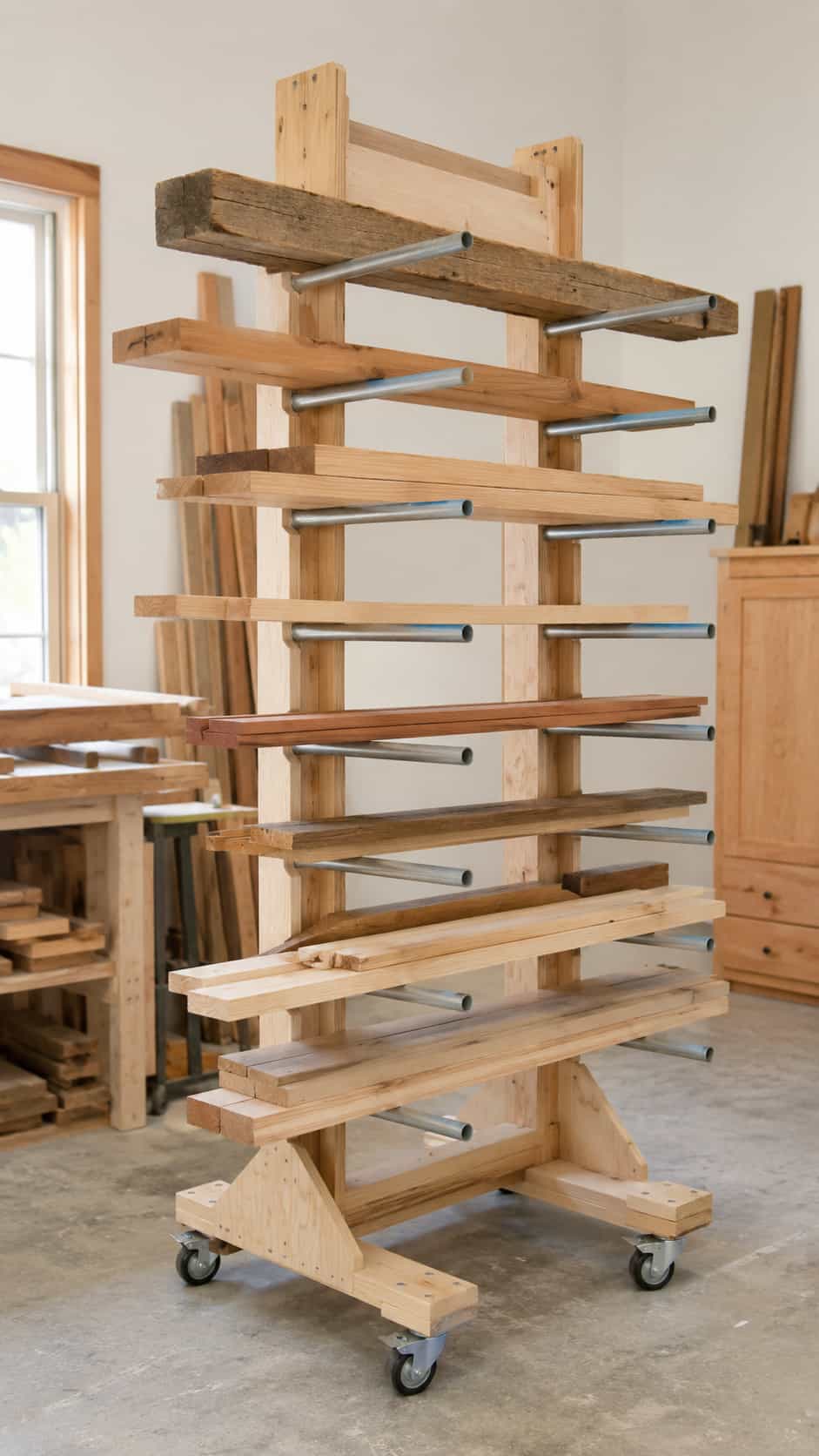
Jaime Costiglio’s movable rack combines a plywood compartment with multiple metal-conduit arms for long boards. It stores full sheets and dimensional lumber in one structure while keeping the material divided by type and size.
The conduit supports create more distinct storage levels than a simple bin, which helps when you keep trim, hardwood and framing boards. Because the tutorial includes angled holes and metal supports, it asks for more careful layout than a basic 2×4 cart. Build the rack for the actual material you own rather than filling every possible level.
Best for: Full sheets plus long boards
Difficulty: Intermediate
Important check: Accurate conduit holes and overall loaded balance
See Jaime Costiglio’s lumber rack plan and tutorial
4. One-Sheet Mobile Plywood and Lumber Cart
Credit : makergray
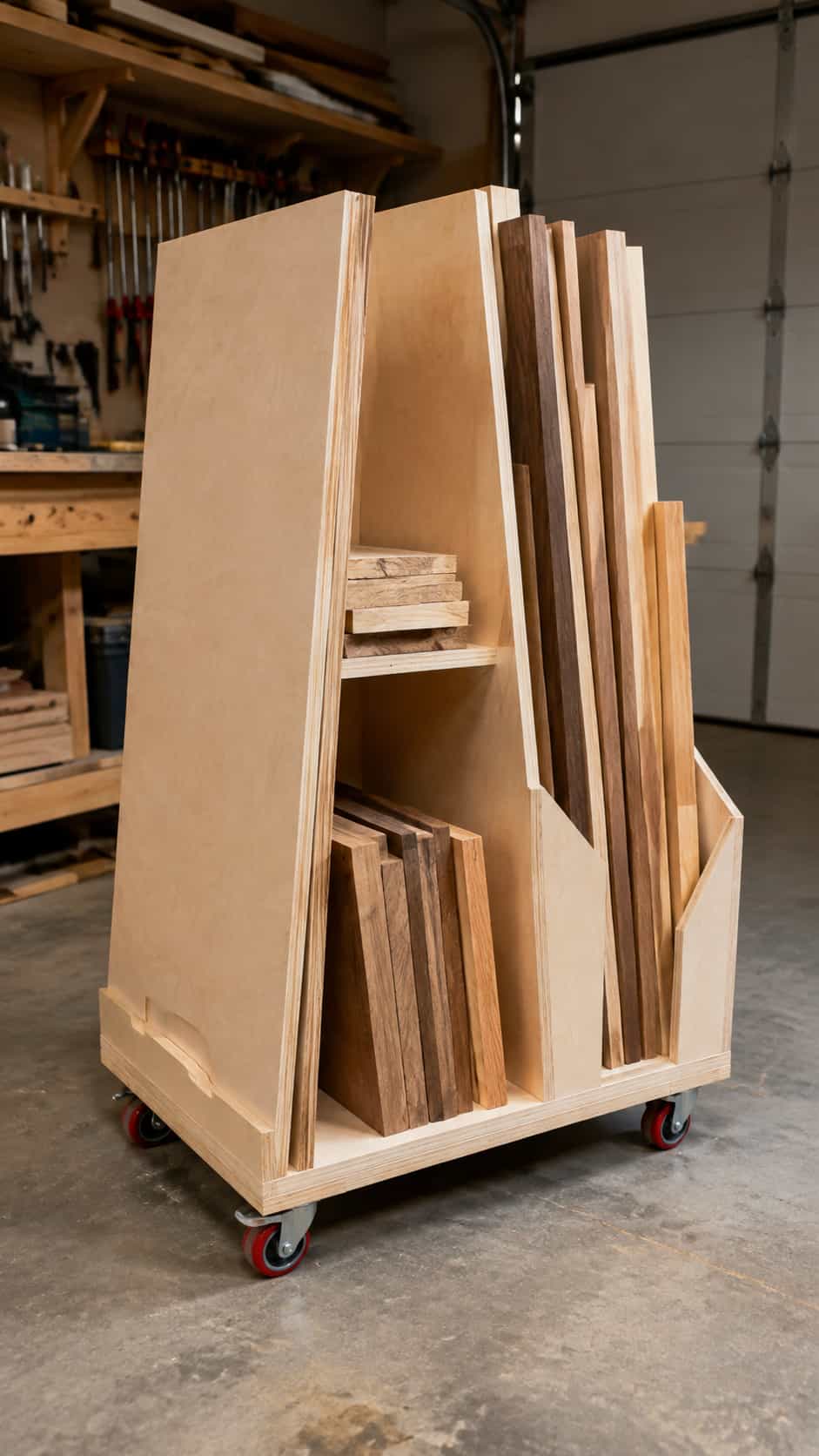
Maker Gray’s compact design uses a 2×4 base and builds most of the organizer from a single sheet of plywood. One side handles sheet goods, while divided spaces organize shorter boards and scraps.
This is a good compromise for a one-car garage: it offers multiple storage zones without becoming a full-wall installation. The vertical dividers also make it easier to see smaller pieces before buying more material. Confirm that your stored sheets cannot tip out when the cart changes direction, and avoid loading one side far more heavily than the other.
Best for: Small shops with mixed materials
Difficulty: Intermediate
Important check: Divider strength and side-to-side balance
View the mobile plywood and lumber cart tutorial
5. Compact Small Lumber Cart on Wheels
Credit : Sawsonskates
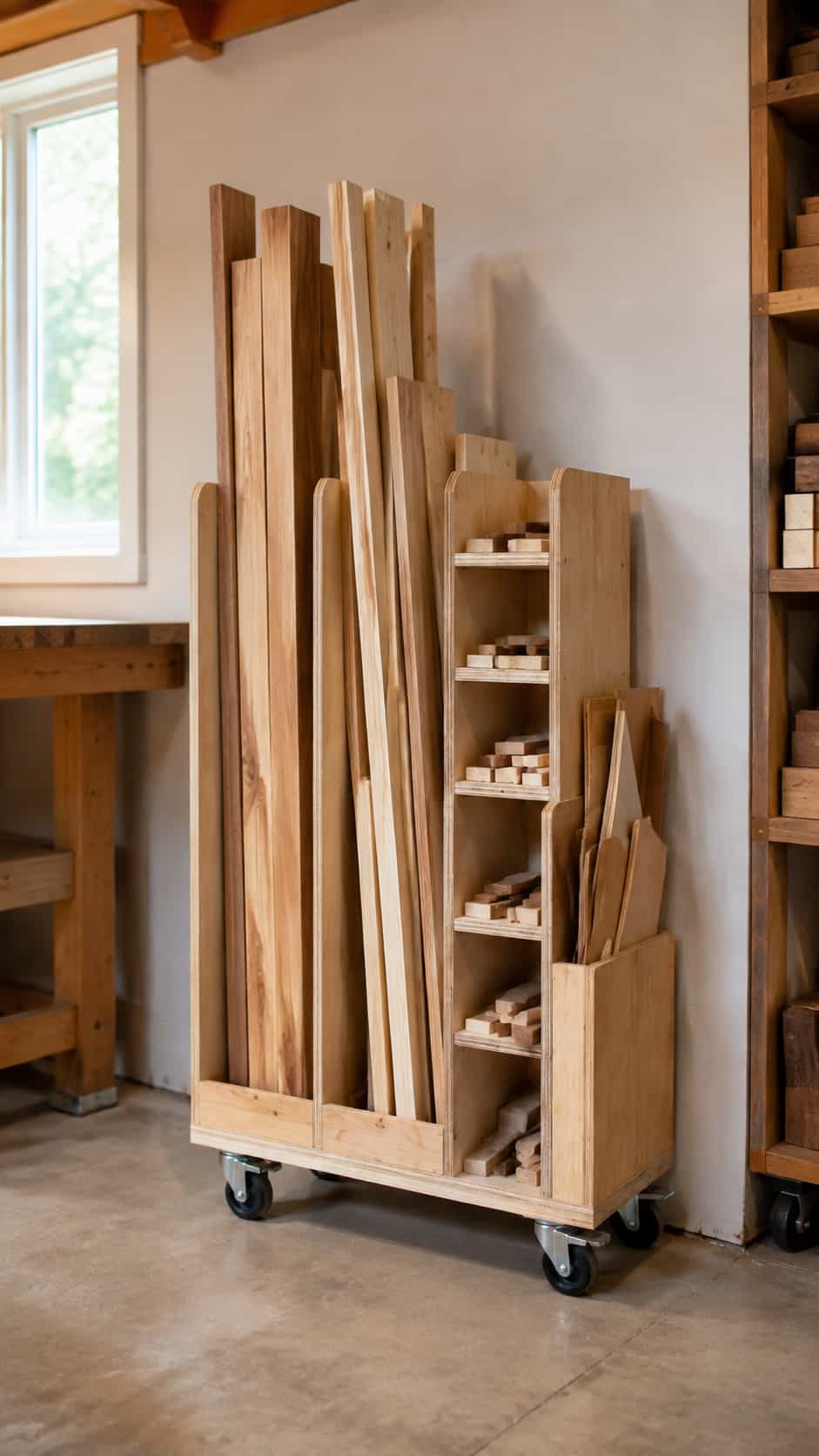
Saws on Skates designed this cart for scraps that are too useful to discard but too awkward for a large horizontal rack. Its divided body sorts offcuts while the casters let the organizer move beside a workbench or saw.
The small footprint is the main advantage. Instead of creating a giant container that encourages hoarding, it puts a practical limit on how much scrap stays in the shop. Sort the contents occasionally and remove warped, damaged or duplicate pieces that no longer justify their space.
Best for: Small workshops and manageable scraps
Difficulty: Beginner
Important check: Maximum useful scrap length
Get the small rolling lumber cart plan
6. Rolling Lumber and Sheet-Goods Cart
Credit : Kregtool
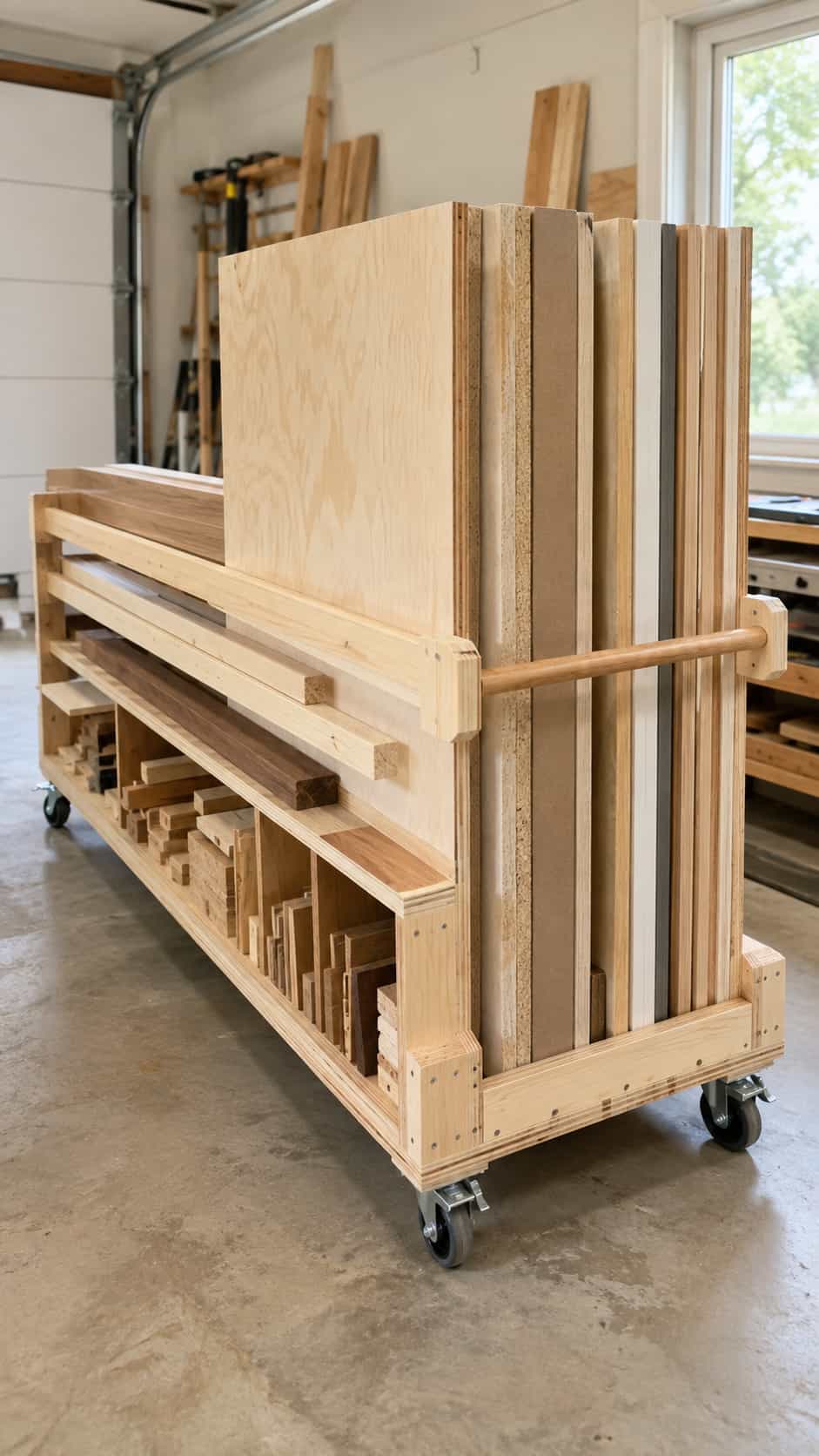
Kreg’s free project plan combines vertical sheet storage, long-board shelving and scrap compartments on a mobile base. The detailed plan format includes a cut list, diagrams and step-by-step assembly guidance.
This design suits a workshop that uses plywood frequently because the sheet-goods bay keeps panels upright and close to the cutting area. Place the cart where a full sheet can be removed without colliding with a car, bench or garage door track. Fully loaded sheet storage gets heavy quickly, so use properly rated casters and keep the floor clear.
Best for: Plywood-heavy workshops
Difficulty: Intermediate
Important check: Sheet-removal path and wheel rating
Open Kreg’s free rolling lumber cart plan
7. Mobile Scrap Wood and Plywood Cart
Credit : Woodshop Diaries
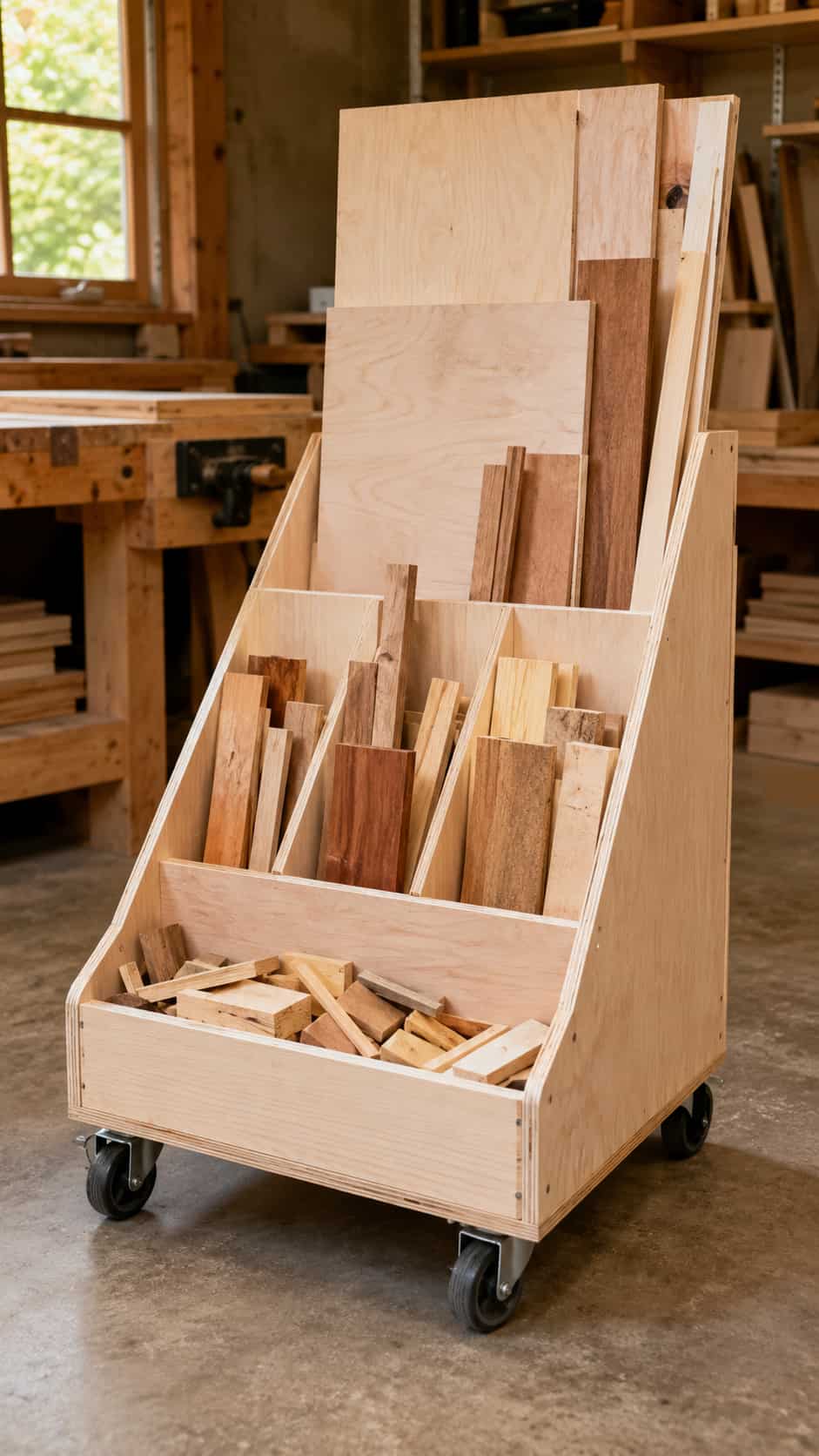
Woodshop Diaries uses a long plywood base, a central divider and separate zones for full sheets and smaller scraps. The open layout keeps the largest material on one side while divided bins prevent offcuts from becoming an unsearchable stack.
This cart is especially useful near a table saw or track-saw cutting area. If sheet goods are part of your normal workflow, pair it with one of these space-saving table saw workbench plans. The main consideration is length: confirm that the cart and its material can turn within your available aisle.
Best for: Full sheets and plywood offcuts
Difficulty: Intermediate
Important check: Turning radius and divider attachment
Follow the mobile scrap wood and plywood cart tutorial
8. Divided Scrap-Wood Organizer Cart
Credit : Housebecominghome
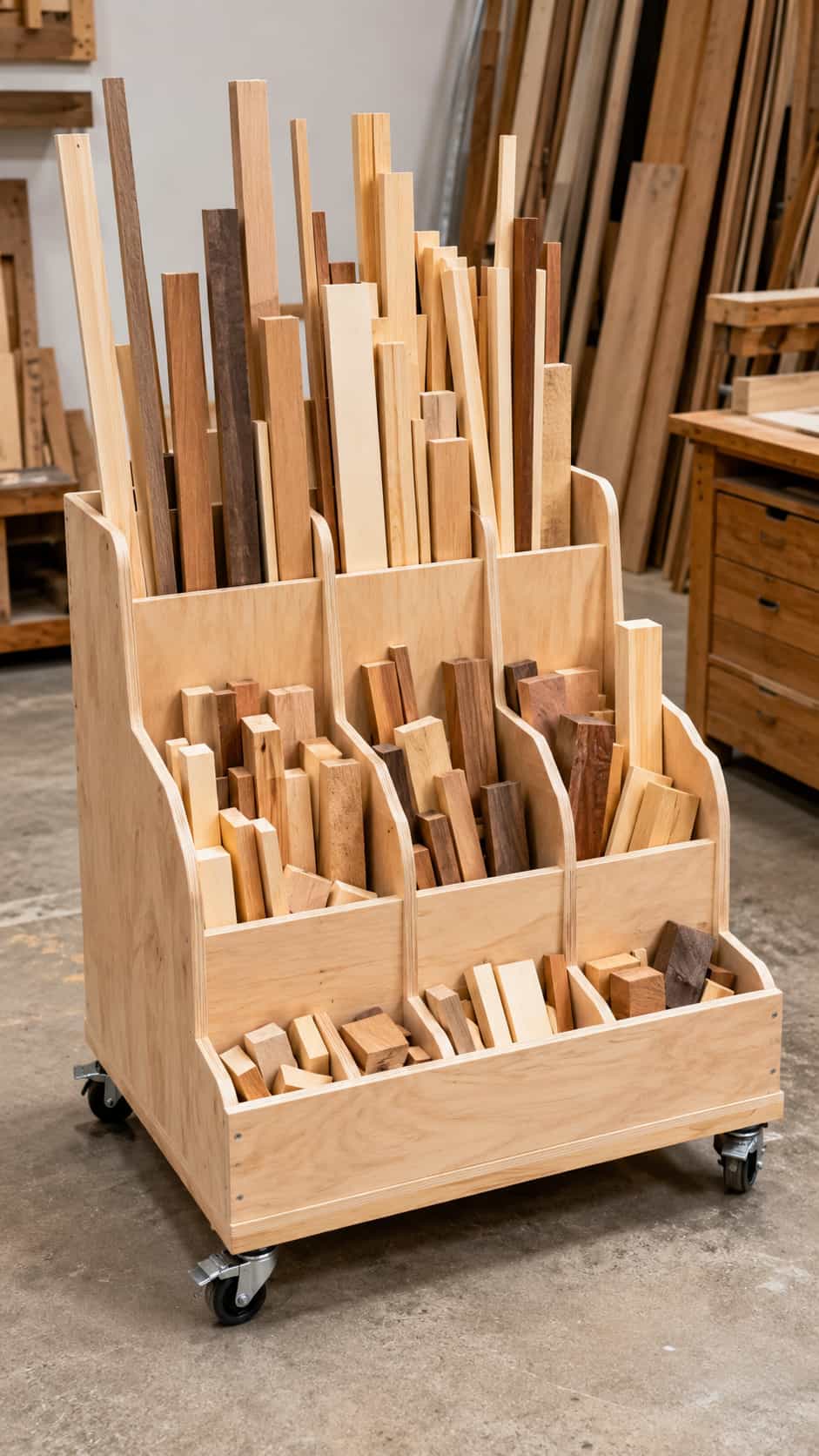
House Becoming Home’s organizer uses multiple compartments to separate small and medium scraps by shape or length. It is a practical choice when most of your leftovers are too short for a wall-mounted lumber rack.
The divided format works because it keeps each category visible. Assign one bay to solid-wood offcuts, another to plywood, and a narrow space to strips or trim. Avoid making the sections so deep that the bottom becomes unreachable. A scrap organizer should encourage reuse, not hide material indefinitely.
Best for: Sorted short and medium offcuts
Difficulty: Beginner to intermediate
Important check: Divider spacing based on your actual scraps
See the free scrap-wood organizer tutorial
9. Cantilever Wall-Mounted Lumber Rack
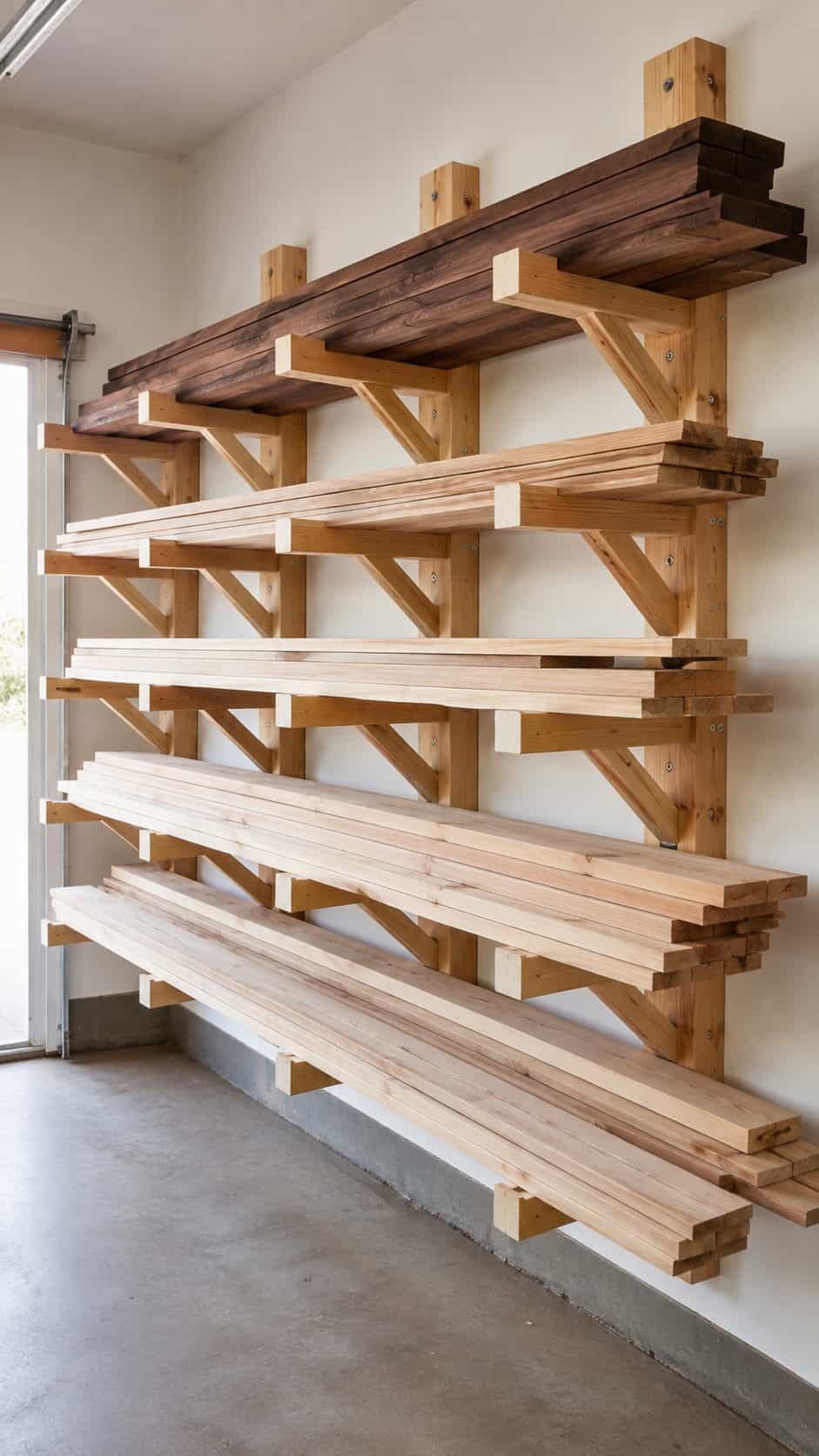
Credit : remodelandolacasa
Remodelando la Casa’s wall system uses vertical supports and plywood-gusseted arms to hold long boards in horizontal layers. It clears the floor completely and makes each stack visible from the aisle.
A cantilever rack is excellent when wall space is available, but installation matters more than appearance. The rack and its load must be tied into suitable framing with appropriate hardware. Keep the densest stock on lower levels and reserve the top for light trim or rarely used pieces that can be reached safely.
Best for: Long lumber and valuable floor space
Difficulty: Intermediate
Important check: Wall framing, fasteners and arm spacing
Read the cantilever lumber rack tutorial
10. Slim Wall-Mounted Lumber Organizer
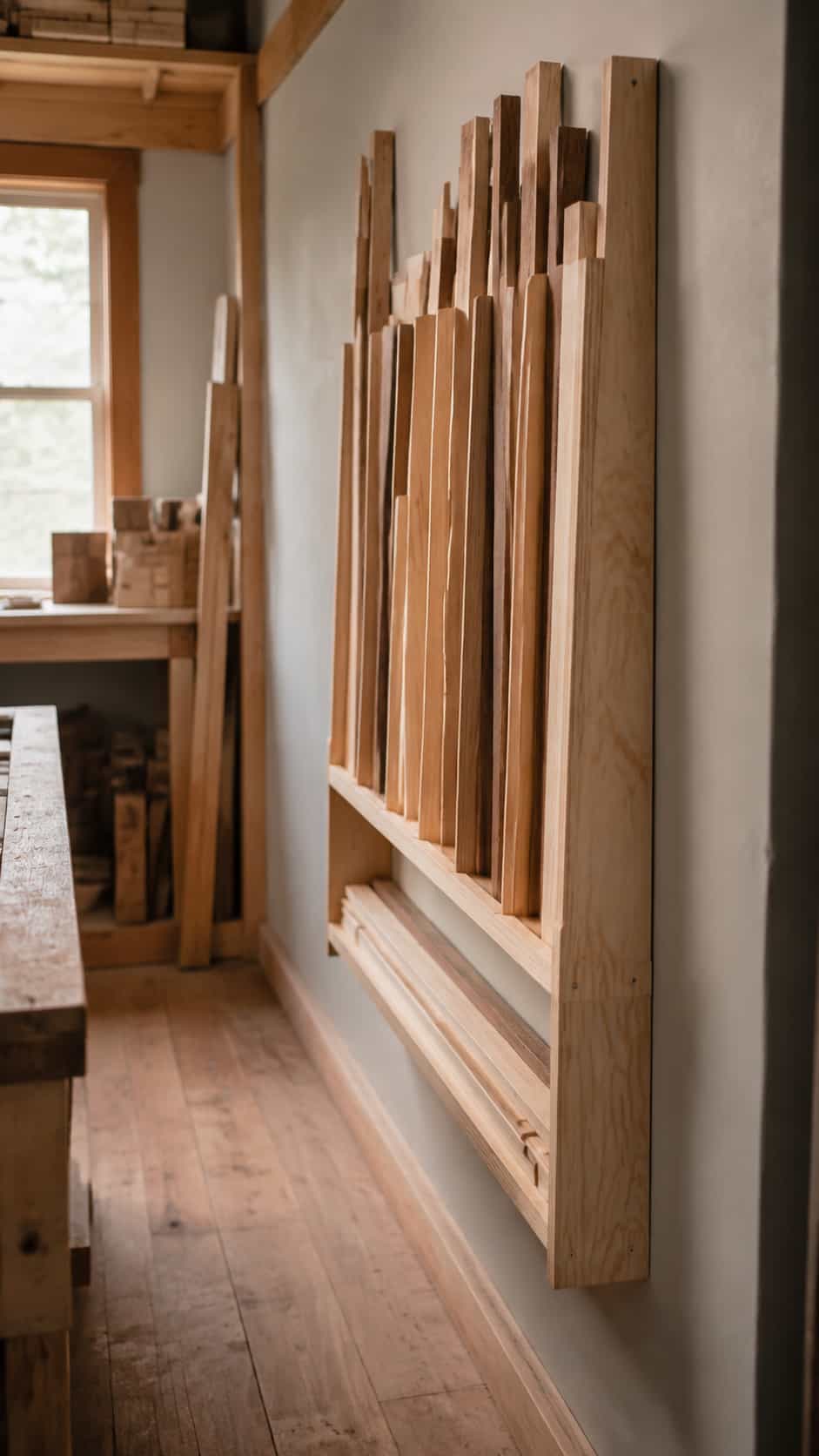
Honeybear Lane’s organizer keeps boards upright against the wall in shallow divided sections. Compared with a projecting horizontal rack, it has a low profile that can fit along the side of a garage.
Vertical storage makes boards easy to compare, but the design needs a stable lower stop and secure upper restraint. Measure your ceiling height and board lengths before choosing this approach; long boards need enough room to lift out without striking lights, tracks or shelving.
Best for: Narrow garage walls
Difficulty: Beginner
Important check: Ceiling clearance and anti-tip restraint
View the wall-mounted lumber organizer plan
11. Rolling Scrap-Wood Storage Cart
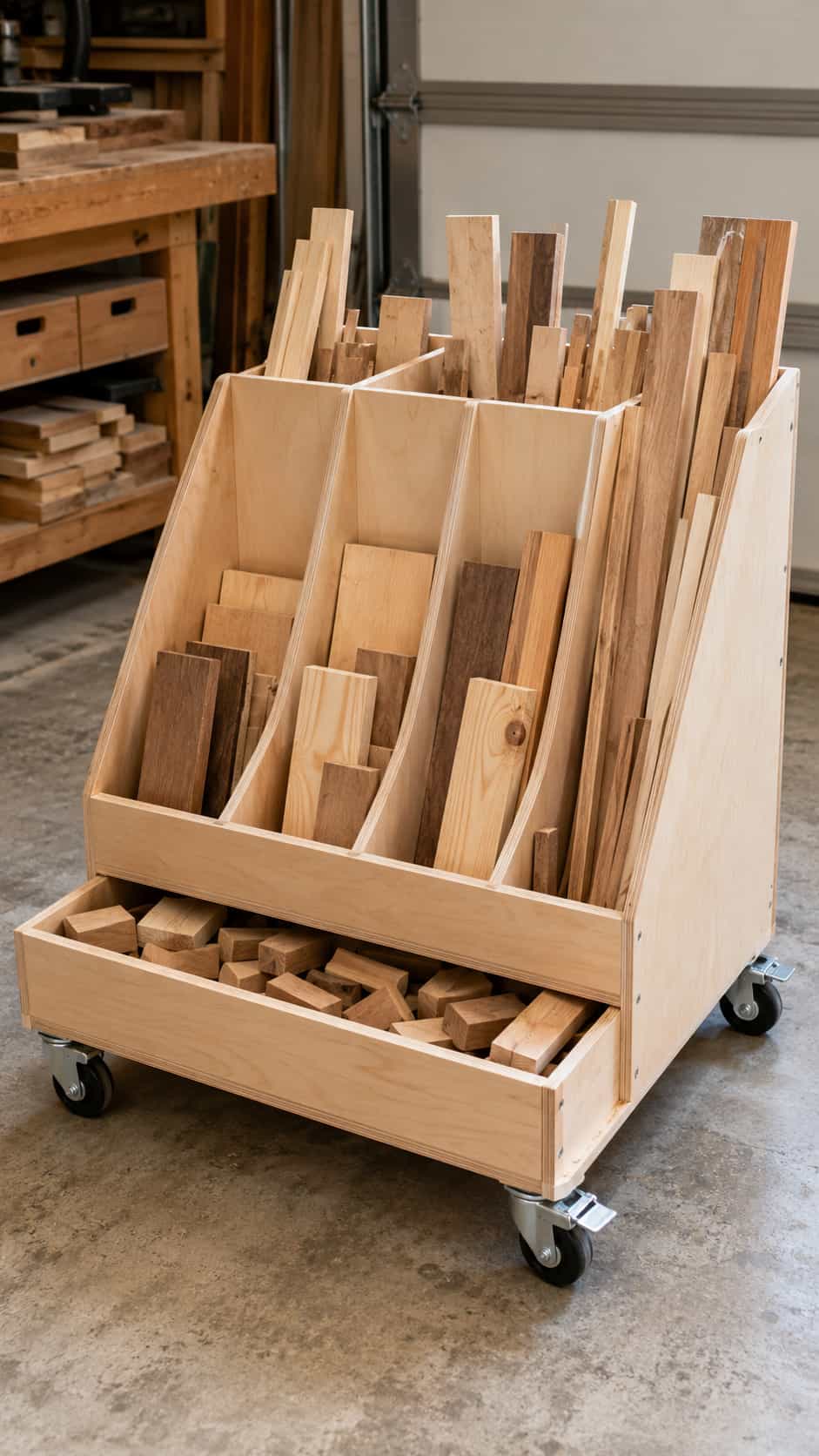
Credit : honeybearlane
Charleston Crafted’s mobile cart creates several vertical compartments for boards and plywood scraps. The simple box-like form is approachable, and the wheels let it tuck beside a cabinet or beneath an open section of wall storage.
This is a useful weekend build when your current “system” is material leaning in a corner. Divide the bays by length or material type and keep one narrow section for strips. Do not let pieces project into the walking path, and remove anything with exposed fasteners or badly damaged edges.
Best for: Mixed scraps in a garage workshop
Difficulty: Beginner
Important check: Stable loading and protruding pieces
Follow the rolling scrap-wood cart tutorial
12. Narrow Rolling Wood Storage Cart
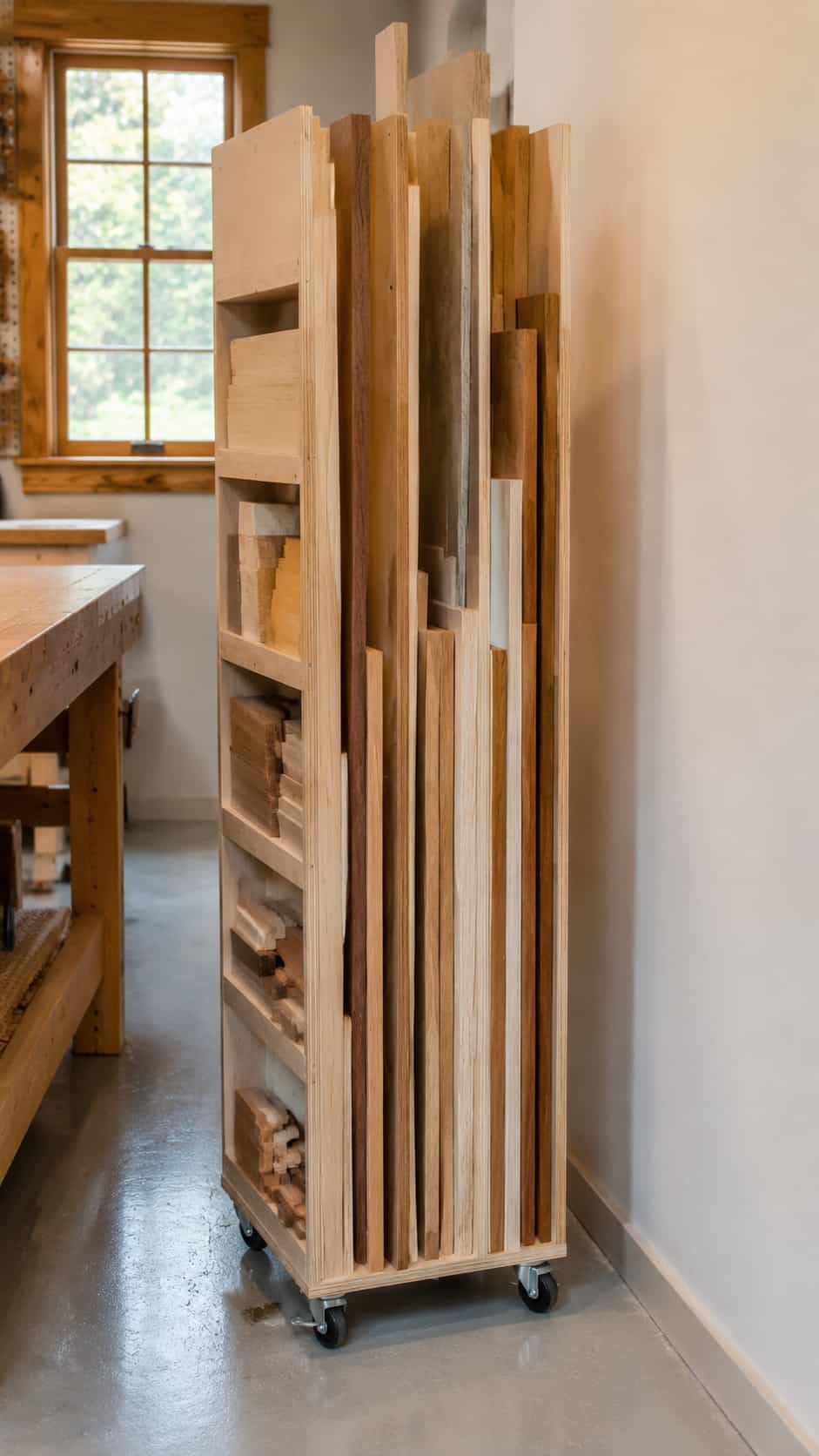
Credit : sawdustgirl
Sawdust Girl’s narrow cart is designed to slide into a slim storage bay and pivot out when material is needed. Internal dividers organize sheets and boards while preserving more open floor space than a wide cart.
This layout is valuable in a tight workshop, but the parking space must remain clear and the cart must roll on a smooth floor. A narrow, heavily loaded organizer can become awkward if the weight sits high, so place full sheets and dense stock low and test stability before filling every compartment.
Best for: Tight spaces and unused gaps
Difficulty: Beginner to intermediate
Important check: Width, center of gravity and floor condition
See the narrow lumber cart plan
13. Adjustable Vertical Lumber Rack
Credit : heatherednest
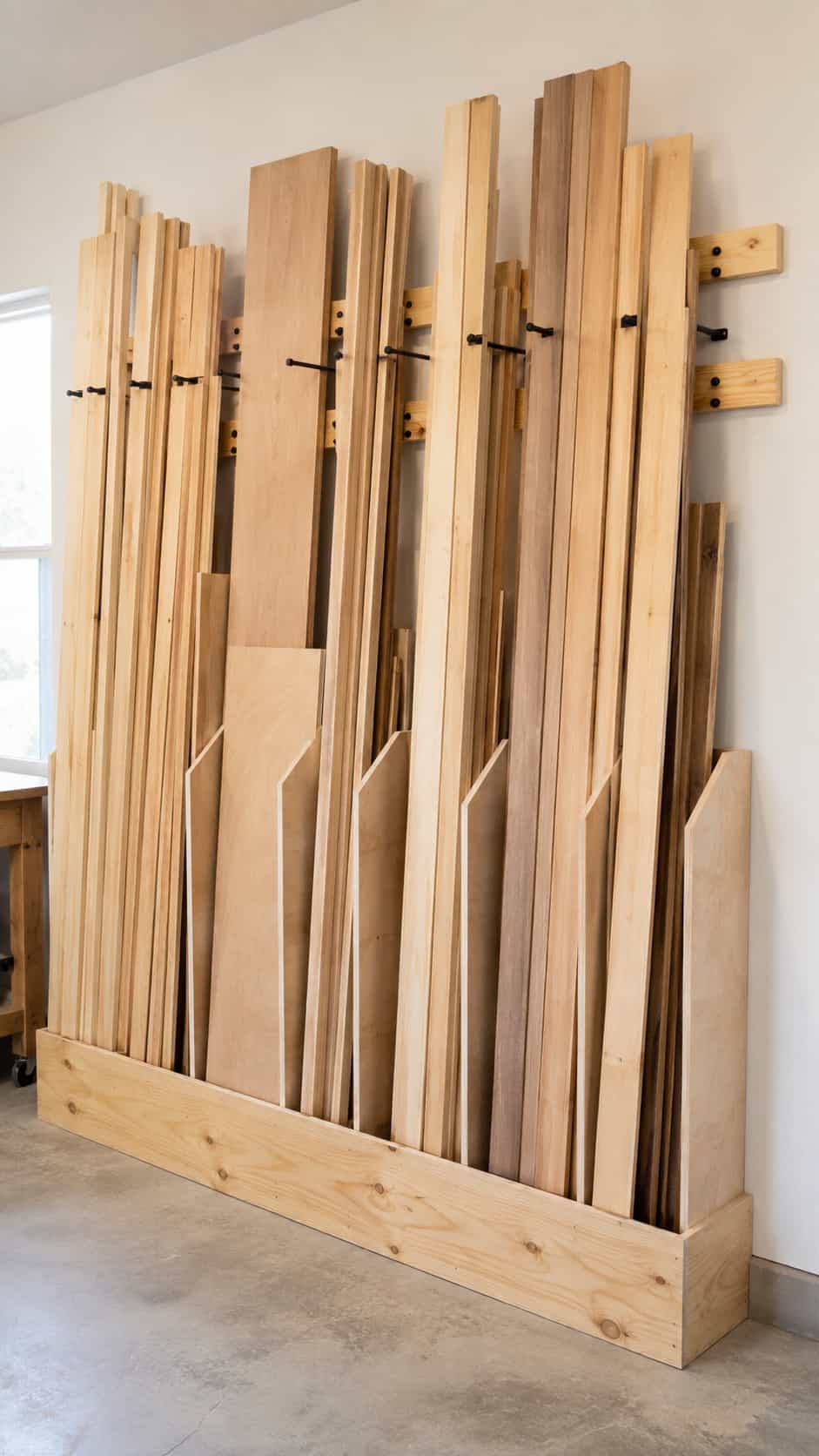
The Heathered Nest uses wall-mounted boards with removable dowels to create adjustable vertical dividers. You can change the spacing as your material collection changes, making it more flexible than permanently fixed bays.
This design is strongest when the base supports the lumber and the dowels mainly keep boards separated and upright. Do not assume small dowels should carry a heavy horizontal load. Confirm the original installation details, secure the wall components properly, and use the configuration as intended.
Best for: Mixed board lengths and changing inventory
Difficulty: Beginner
Important check: Correct wall attachment and dowel purpose
Read the adjustable vertical lumber rack tutorial
14. Large Vertical-and-Horizontal Lumber Cart
Credit : shanty-2-chic
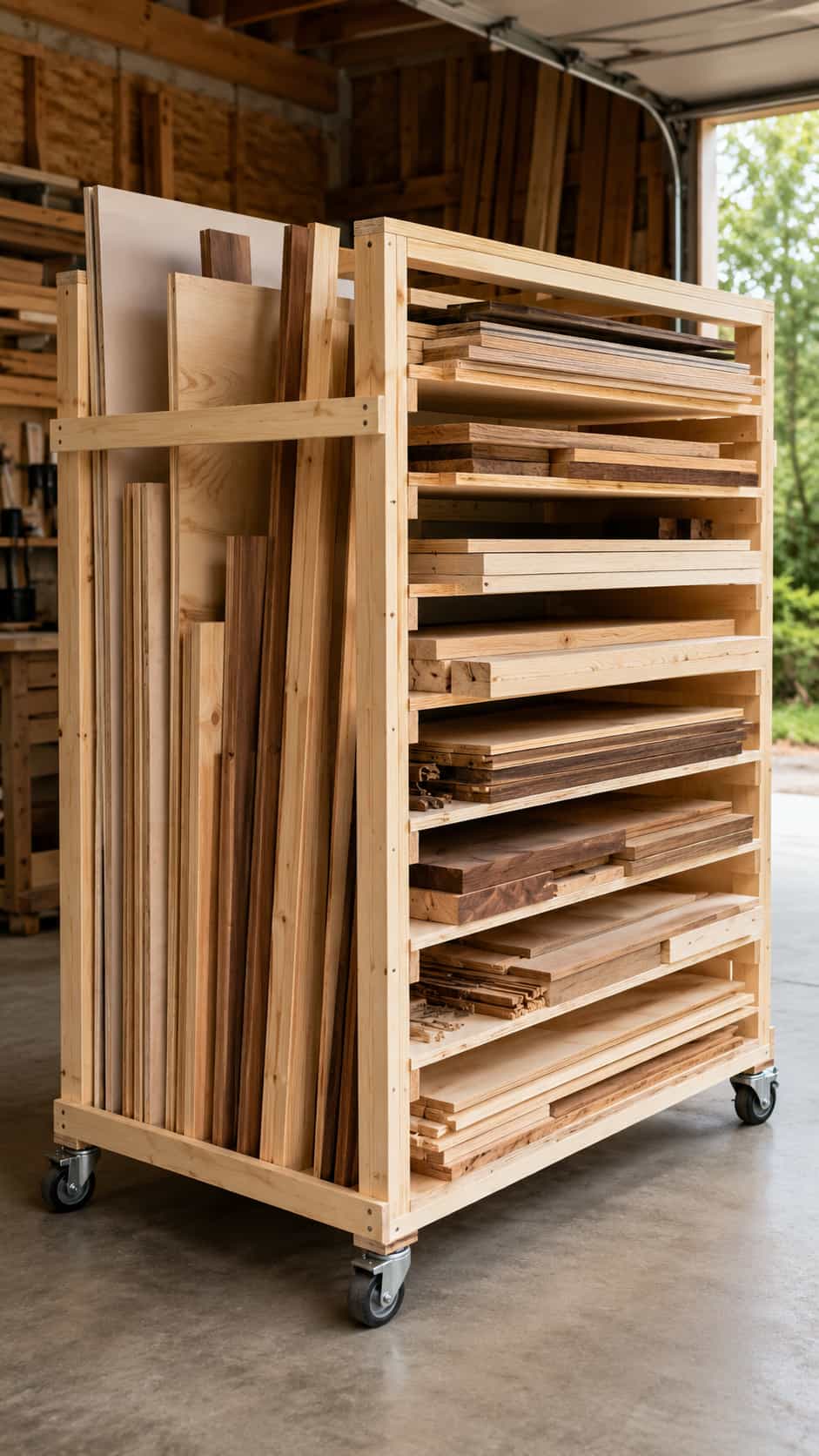
Shanty 2 Chic’s lumber cart combines horizontal shelves for longer stock, upright zones for shorter pieces and a compartment for sheet goods. It is a high-capacity system for a dedicated workshop rather than a tiny temporary corner.
The appeal is consolidation: one cart can replace several disconnected piles. The tradeoff is size and weight. Map the cart’s footprint with painter’s tape before building, include the width of stored boards in your measurement, and confirm that the chosen parking position leaves a comfortable walkway.
Best for: Large mixed collections
Difficulty: Intermediate
Important check: True loaded footprint, not just frame dimensions
View the DIY lumber cart tutorial and plan
15. Easy Wall-Mounted 2×4 Lumber Rack
Credit : Woodshopdiaries
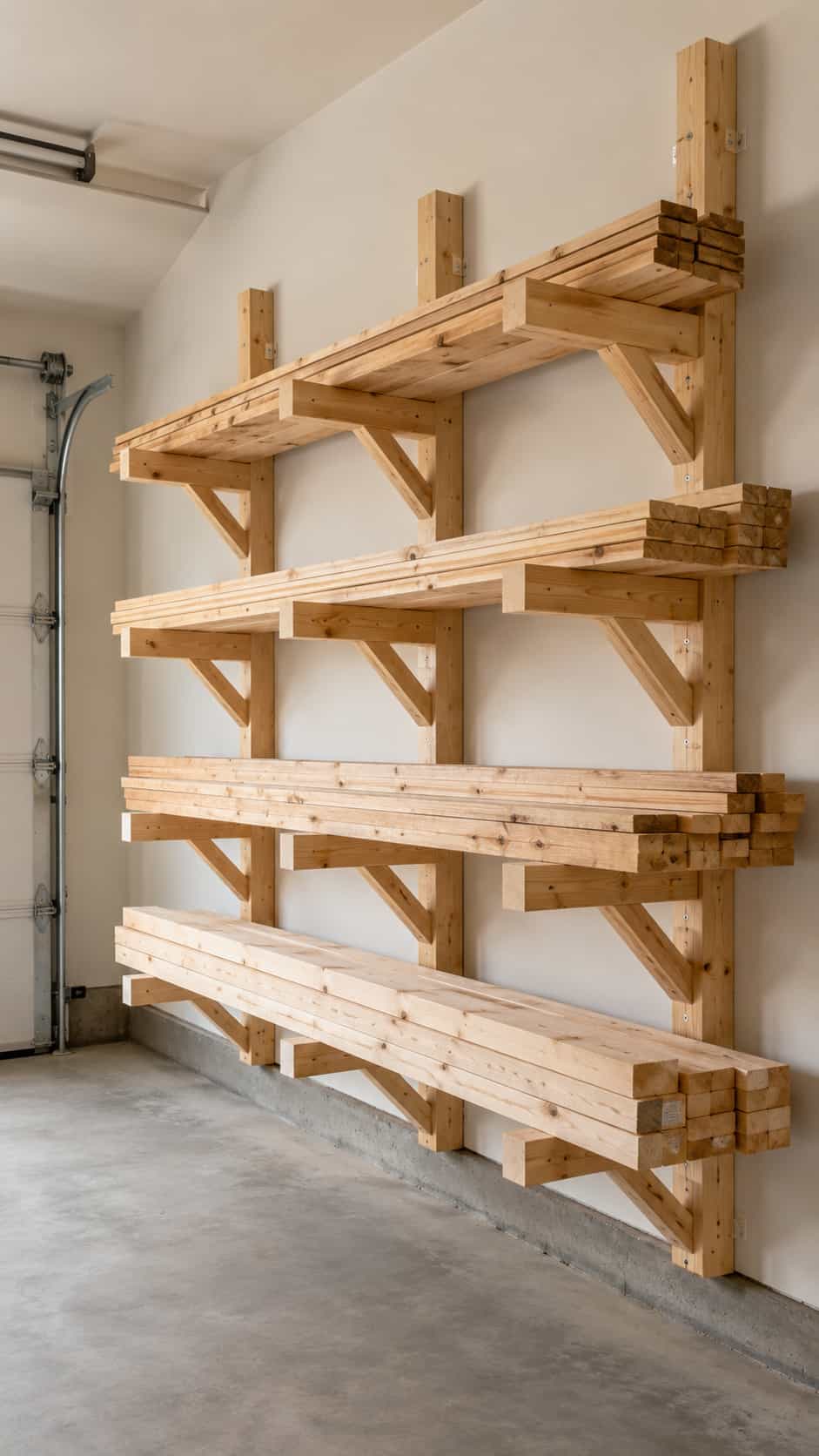
Woodshop Diaries’ simple rack uses basic 2×4 backers and projecting rungs to create horizontal storage levels. It is one of the most approachable wall-mounted options and can be adjusted to the length of your available wall.
Because the system is open, you can see board lengths and pull stock without moving a cart. The important part is mounting the backers into appropriate wall framing and spacing the supports so shorter boards cannot fall between them. If you already use wall storage for tools, coordinate this rack with your French cleat tool holders before drilling anything.
Best for: A simple, low-cost wall solution
Difficulty: Beginner
Important check: Stud locations and support spacing
Follow the easy 2×4 lumber rack tutorial
Want Your Entire Small Workshop to Work as One System?
Disclosure: This section contains an affiliate link. If you purchase through it, we may earn a commission at no additional cost to you.
A lumber rack solves one frustrating problem, but it does not automatically create a good workshop layout. The rack still needs to work with your saws, workbench, tool storage, lighting, dust control and the path material follows from storage to cutting and assembly.
That is where Ultimate Small Shop may be useful. It is a workshop-planning resource for woodworkers who want to arrange a practical garage, basement, shed or other limited space without filling it with unnecessary equipment. The value is not another isolated storage project; it is thinking about the whole room as a connected workflow.
If lumber is your only problem, one of the free plans above may be all you need. If the rack is part of a larger reorganization, reviewing a complete layout system first could prevent you from building storage where a future workbench, machine or assembly aisle needs to go.
Learn more about Ultimate Small Shop
You can also continue planning with our essential woodworking tools guide and DIY plywood project ideas.
How to Choose the Best Lumber Rack for Your Space
Choose a wall rack when floor space matters most
Horizontal wall racks suit long boards and open garage walls. They preserve floor area but demand reliable structural mounting. Space the supports for the shortest boards you plan to store and keep heavy stock at a comfortable height.
Choose a rolling cart when the shop layout changes
A mobile cart can move beside a saw for material breakdown and return to a parking bay afterward. It works best on a smooth, level floor with a clear turning path. Remember that a cart full of plywood may be technically mobile but still very heavy.
Choose vertical storage for narrow rooms
Vertical organizers reduce horizontal wall width and make boards easy to compare. They need enough ceiling clearance and a secure restraint so stock cannot tip into the aisle. Avoid storing boards so tightly that removing one disturbs the entire group.
Choose divided bins for scraps
Short offcuts benefit from shallow, labeled compartments. Separate plywood, solid wood, long strips and project-ready pieces. Set a capacity limit; when a bin is full, use or remove material before adding more.
Frequently Asked Questions
Is it better to store lumber vertically or horizontally?
Both can work. Horizontal racks support long boards along their length and use wall height. Vertical storage makes individual boards easier to see but needs ceiling clearance and secure anti-tip restraint. Follow the chosen plan and avoid unsupported storage that encourages warping or falling material.
Can plywood be stored upright?
Many shop carts store sheet goods close to vertical with a stable base and side support. The sheets should not be able to slide or tip into the aisle. For long-term or valuable material, follow the supplier’s storage guidance and keep panels dry and well supported.
How deep should a lumber rack be?
Depth depends on the stock. Wall arms around 12 to 16 inches suit many boards, while sheet-goods carts need a wider stable base. Use the dimensions and load assumptions in the original plan rather than copying a measurement from an unrelated rack.
What should I do with tiny wood scraps?
Keep only pieces with a realistic use. Sort small blocks, thin strips and jig material into labeled bins. Discard unsafe, contaminated, cracked or fastener-filled scraps through an appropriate local method instead of letting them accumulate.
Should a lumber cart have locking casters?
Locking casters help keep the cart stationary while material is loaded or removed. Their total rating should exceed the combined weight of the rack and its maximum intended load, with a generous safety margin.
Final Thoughts
The best DIY lumber storage rack is not automatically the biggest. It is the design that fits your material, your available space and the way you work. A simple 2×4 wall rack may outperform a complicated cart in a narrow garage, while a mobile plywood station can transform a shop that processes full sheets every week.
Start by sorting the wood and measuring the true storage area. Then choose one original plan, follow its structural details, keep heavy material low, and leave a clear route for loading and removal. Once every board has a visible home, the workshop becomes easier to navigate—and the lumber you already paid for is far more likely to become your next project.