
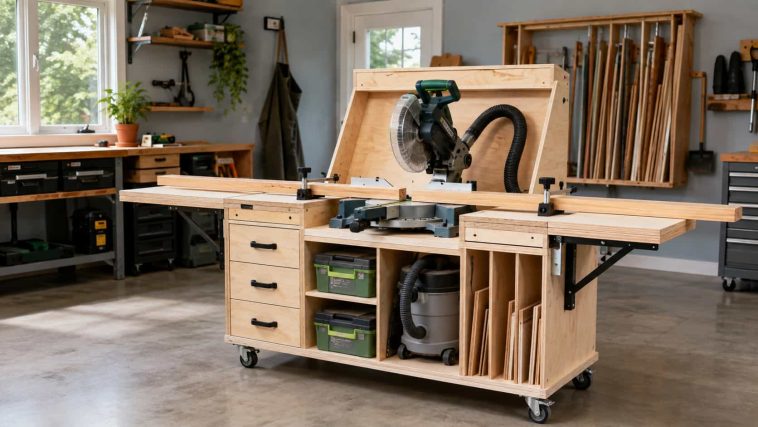
A miter saw is easy to place on a temporary bench and surprisingly difficult to live with there. The saw takes over the work surface, long boards hang in midair, offcuts collect behind the fence, and the nearest flat spot becomes permanent storage for blades, clamps and tape measures.
A dedicated station fixes those problems, but the right design depends on the shop. Someone working in half of a one-car garage needs a cart that folds or rolls away. A woodworker with a long open wall may be better served by a fixed cabinet system. A third person may need one station to store several benchtop tools without sacrificing the only assembly area in the room.
The 15 miter saw station plans below cover those different situations. You will find beginner-friendly plywood carts, folding-wing stands, mobile stations with drawers, modular cabinet systems, and long benches built around storage and dust control. Every idea links to a free plan or a detailed free tutorial from the original builder, so you can review its measurements, materials and full construction guidance before choosing it.
If the rest of the garage still feels crowded, start with these DIY garage shelves and this guide to setting up a small woodworking shop. A saw station works best when lumber, tools and walking space have already been given sensible locations.
What to Measure Before Choosing a Miter Saw Station
Do not choose a plan from the finished photo alone. First measure the saw and the room around it.
- Saw-table height: The station’s left and right support surfaces need to align with the working table of your specific saw, not the base of its feet.
- Front-to-back depth: Sliding saws can require considerable clearance behind the fence. Check the full range specified by the manufacturer.
- Maximum open width: Folding wings save storage space, but they still need room when raised. Include doorways, parked vehicles and adjacent machines in your measurement.
- Folded footprint: In a shared garage, the closed size may matter more than the open size.
- Board path: Imagine a long board extending in both directions. It should not meet a wall, shelving unit, garage-door track or busy walkway.
- Electrical and dust-control access: Plan safe, unobstructed locations for cords, hoses and collection equipment without creating trip hazards.
Also decide whether the station will remain in one position or move regularly. A mobile design needs properly rated locking casters and a base that stays rigid. A fixed station can offer more storage, but it should fit the long-term workshop layout. Compare these plans with the storage and mobility features in our table saw workbench plans before committing an entire wall.
Quick Comparison of the 15 Free Plans
| # | Miter saw station | Best for | Difficulty | Space-saving feature |
|---|---|---|---|---|
| 1 | One-sheet plywood cart | Beginners and very small garages | Beginner | Folding wings and narrow base |
| 2 | Folding-arm mobile stand | Shops that need fast setup and storage | Intermediate | Articulated support arms |
| 3 | Budget 2×4 folding stand | Affordable weekend build | Beginner–intermediate | Collapsible bracket wings |
| 4 | Premium mobile station | Accuracy, mobility and dust control | Intermediate–advanced | Wings, fence, stop and vacuum bay |
| 5 | Rolling stand with drawers | Compact storage in a small footprint | Intermediate | Fold-down extensions |
| 6 | Long mobile storage station | One movable all-in-one workstation | Intermediate | Full cabinet on casters |
| 7 | Fixed shed-shop station | A permanent, simple setup | Beginner–intermediate | Open base and straight worktops |
| 8 | Modular cabinet station | Storage that can grow in phases | Intermediate | Separate cabinet modules |
| 9 | Multi-tool workshop hub | Several benchtop tools in one area | Advanced | Roll-out companion carts |
| 10 | Simple open-frame stand | Fast, uncomplicated construction | Beginner | Open frame and shelf |
| 11 | Rolling stand with supports | Long boards in a narrow garage | Intermediate | Compact rolling core |
| 12 | Storage-heavy miter table | Tools, accessories and repeat cuts | Advanced | Cabinets, drawers and fence |
| 13 | Workshop cabinet wall | Maximum organized storage | Intermediate–advanced | Base and upper cabinets |
| 14 | Full-length drawer station | Permanent production-style setup | Advanced | Many shallow drawers |
| 15 | Roll-away workbench system | Flexible multi-use floor space | Advanced | Nested mobile carts |
Important Workshop Safety Note
These projects create stations for a power tool; they are not substitutes for the instructions supplied with the tool. Use the original plan as written, confirm that its dimensions and fasteners suit your saw, and follow the saw, blade, dust collector, caster and hardware manufacturers’ requirements. Keep guards and safety features in place, disconnect power before adjusting or securing equipment, and use suitable eye, hearing and respiratory protection.
Power-tool work should be performed by a capable adult. Inexperienced or underage builders should work only with direct supervision from a qualified adult. If electrical work, wall structure, dust control or load capacity is unclear, use an appropriate professional. A stable station, clear floor and properly supported stock are essential; do not improvise around a machine that can move, tip or interfere with a guard.
15 DIY Miter Saw Station Plans for Small Workshops
1. One-Sheet Plywood Miter Saw Cart with Folding Wings
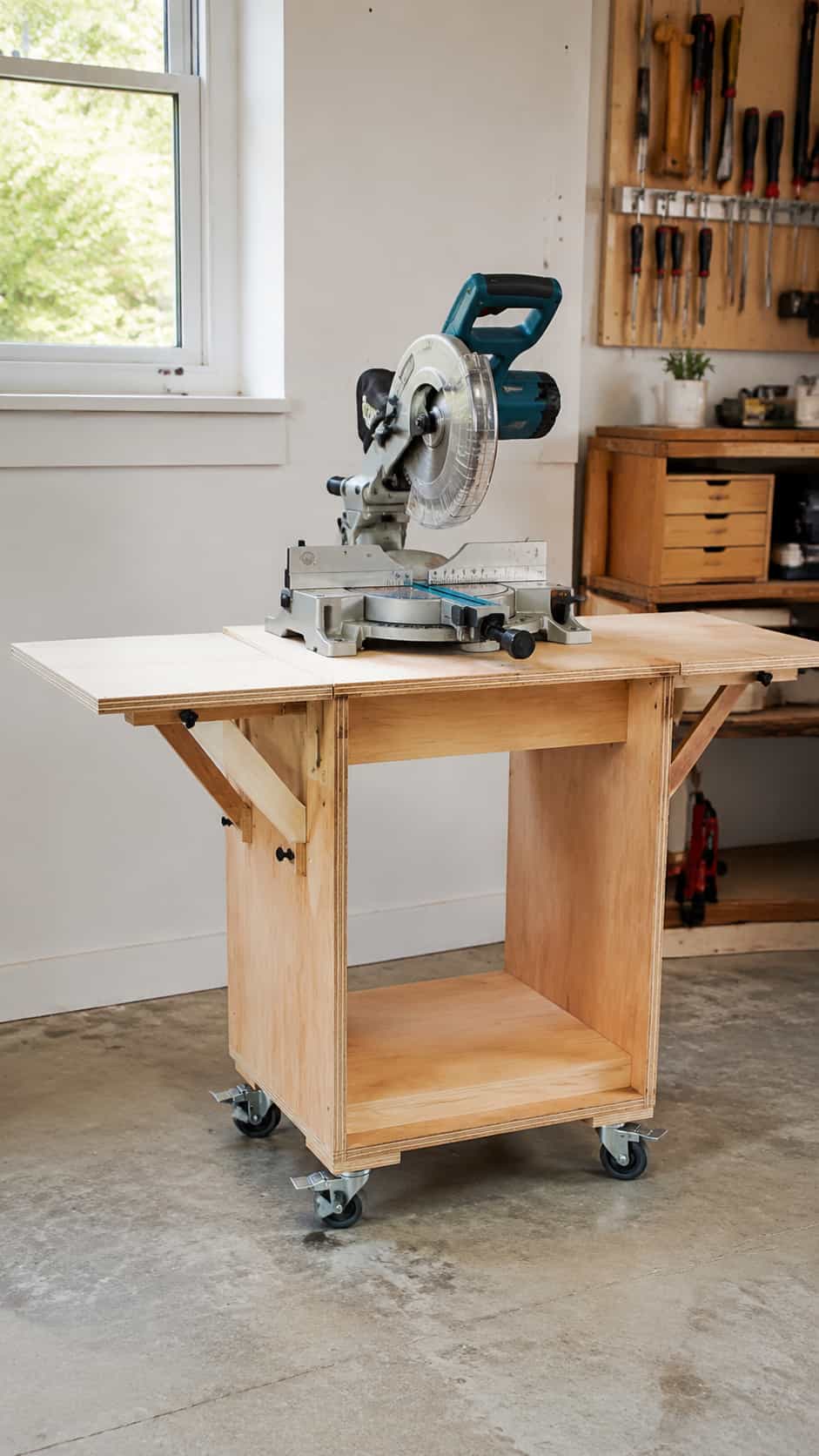
Ana White’s compact cart is a strong place to start when floor space and material cost both matter. The main body is made from a single sheet of plywood, creating a narrow central cabinet with an open lower shelf. Two side wings fold down against the cart when they are not supporting longer boards.
Best for: A first station in a garage that also stores a car
Difficulty: Beginner
Space check: Measure the cart with both wings folded and fully open
Customization to consider: Add locking casters only if their height and load rating are included in your revised measurements
View Ana White’s free miter saw cart plan
2. Folding-Arm Mobile Miter Saw Stand
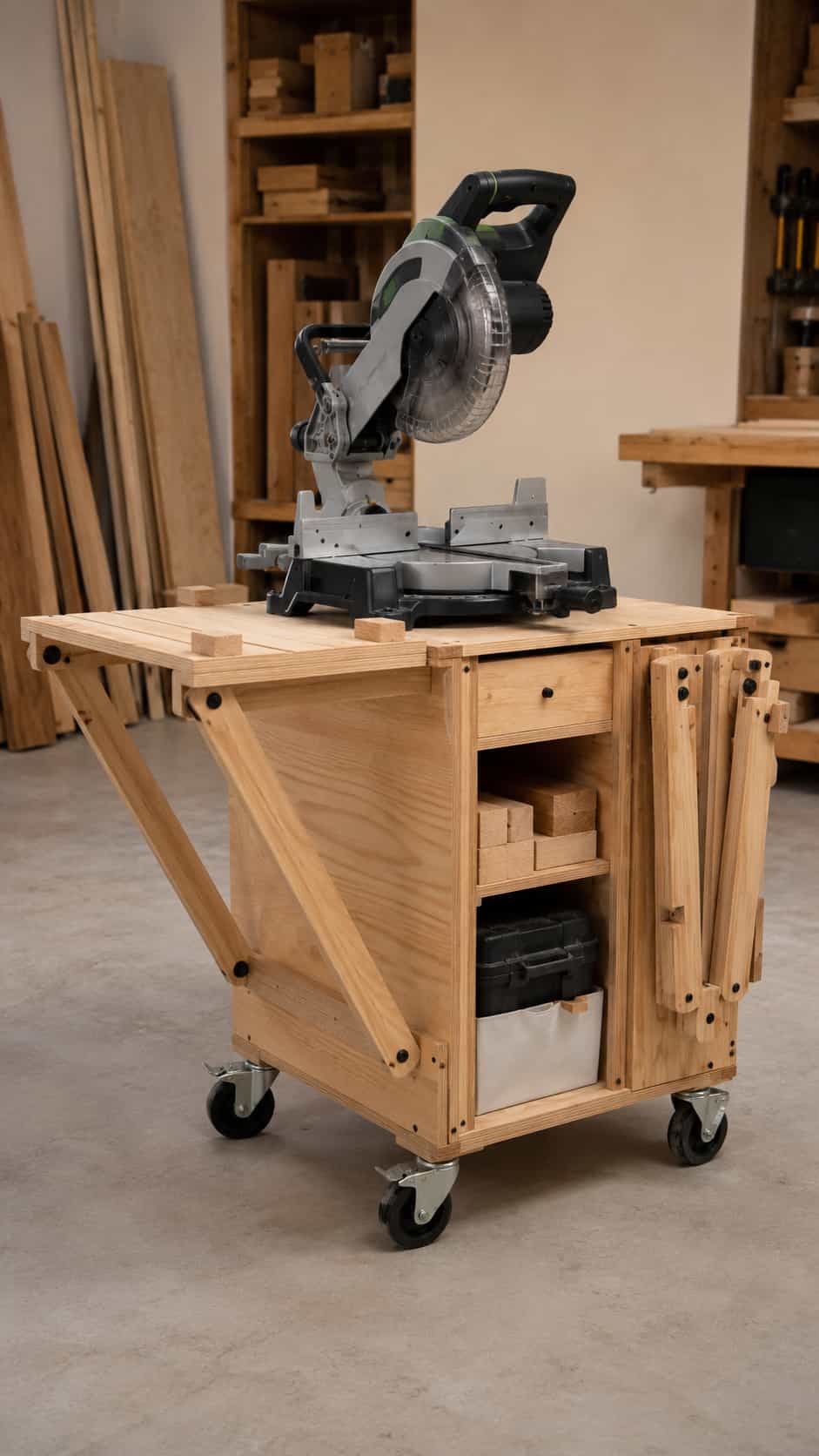
This Saws on Skates design approaches long-board support differently. Instead of two simple rectangular leaves, it uses folding wooden arms that open to create a broad work zone and collapse against the mobile base for storage. Four casters make the core easy to reposition in a small garage or shed.
Best for: Maximum open support from a compact stored footprint
Difficulty: Intermediate
Space check: Confirm the arm sweep does not meet a wall or nearby tool
Customization to consider: Reserve a safe, reachable location for the stop and commonly used accessories
See the free folding mobile miter saw stand plan from Saws on Skates
3. Budget 2×4 Mobile Stand with Collapsible Wings
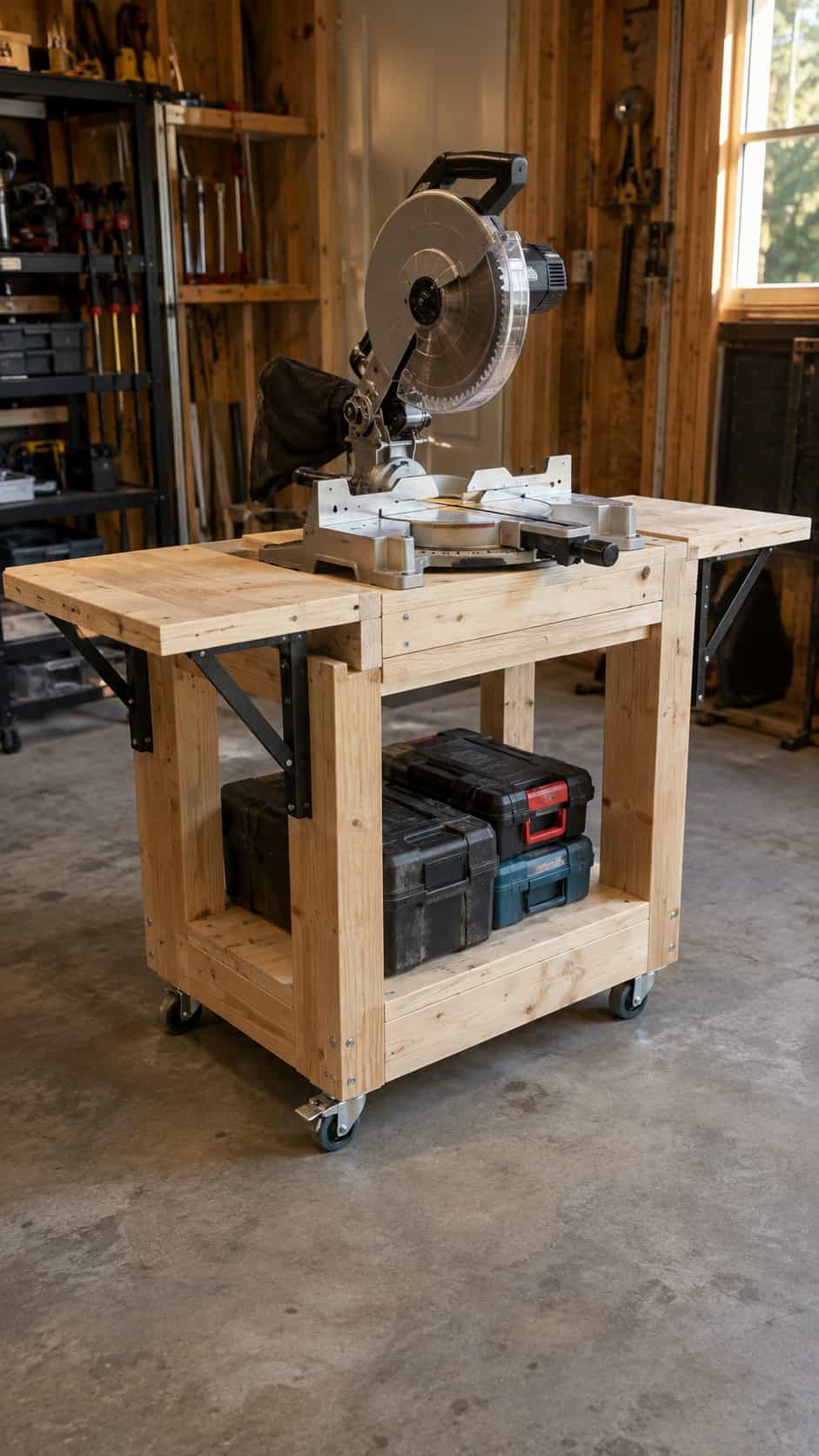
Tylynn M’s stand uses familiar construction lumber and a straightforward framed base. A central section supports the saw, the bottom shelf stores larger equipment, and folding brackets allow the left and right tables to collapse. It has the useful proportions of a serious workstation without the time commitment of building cabinet doors and fitted drawers.
Best for: A sturdy, budget-conscious weekend project
Difficulty: Beginner to intermediate
Space check: Allow room for the wing brackets and their supports
Customization to consider: Divide the lower shelf into zones for the vacuum, cases and offcuts
Read the free on-page plan for Tylynn M’s mobile miter saw stand
4. Premium Mobile Station with Fence, Stop and Dust Collection
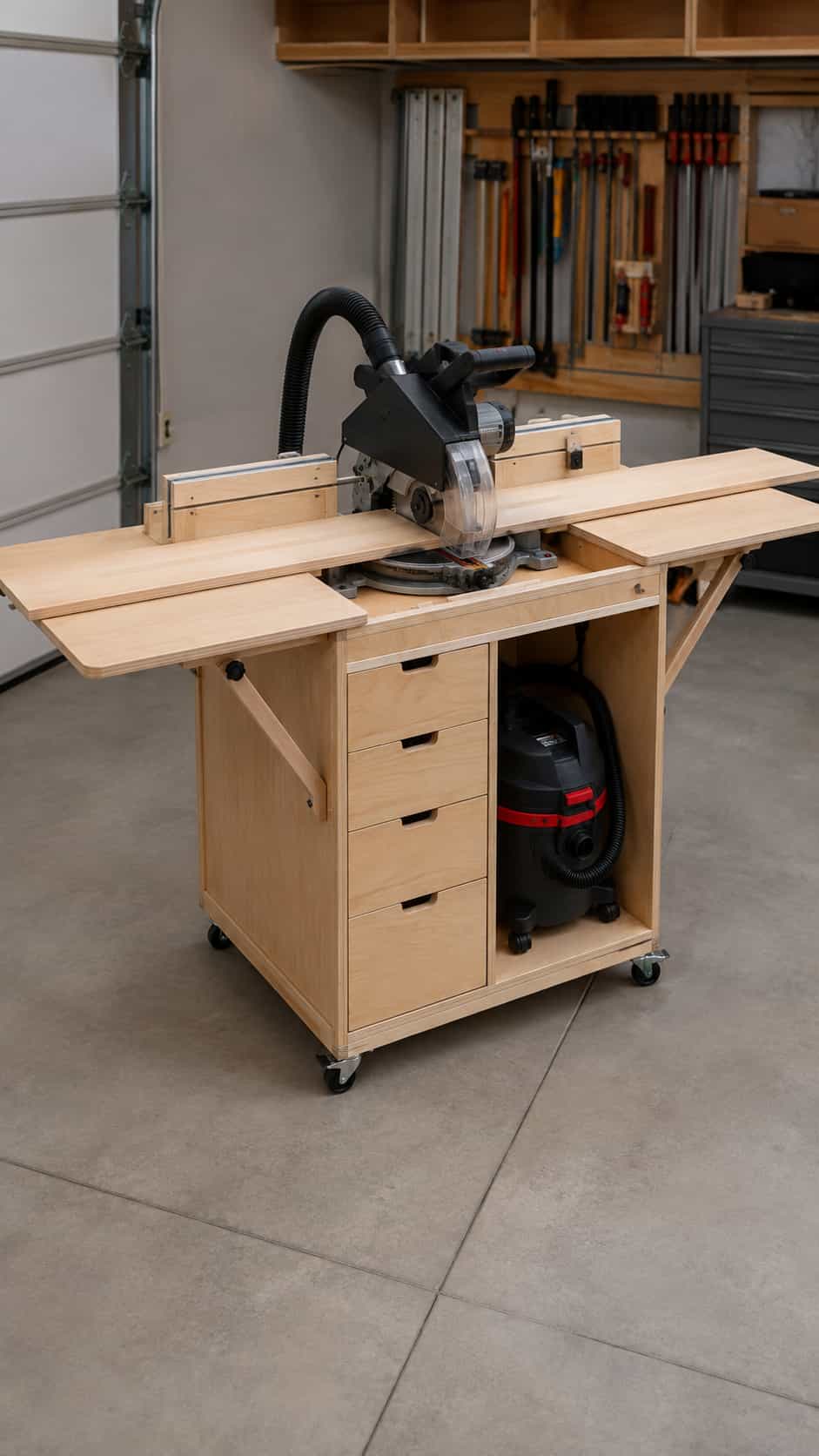
Fix This Build That’s mobile station is for the woodworker who wants a compact cart to behave like a more permanent shop fixture. The core design can include foldable support wings, a fence and stop system, storage, a dust-collection area and large casters. The free build article explains the station, while optional upgrades let the reader decide how elaborate it should become.
Best for: A small shop that wants mobility without giving up workstation features
Difficulty: Intermediate to advanced, depending on upgrades
Space check: Include the dust hood, hose and fence in the full depth
Customization to consider: Prioritize storage for the accessories actually used with your saw
Explore the free Fix This Build That mobile miter saw station tutorial
5. Narrow Rolling Stand with Drawers and Fold-Down Extensions
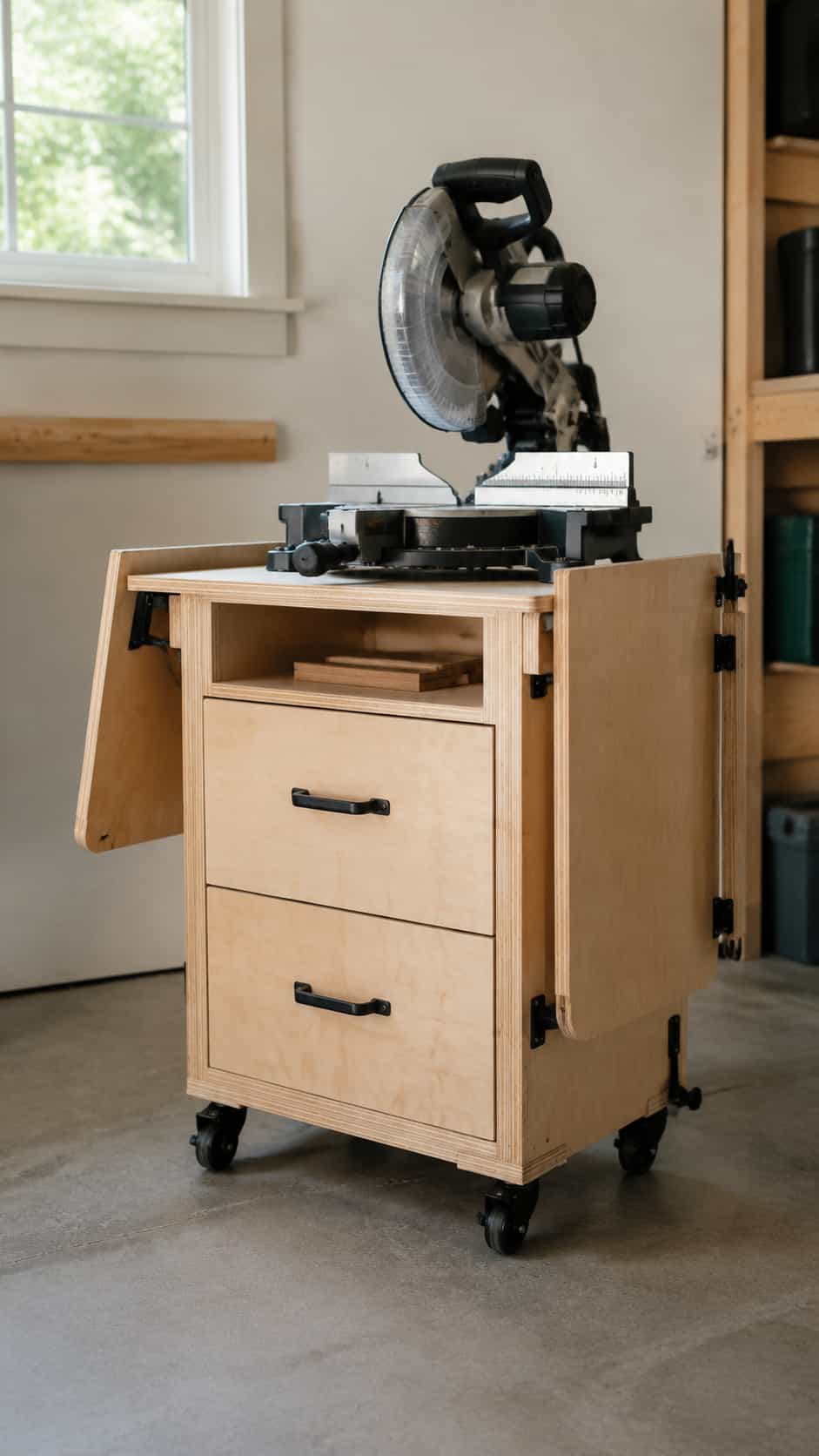
The earlier Woodshop Diaries mobile stand combines a small central cabinet, storage drawers and folding extension wings. It is especially helpful when a miter saw is used often but the shop cannot spare a permanently long counter. With the wings lowered, the unit becomes a manageable rolling cabinet; opened, it provides support much farther from the blade area.
Best for: A compact rolling station with enclosed accessory storage
Difficulty: Intermediate
Space check: Verify folded wings do not block caster locks or handles
Customization to consider: Use shallow organizers inside the drawers so small parts do not become a pile
View the free Woodshop Diaries miter saw stand tutorial
6. Long Mobile Miter Saw Station Packed with Storage
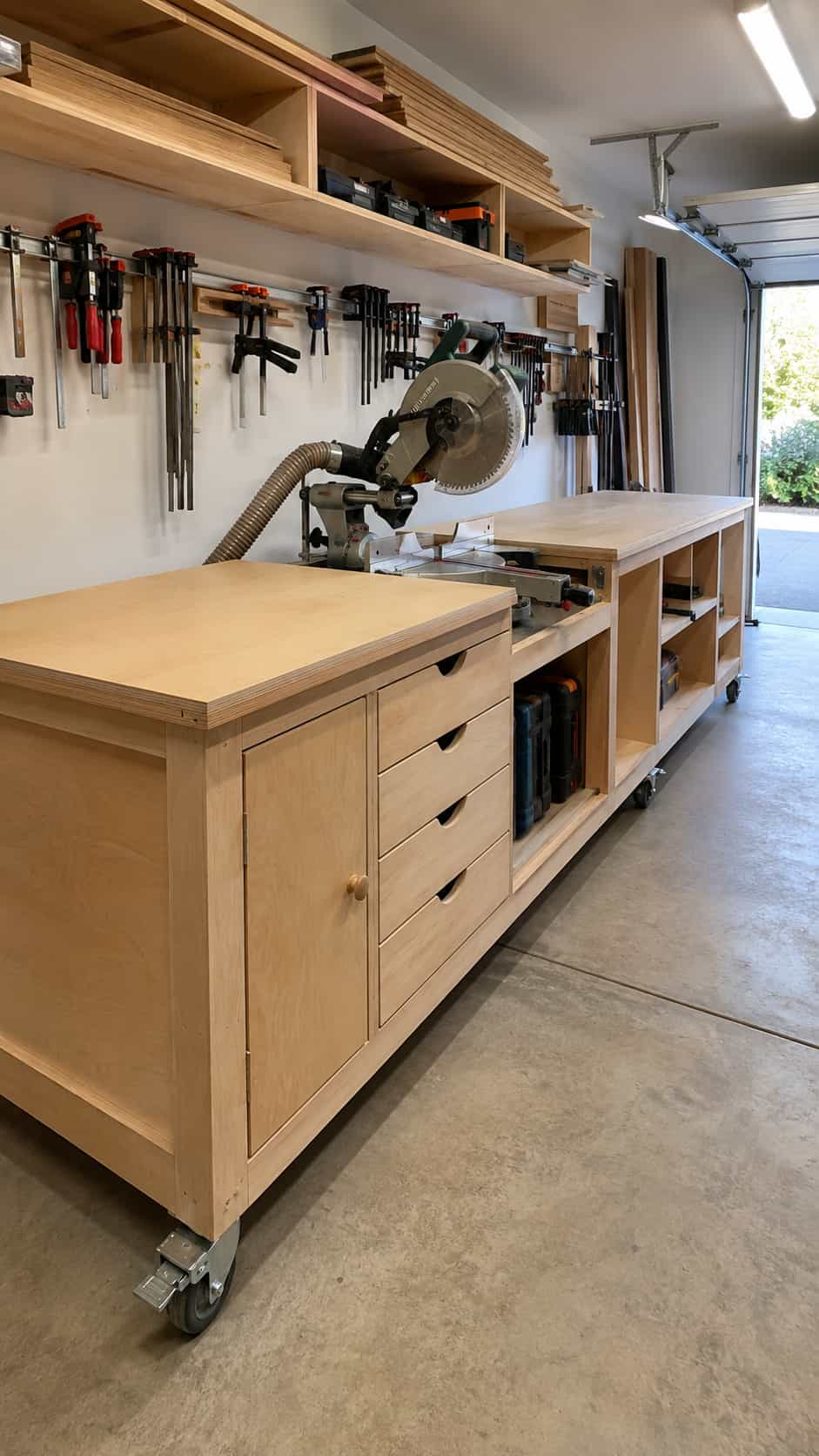
Woodshop Diaries’ newer station is closer to a complete mobile cabinet wall laid horizontally. The miter saw sits in a recessed central bay, while drawers, a door cabinet, shelves and open cubbies organize larger tools and supplies. The entire structure rolls, allowing a substantial workstation to move when the floor plan changes.
Best for: Consolidating several storage units into one mobile workstation
Difficulty: Intermediate
Space check: Measure turning room, not just the station’s parked footprint
Customization to consider: Assign each cabinet bay before building so the openings match real tools
See the free Woodshop Diaries mobile miter saw station build
7. Sturdy Fixed Miter Saw Station for a Shed Shop
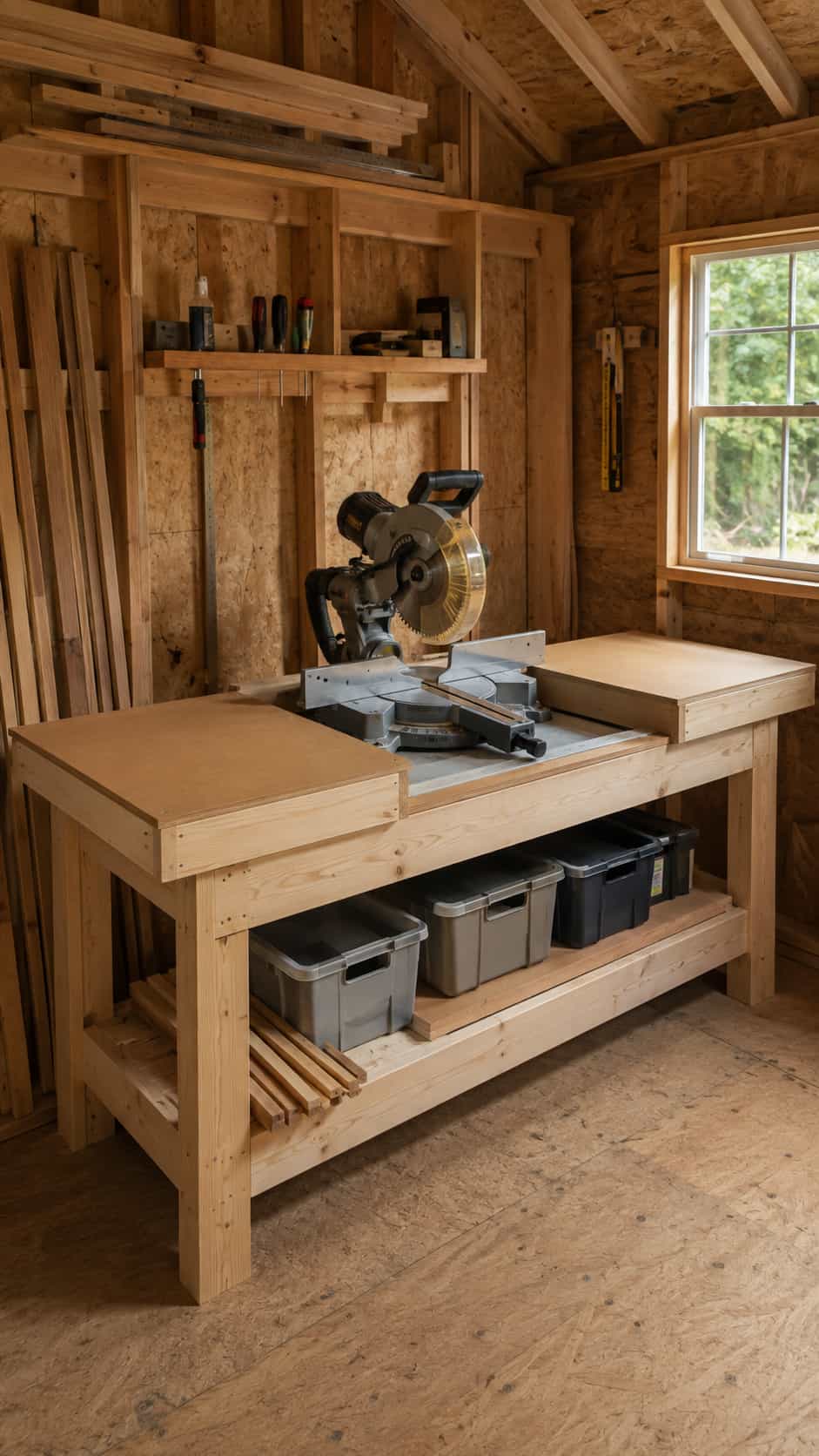
Jaime Costiglio’s fixed station is a good reminder that a useful build does not have to roll or fold. A solid base, recessed saw area and broad support tops create a dependable work zone in a shed or garage with a dedicated wall. The open lower area keeps the structure simpler than a full cabinet build and leaves flexible space for bins.
Best for: A dedicated workshop with one permanent saw location
Difficulty: Beginner to intermediate
Space check: Test the full board path and rear clearance before fixing the layout
Customization to consider: Add open bins or a simple shelf before committing to complex drawers
Get Jaime Costiglio’s free miter saw station plan
8. Modular Mobile Miter Saw Station with Storage Cabinets
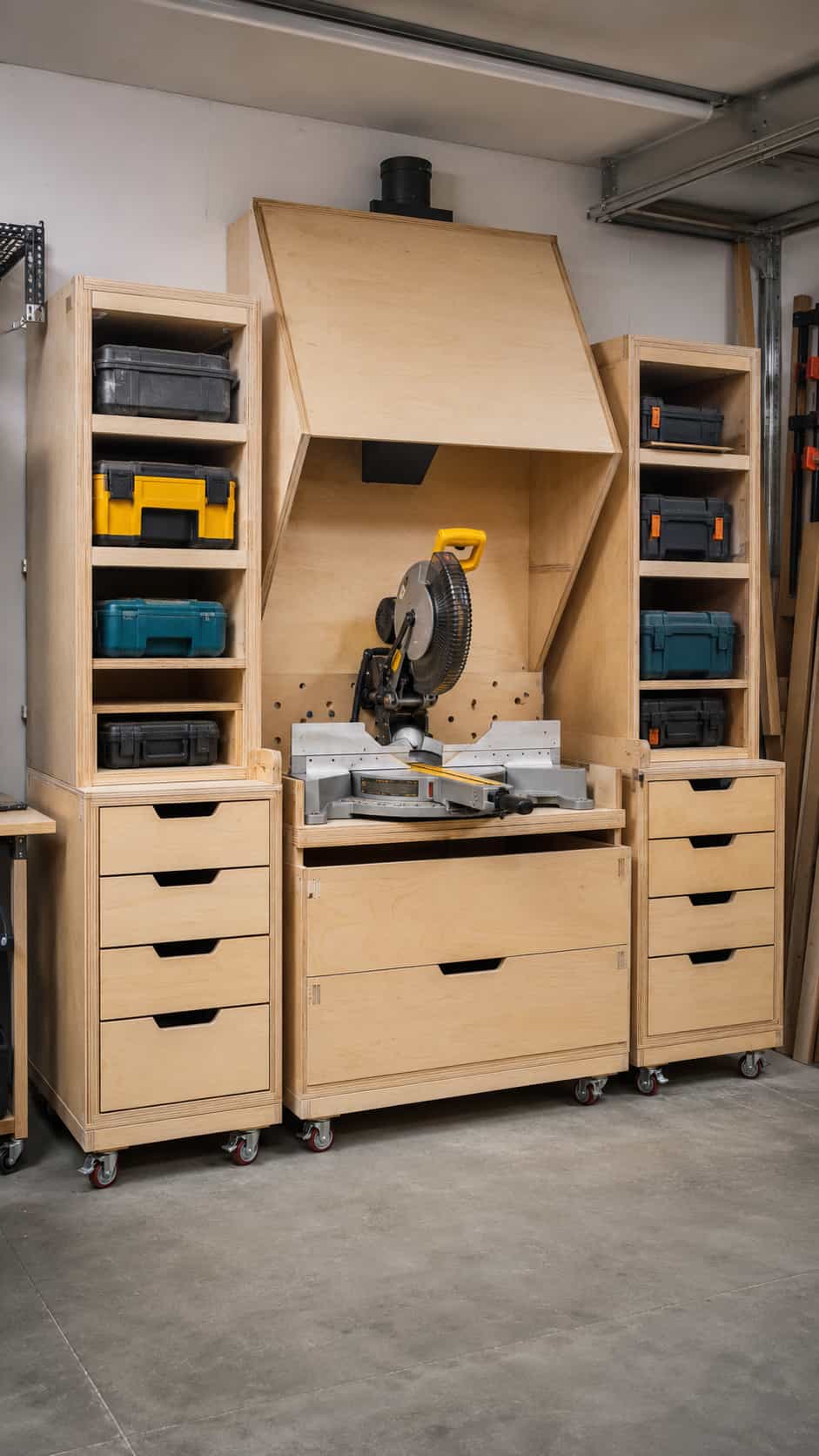
DIY Huntress designed a mobile station around storage flexibility. Cabinet sections, drawers and cubbies provide places for tools of different sizes, while the saw remains the center of a modular layout. It is a smart direction for a small workshop where one large empty cabinet would waste space and one fixed layout might stop working as the tool collection changes.
Best for: A small workshop with changing storage needs
Difficulty: Intermediate
Space check: Include drawer and door swing in the working aisle
Customization to consider: Pair the station with movable wall storage such as these French cleat tool holders
Read the DIY Huntress mobile miter saw stand tutorial
9. Compact Multi-Tool Miter Saw Workshop Hub
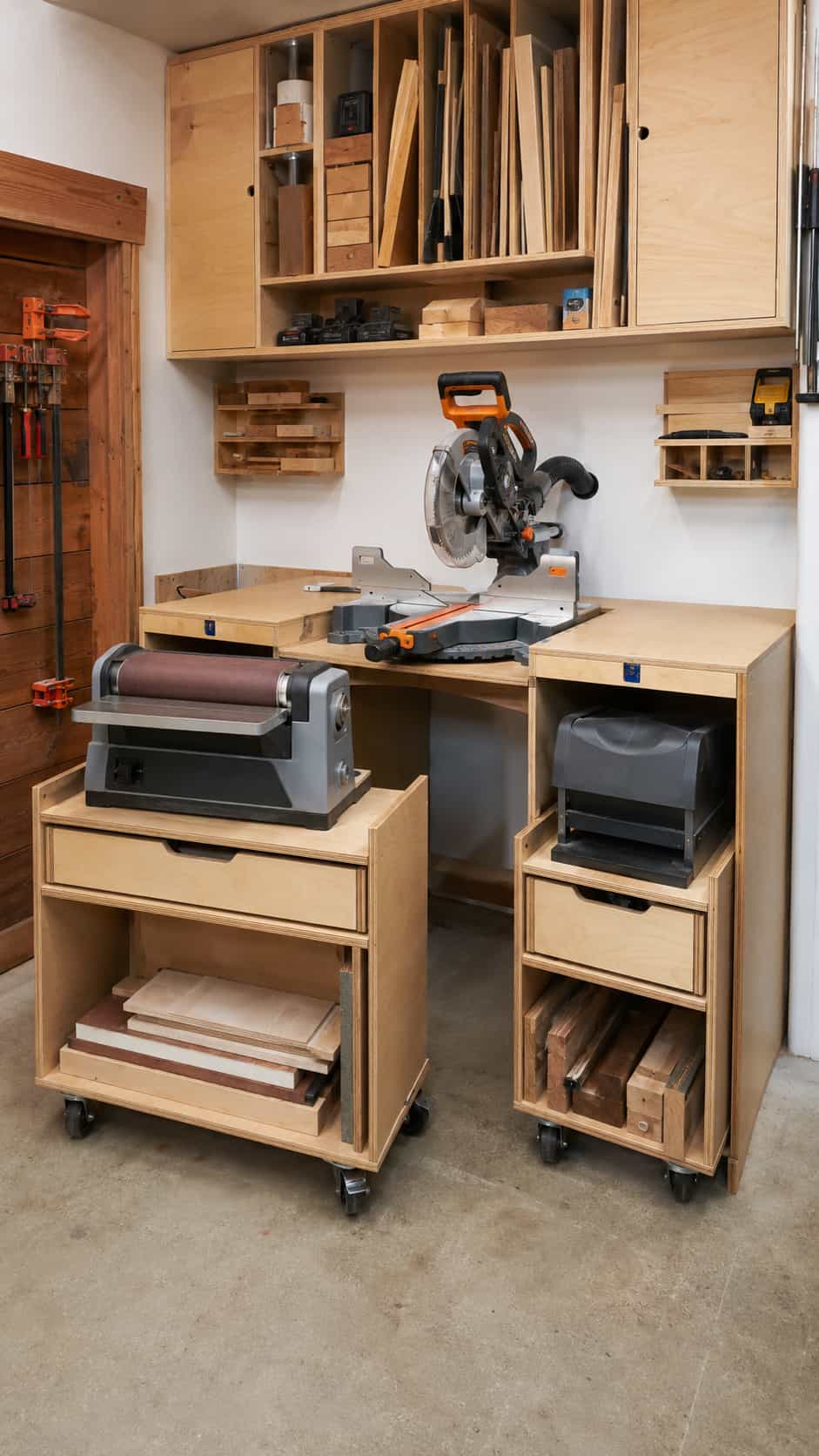
The Handyman’s Daughter takes the station beyond one machine by coordinating it with other tool stands. The miter saw station forms the main support surface, while compact companion carts can share the footprint and roll out when another benchtop tool is needed. That approach is valuable in a shop where every machine cannot have its own permanent island.
Best for: Several benchtop tools in one coordinated zone
Difficulty: Advanced as a complete system
Space check: Leave a safe parking location for every cart when it is pulled out
Customization to consider: Start with the miter station and add only one compatible cart at a time
See The Handyman’s Daughter miter saw station plan and tutorial
Want a Small Workshop That Works as One Complete System?
Disclosure: This section contains an affiliate link. If you purchase through it, we may earn a commission at no additional cost to you.
A good miter saw station solves board support and tool storage in one zone, but it cannot fix a workshop whose overall layout works against the user. Workbench position, lumber storage, lighting, dust control, electrical access, machine clearance and the path a project takes through the shop all affect how comfortable the room feels.
That is where Ultimate Small Shop may be useful. It is a workshop-planning resource for woodworkers who want to arrange a practical shop in a garage, basement, shed or other limited area without buying unnecessary equipment. Instead of treating every cart and shelf as an isolated project, it encourages planning around the whole workflow and available budget.
Review the offer carefully and decide whether it suits your goals. If the only problem is that the miter saw needs a stable home, one of the free plans in this article may be enough. If you are reorganizing an entire small shop, a broader layout system may help prevent expensive moves and rebuilds later.
Learn more about Ultimate Small Shop
You can also combine the chosen station with scrap-wood storage ideas and DIY tool-storage projects so the new worktop stays clear after the first few projects.
10. Simple Open-Frame Miter Saw Stand
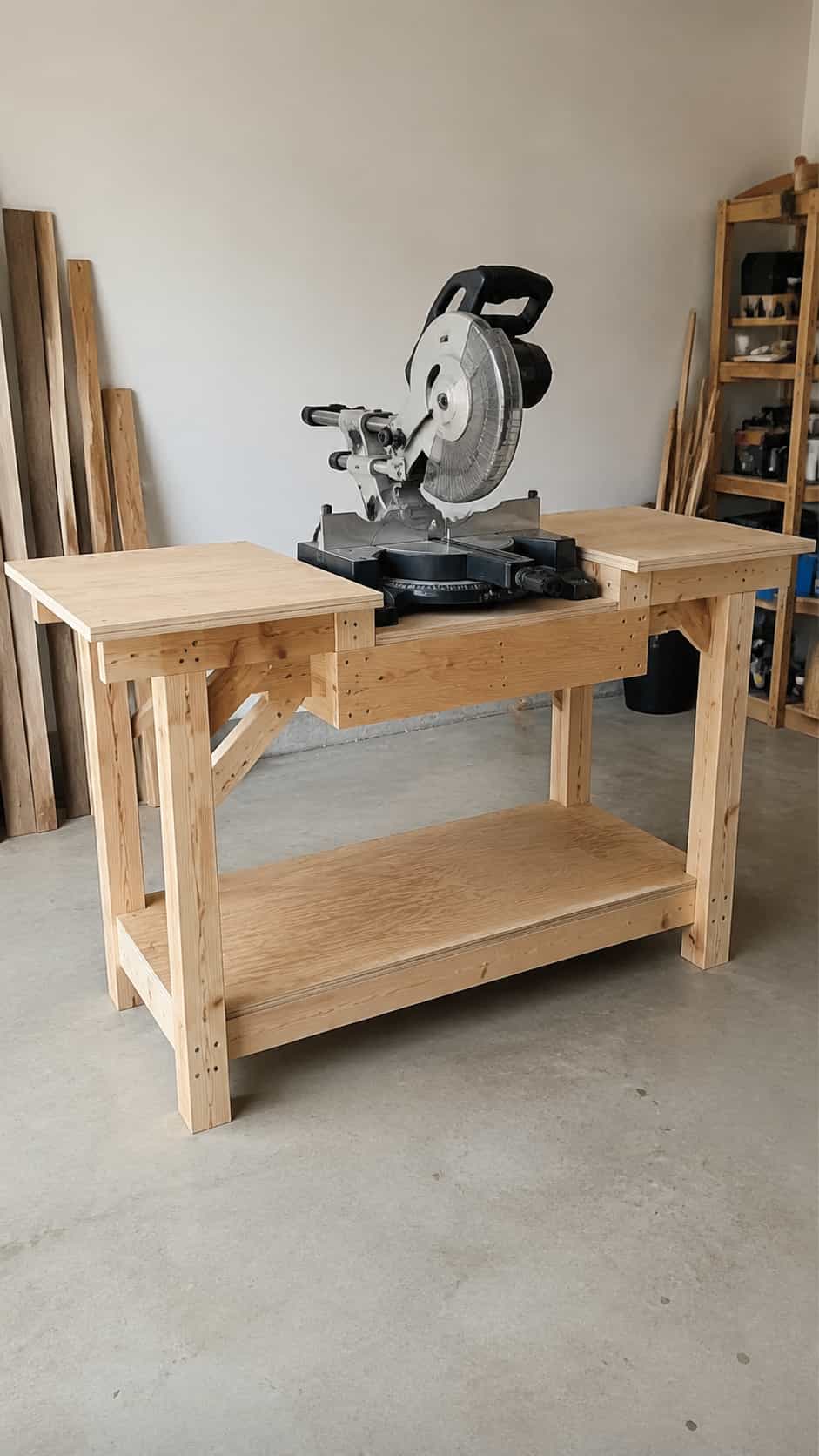
Shanty 2 Chic’s stand focuses on the essentials: a strong open frame, a properly placed saw platform and useful work surfaces on both sides. It skips the long list of optional features, making it easier to understand as a first dedicated station. The open shelf below can accept boxes, a vacuum or future organizers without forcing those decisions during the initial build.
Best for: A fast fixed station with uncomplicated storage
Difficulty: Beginner
Space check: Confirm the long support tops do not narrow an important walkway
Customization to consider: Add removable bins rather than permanent dividers at first
Follow the free Shanty 2 Chic miter saw stand tutorial
11. Rolling Miter Saw Stand with Long Board Supports
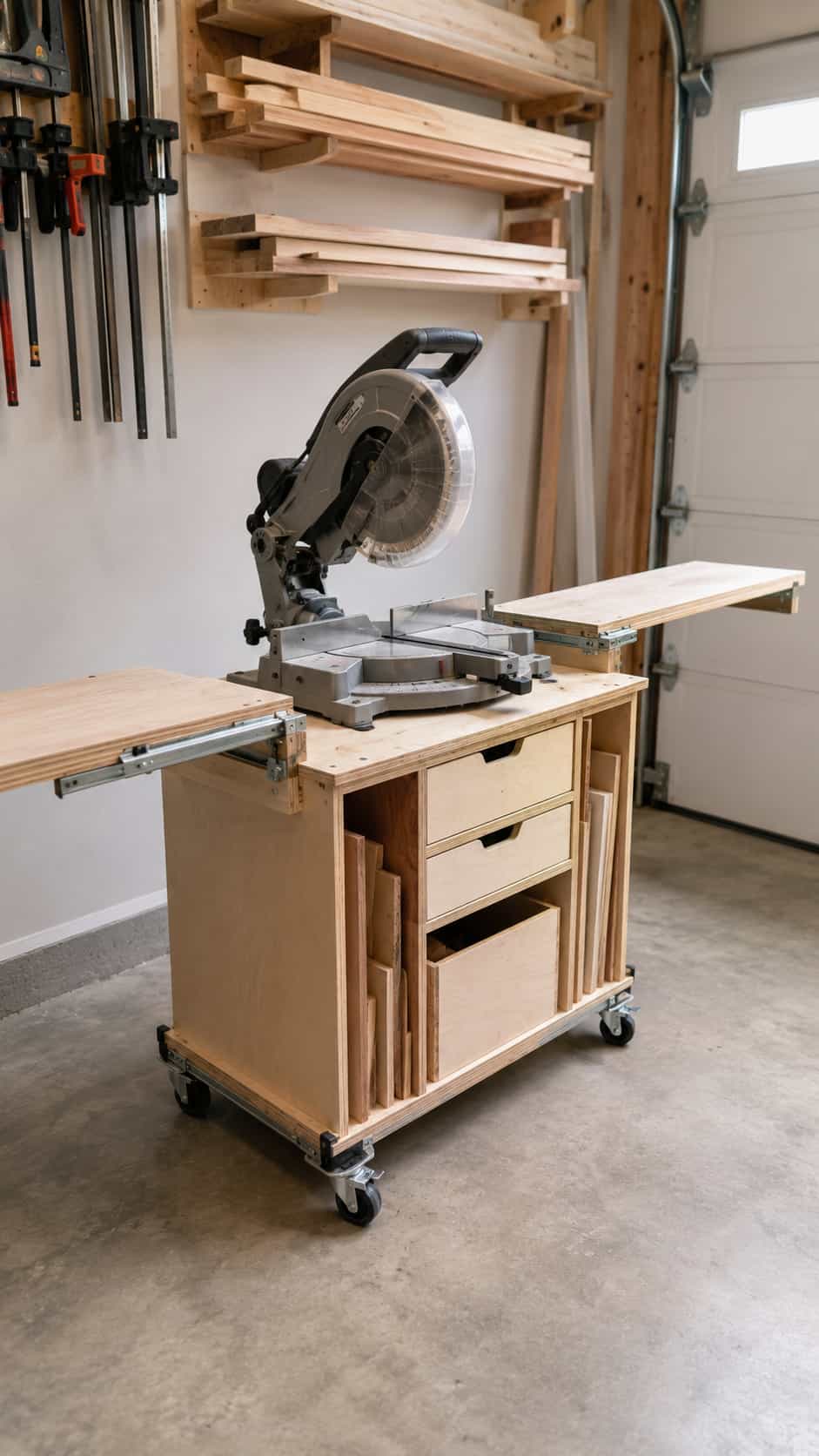
Kreg’s rolling stand places a compact cabinet under the saw and uses extended support areas to handle longer material. The wheeled base suits a narrow garage because the saw can be positioned for a clear cutting lane, then returned to storage after the area is cleaned. Built-in storage uses the dead space beneath the machine without creating a full wall of cabinets.
Best for: A garage where the station must move before use
Difficulty: Intermediate
Space check: Plan both the storage route and the long-board working lane
Customization to consider: Store frequently used measuring tools in the top drawer and heavier items lower
Open Kreg’s free rolling miter saw stand plan
12. Storage-Heavy Miter Saw Table with Fence and Cabinets
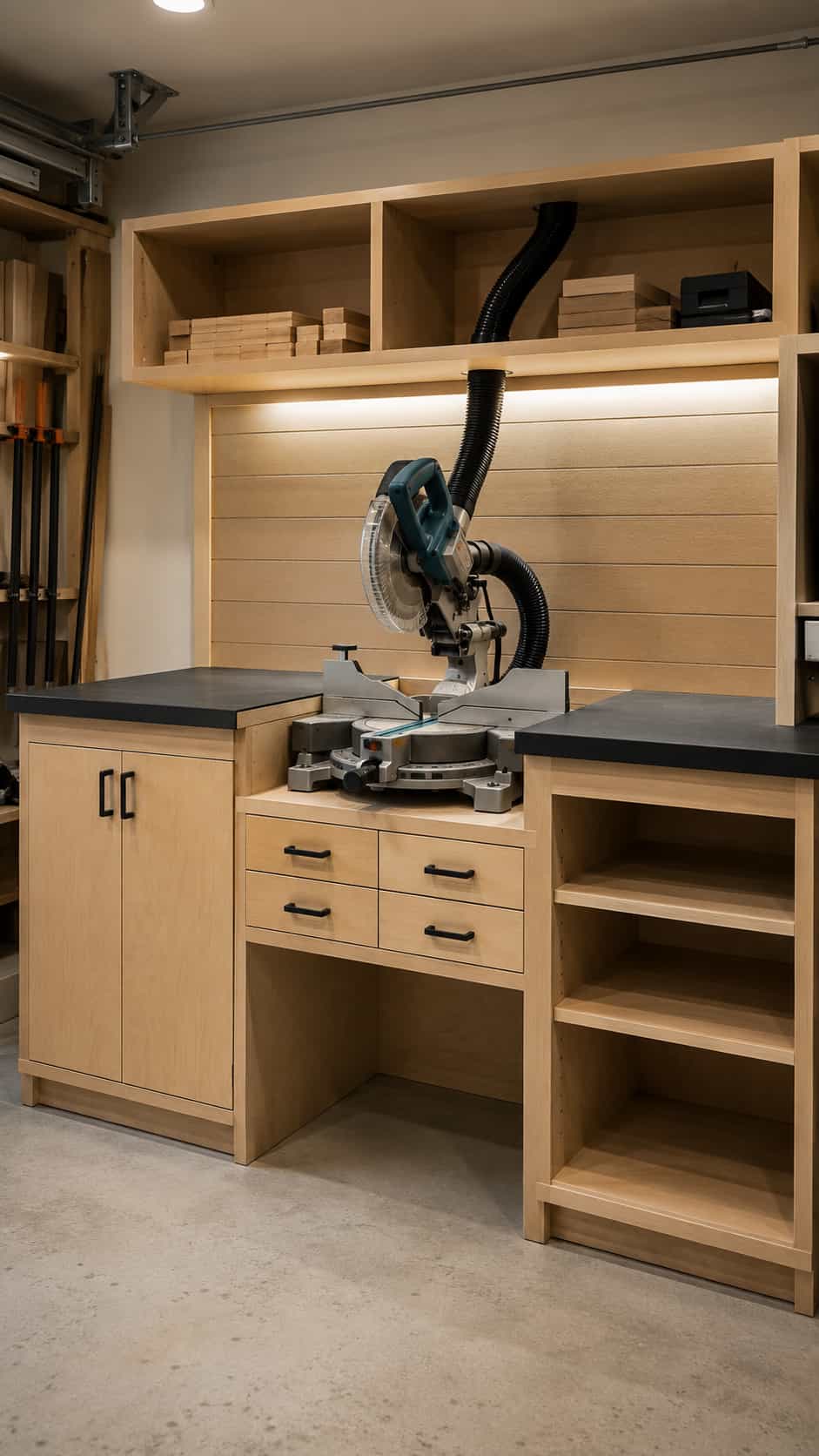
This Kreg plan, credited to Her Tool Belt, turns the space under both support wings into useful storage. Cabinets and open areas hold tools and supplies, while a long fence and stop system support repeatable work. The finished station is substantial enough to function as the main workshop storage zone rather than another standalone cart.
Best for: A permanent station that replaces separate cabinets
Difficulty: Advanced
Space check: Measure the total wall length and full fence run
Customization to consider: Use drawer inserts for small accessories and open shelves for bulky cases
View the free Kreg miter saw station and storage plan
13. Workshop Storage Cabinets with a Central Miter Saw Station
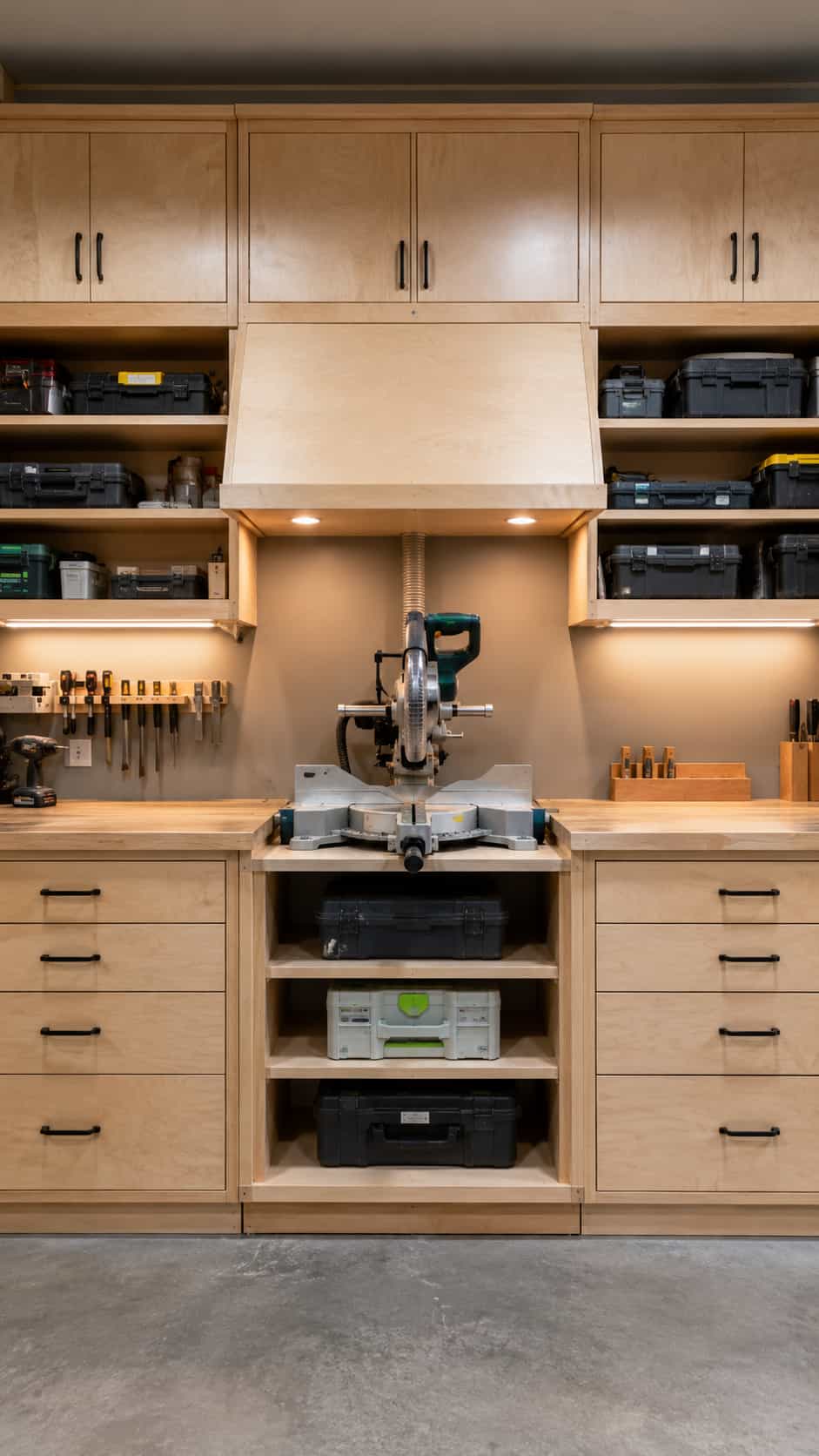
The DIY Huntress plan hosted by Kreg integrates the miter saw into a larger cabinet wall. Base cabinets support broad worktops, upper storage uses the vertical space, and the central bay gives the saw a defined home. Visually, it can make a garage feel calmer because cases and supplies are no longer scattered across unrelated shelves.
Best for: Turning one long wall into the workshop’s main work-and-storage zone
Difficulty: Intermediate to advanced
Space check: Confirm upper cabinets do not conflict with doors, tracks or lighting
Customization to consider: Keep a section of adjustable shelving for future tools
See the free Kreg workshop cabinets and miter saw station plan
14. Full-Length Miter Saw Station with Drawers
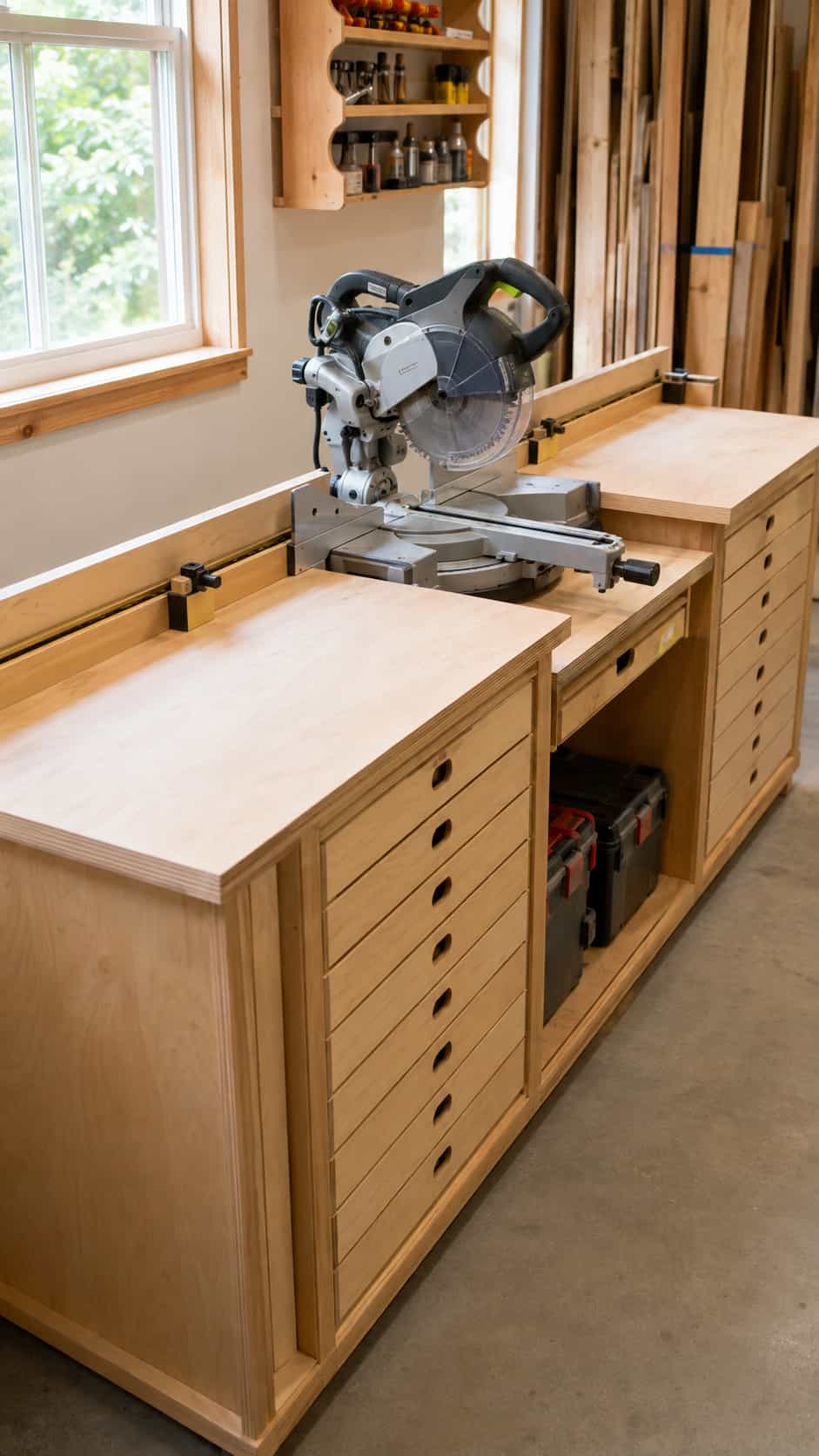
Kreg’s drawer-heavy station is designed for a shop where the saw has earned a permanent, production-style position. Multiple base cabinets create a long support surface, while shallow drawers organize blades, layout tools, hardware and jigs. The central saw area remains recessed so the surrounding tops support material at the correct level.
Best for: An established workshop with a fixed workflow and many small accessories
Difficulty: Advanced
Space check: Allow clearance for every drawer while someone can still pass safely
Customization to consider: Dedicate one drawer to woodworking jigs used for measuring and repeatability
Review Kreg’s free miter saw station with drawers plan
15. Ultimate Roll-Away Workbench and Miter Saw System
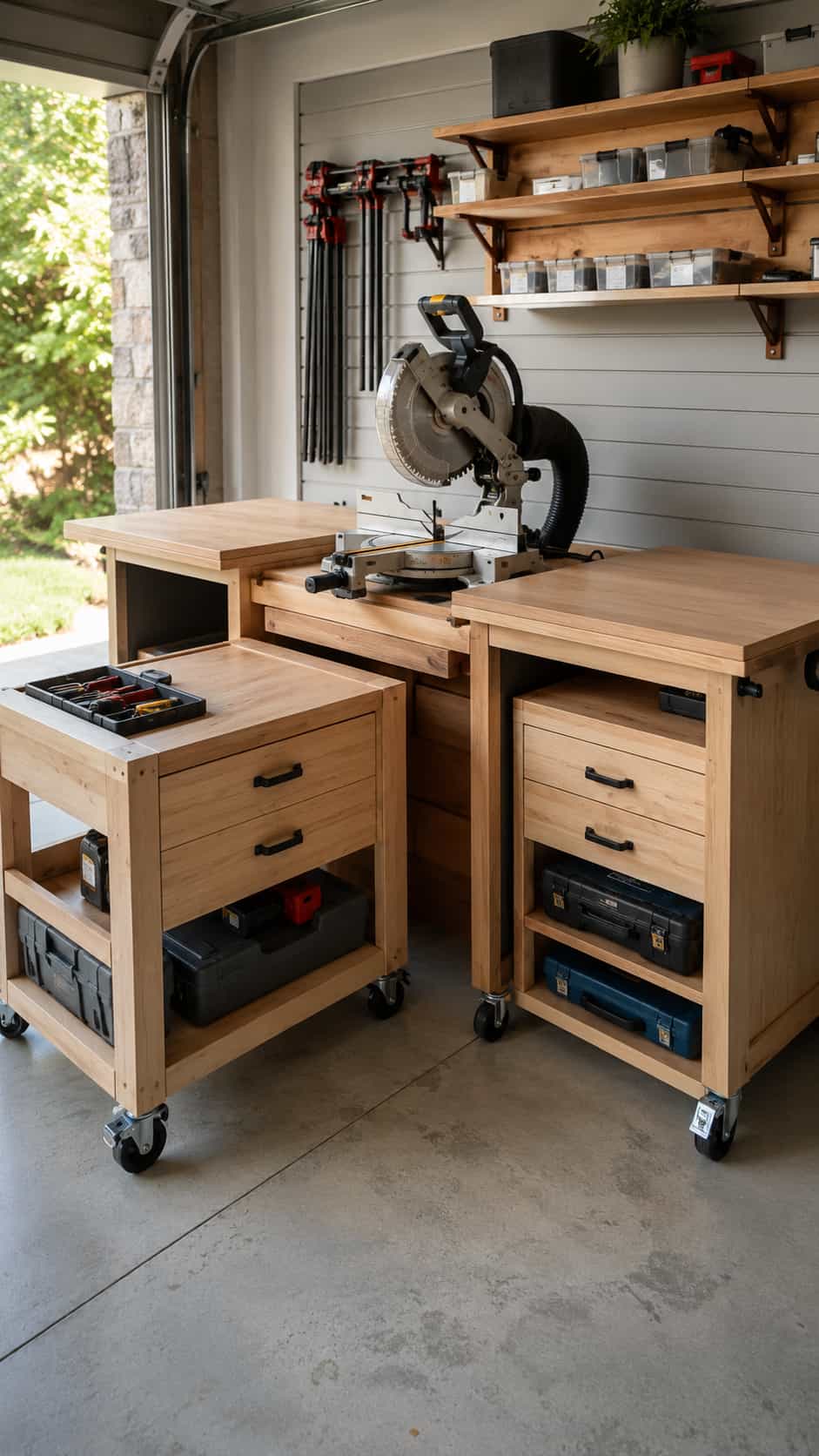
Ana White’s ultimate roll-away design treats the miter station as the anchor for an adaptable workshop. Mobile carts nest beneath the long work surfaces and roll out to create separate work areas. When the project is finished, the carts return to the main wall, restoring open floor space.
Best for: A multi-use garage that needs flexible work surfaces
Difficulty: Advanced as a full system
Space check: Draw the parked and deployed positions of every cart
Customization to consider: Keep one roll-away cart as a clear assembly surface instead of mounting another tool
Get Ana White’s free ultimate roll-away workbench and miter saw plan
Which Miter Saw Station Plan Should You Choose?
For a first build, start with Plan 1, 3 or 10. Each focuses on a stable saw location and basic board support without requiring a room full of drawers. A mobile station with folding wings is generally the strongest fit for a garage shared with a vehicle.
Choose Plan 4, 5 or 11 when mobility matters but you also want better accessory storage. These designs provide more workstation features while keeping the core footprint manageable.
Plans 12, 13 and 14 suit a permanent wall and an established workflow. They demand more material and planning, but they can replace several smaller cabinets. Plan 15 is the most flexible full-room system when roll-away carts would genuinely serve multiple tools and assembly tasks.
Whichever plan you prefer, borrow only the features that solve real problems. A folding wing is valuable when it clears a parking space. Twelve drawers are valuable when twelve categories need homes. A dust hood is valuable when it is compatible with the saw and collection system. More features do not automatically create a better small shop.
Frequently Asked Questions
How tall should a miter saw station be?
There is no universal finished height. The important relationship is that the left and right support surfaces align with the working table of the specific miter saw. Builder height and comfort matter too, but copying another person’s leg length without measuring the saw, top thickness and casters can produce the wrong result. Follow the selected plan’s adjustment method and the tool manufacturer’s requirements.
How deep should a miter saw bench be?
Depth depends heavily on the saw. Sliding models may need more room behind the fence than non-sliding models, and a dust hood adds further depth. Measure the saw through its full manufacturer-approved range and include hoses, wall clearance and safe access. Do not force a deep machine against a shallow wall simply to match a plan photo.
Is a mobile or fixed miter saw station better for a small shop?
A mobile station is usually more flexible in a shared garage because it can move into a clear lane for long boards. A fixed station can provide more storage and faster daily setup when a dedicated wall is available. The better choice is the one that protects the working aisle and does not require repeatedly lifting the saw.
Are folding wings worth adding?
Yes, when the station must become narrow for storage. They are less valuable if the supports can stay open permanently. Hinges, brackets and stops introduce more parts, so use the original plan’s specified hardware and verify that the opened surfaces are stable and level.
Does every station need a fence and stop block?
No. A simple stand can be useful without either. A well-planned fence and stop can help with repeatable layout work, but it must be compatible with the tool, guard and stock support. Do not attach improvised fixtures that interfere with the saw’s designed operation.
What should be stored under a miter saw station?
Good candidates include blades in protective storage, measuring tools, manufacturer-approved accessories, tool cases and light shop supplies. Keep heavy objects low, do not overload drawers or casters, and leave dust-control equipment accessible. Avoid storing items where they block ventilation, electrical access or moving parts.
Can one miter saw station work with several saw models?
The cabinet may be adaptable, but the recessed platform height, depth and mounting arrangement are usually model-specific. If the saw changes, remeasure everything rather than assuming the replacement will align with the existing wings and fence.
Final Thoughts
The best miter saw station is not necessarily the one with the most drawers or the longest countertop. It is the one that supports the material, fits the machine, protects the walkway and gives nearby accessories a logical home.
Start by solving the biggest constraint. Choose a one-sheet cart if the saw must disappear into a corner. Use folding wings if the garage needs its width back after every project. Build a fixed cabinet station only when the wall and workflow are settled. Consider a roll-away system when several tools genuinely need to share the same floor area.
Every linked plan was created around a particular saw and workshop. Study the original free plan, measure your own space, retain every manufacturer safety feature, and involve a qualified adult or professional wherever the work exceeds your experience. Careful planning now is much easier than rebuilding a beautiful station that blocks the garage door or supports boards at the wrong height.